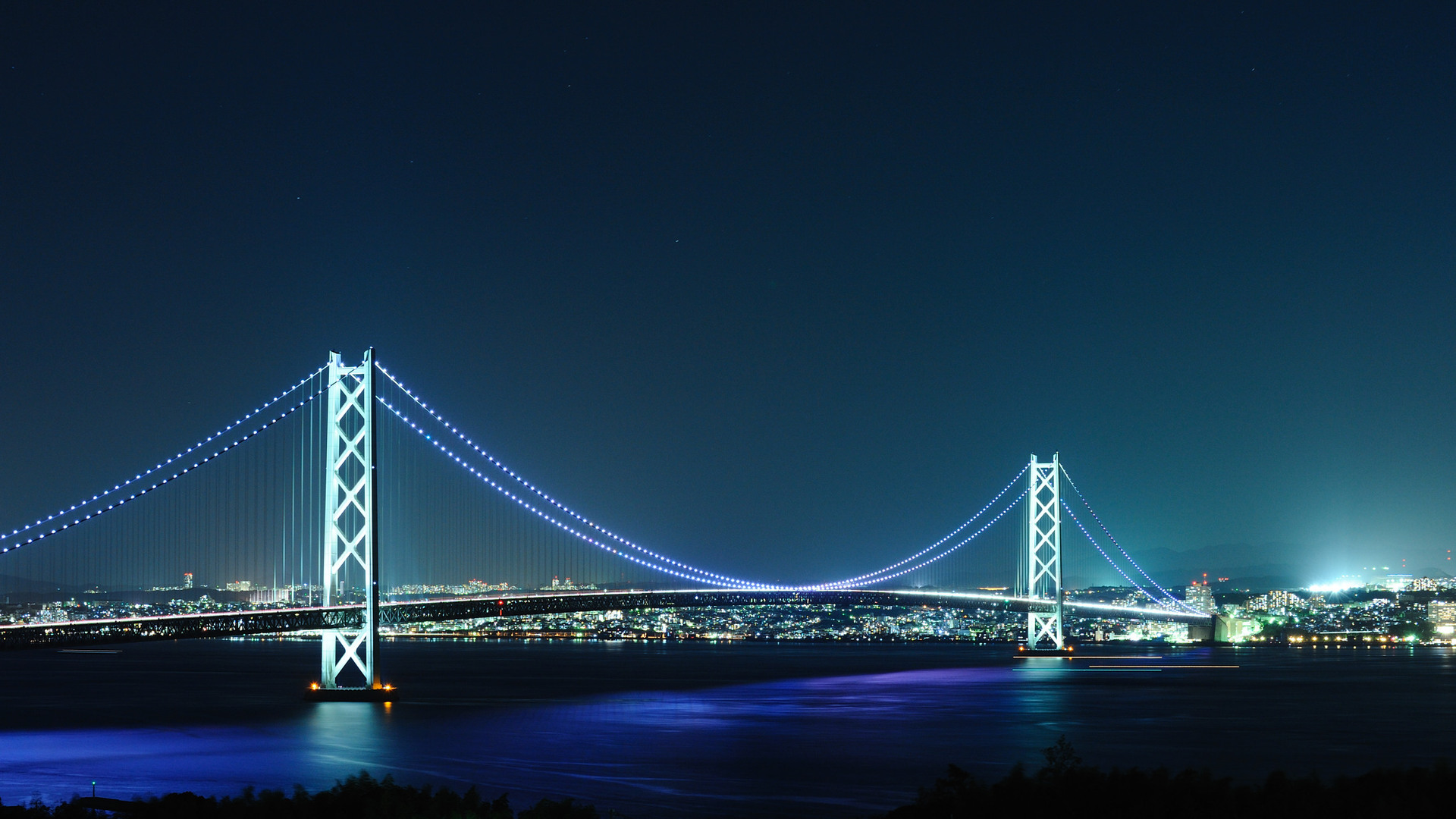
If you’re standing on the waterfront in Kobe, looking out toward Awaji Island, you see it. The Pearl Bridge. Most people just call it the Akashi Kaikyo Bridge, and honestly, photos don't do the scale justice. It’s huge. It’s so big that it basically has its own weather system. For years, it held the title of the longest central span of any suspension bridge in the world. Even though the 1915 Çanakkale Bridge in Turkey eventually took that crown in 2022, the Akashi Kaikyo remains the gold standard for how to build something that shouldn't exist in a place that wants to destroy it.
Japan is a nightmare for civil engineers. You've got typhoons. You've got massive seismic shifts. You've got currents in the Akashi Strait that move at nearly 4.5 meters per second. It’s a mess. Yet, this bridge stands there, carrying nearly 23,000 vehicles a day.
The Night the Earth Literally Moved the Bridge
Here is the thing about the Akashi Kaikyo Bridge that most people forget: the Earth actually tried to break it before it was even finished. On January 17, 1995, the Great Hanshin Earthquake (Kobe Earthquake) hit. It was a 7.3 magnitude monster. At that point, the two massive towers were already standing. The cables were being prepared.
The epicenter was basically right under the bridge.
Engineers rushed to the site, expecting to see two billion dollars of steel sitting at the bottom of the ocean. Instead, they found something weird. The towers were fine. They hadn't fallen. But the ground had literally stretched. The towers were now exactly one meter further apart than they were the day before. Because the bridge was still under construction, the engineers had to scramble to redesign the deck sections on the fly to accommodate that extra meter. It’s a testament to Japanese planning that they just... fixed it. They added the extra length into the design and kept moving.
How It Actually Stays Standing
You might think a bridge this long—nearly four kilometers in total length—would be stiff. It’s actually the opposite. It’s flexible. If you made it rigid, the wind would snap it like a twig. The Akashi Kaikyo Bridge uses a complex truss system beneath the roadway. This isn't just for looks; it allows the wind to blow through the structure rather than pushing against it.
The dual-hinged stiffening girder system is the secret sauce here. It allows the bridge to withstand winds of up to 286 kilometers per hour. That is faster than most Category 5 hurricanes. Then there are the tuned mass dampers. Think of these as giant pendulums inside the towers. When the wind pushes the bridge one way, these weights swing the other way to cancel out the resonance. Without them, the bridge would vibrate itself to pieces. It's basically a 3.9-kilometer-long musical instrument that is constantly being tuned by physics.
The foundations are another story. They are essentially giant "caissons"—massive steel cylinders sunk into the seabed. They had to be placed with a precision of within a few centimeters, despite the fact that the currents were trying to wash them away. Engineers used a special kind of "underwater concrete" that doesn't dissolve in seawater. It sets like a rock while submerged.
Why the Akashi Kaikyo Bridge Matters for Your Next Trip
If you’re visiting Japan, don't just drive over it. Driving is fine, sure. You get a great view. But it’s expensive—the tolls aren't cheap. To really feel the scale, you need to go to the Bridge Exhibition Center on the Kobe side.
There’s a thing called the "Bridge World" tour. It’s not for people who hate heights. They take you up to the very top of the 297-meter-tall towers. You walk on the maintenance paths, which are basically steel grates where you can see the ocean hundreds of feet below your boots. It’s terrifying. It’s also the best view in Hyogo Prefecture. From the top, you can see all the way to Osaka on a clear day.
Quick Facts for the Skeptics
- Total Length: 3,911 meters.
- Central Span: 1,991 meters (Originally 1,990 before the earthquake stretched it).
- Steel Wire: The amount of wire used in the cables could circle the Earth seven times.
- Paint: They used a special high-performance resin paint because salt air eats metal for breakfast.
The color is also specific. It’s "Green-gray." Designers spent a lot of time making sure the bridge didn't look like an eyesore against the Akashi Strait. It's meant to blend into the mist and the water.
The Economic Reality
Let's be real: this bridge was a political and financial gamble. It cost roughly 500 billion yen. Before it was built, people had to rely on ferries. In 1955, two ferries sank in the strait during a storm, killing 168 people, many of them children. That tragedy is the real reason the bridge exists. The Japanese government decided that the cost of the bridge was worth more than the risk of losing more lives to the unpredictable waters of the Seto Inland Sea.
Today, it connects the main island of Honshu with Awaji Island, and eventually Shikoku. It turned a dangerous boat journey into a 5-minute commute. Is it profitable? That’s a debated topic in Japanese economics. But in terms of regional stability and safety, it’s priceless.
Misconceptions About the "Pearl Bridge"
People often think the bridge is called the "Pearl Bridge" because of some hidden treasure or the shape of the towers. Honestly, it’s just because of the lights. At night, the bridge is covered in thousands of computer-controlled LED lights. They change color based on the season, the day of the week, or even national holidays. On a misty night, the lights look like a string of glowing pearls draped across the water.
Another misconception is that the bridge is "earthquake-proof." Nothing is earthquake-proof. The Akashi Kaikyo Bridge is earthquake-resistant. It’s designed to survive an 8.5 magnitude quake centered nearby. But even the best engineers acknowledge that nature has a way of surprising us. The 1995 quake proved that the bridge can handle a lot, but it also taught the world that the earth is always moving, and our structures have to move with it.
Actionable Tips for Visiting
If you are planning to see the bridge, do it right. Don't just look at it from a train window.
- Check the Illumination Schedule: Before you go, check the official Honshu-Shikoku Bridge Expressway Company website. They have a calendar for the light shows. Seeing it in "Rainbow" mode is a totally different experience than the standard green.
- Maiko Marine Promenade: If you don't want to pay for the full "Bridge World" tour, go to the Maiko Marine Promenade. It’s an observation deck built inside the bridge structure. You’re about 50 meters above the water, and there are glass floor panels. It’s a cheap way to get the "floating" feeling.
- Eat the Octopus: The Akashi Strait is famous for Akashiyaki—it’s like takoyaki but eggier and dipped in dashi broth. The fast-moving currents make the octopus there really firm and flavorful. Grab some at a shop near Maiko Station.
- Visit at Sunset: The sun sets behind the bridge from the Kobe side. It’s a photographer's dream. The silhouette of the towers against the orange sky is the iconic shot you want.
The Akashi Kaikyo Bridge isn't just a way to get from Point A to Point B. It’s a massive, vibrating, breathing piece of technology that proves we can build things in the middle of disaster zones. It’s been standing for over 25 years, and despite the typhoons and the shifting tectonic plates, it hasn't budged.
To get there, take the JR Kobe Line to Maiko Station. It’s about a 25-minute ride from Sannomiya (Kobe) or 45 minutes from Osaka. The station is literally right at the foot of the bridge. You can't miss it. Walk out the exit, look up, and try not to feel small.