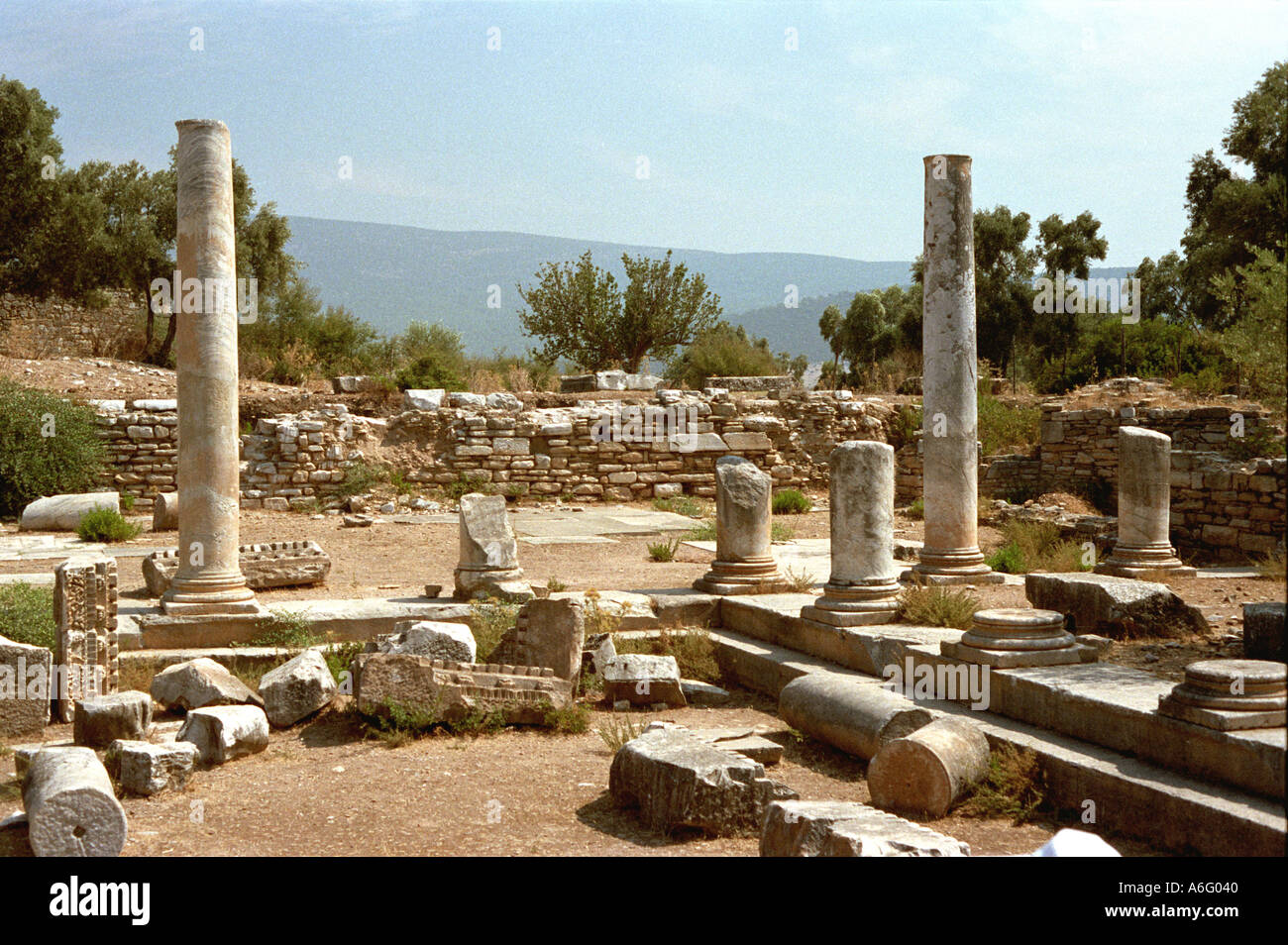
You’ve seen the photos of the Library of Celsus. It’s stunning, honestly. But if you think ancient ruins in turkey begin and end with a day trip to Ephesus, you’re missing the weirdest, oldest, and most technically baffling parts of human history. Turkey isn't just a "bridge between east and west." That’s a cliché travel agents love. In reality, it’s a graveyard of empires where the layers of dirt are literally packed with marble, obsidian, and secrets we’re still trying to decode.
Some of these places don't even make sense.
Take Göbekli Tepe. It’s sitting up in the southeast, near Şanlıurfa. Archaeologists like the late Klaus Schmidt, who really put this place on the map, basically had to rewrite the history books because of it. We used to think humans settled down, started farming, and then built temples. Göbekli Tepe says we’re wrong. These massive T-shaped pillars, carved with lions and scorpions, were put there by hunter-gatherers 11,000 years ago. No metal tools. No wheels. Just raw human obsession. It makes you wonder what else we've gotten wrong about how "primitive" our ancestors were.
The Ephesus Trap and Where to Go Instead
Look, Ephesus is great. It’s iconic. You walk down the Curetes Way and feel the ghost of Roman sandals on the stones. But it’s also packed. You’ll be shoulder-to-shoulder with cruise ship crowds from Kuşadası, all sweating under the Aegean sun.
If you want the same Roman grandeur without the selfie sticks, drive a few hours inland to Aphrodisias.
It’s named after Aphrodite, the goddess of love, and the vibe there is just... different. Because it was located near a high-quality marble quarry, the school of sculpture there was world-class. You can still see the detail in the friezes—veins in the marble "skin," fabric that looks like it’s fluttering in the wind. The stadium is one of the best-preserved in the entire world. It held 30,000 people. You can sit on the stone benches and almost hear the roar of the crowd.
There’s also Sagalassos. It’s tucked away in the Taurus Mountains. Because it’s so high up—about 1,500 meters—it stayed hidden for a long time. They have a restored fountain, the Antonine Nymphaeum, where the water still flows through the original ancient pipes. Drinking water from a Roman fountain built in 160 AD is a core memory kind of experience.
The Hittites: The Empire Everyone Forgets
When people talk about ancient ruins in turkey, they usually gravitate toward the Greeks and Romans. That’s a mistake. Long before the Greeks were building temples, the Hittites were the superpowers of the Bronze Age. They were the only ones who could stand toe-to-toe with the Egyptian Pharaohs.
Their capital, Hattusa, is a sprawling, windswept site near modern-day Boğazkale.
It’s not "pretty" in the way a white-marble Greek city is. It’s rugged. Formidable. The walls are made of massive, interlocking stones that look like they were carved by giants. Then there’s Yazılıkaya, an open-air sanctuary nearby. It’s a series of rock chambers where the Hittites carved their entire pantheon of gods into the limestone walls. Seeing the "Twelve Gods of the Underworld" marching in a line across the rock face is haunting. It’s deep, ancient Anatolia. It feels heavy with time.
Why Troy is Often a Letdown (And How to Enjoy It)
People visit Troy expecting the movie Troy. They want Brad Pitt and a giant wooden horse.
What you actually get is a complex, confusing archaeological puzzle. There aren't just one Troy; there are at least nine layers built on top of each other. Heinrich Schliemann, the guy who "found" it in the 1870s, was kind of a disaster. He used dynamite. He literally blasted through the layers of the actual Troy (Troy VI or VII) to find what he thought was King Priam's treasure in a much older layer.
To enjoy Troy, you have to look at the fortification walls and realize you're standing at the spot that sparked the greatest poem in Western literature. Don't go for the ruins alone. Go for the brand-new Troy Museum nearby. It’s a masterpiece of modern architecture that holds the artifacts Schliemann didn't manage to smuggle out.
The Sunken Cities of the Lycian Way
Down on the southern coast, the ruins get a bit more adventurous. The Lycians were a fiercely independent people with a unique culture. They didn't just bury their dead; they built elaborate rock-cut tombs high into the cliffs so the "winged sirens" could carry them to the afterlife.
Myra is the place to see this. The cliffside looks like a honeycomb of stone doorways. It’s also where the real St. Nicholas lived. Forget the North Pole; Santa Claus was a bishop in a sunny Mediterranean town who probably dealt with more pirates than reindeer.
Then there’s Kekova.
You take a boat out over crystal clear turquoise water and look down. Beneath the surface, you can see the stairs, walls, and foundations of an ancient city that sank during an earthquake in the 2nd century. You can't swim right over the ruins (to protect them), but drifting over a submerged civilization in a glass-bottom boat is surreal. It’s a reminder of how fragile these empires actually were. Nature just pushed a button, and the city was gone.
Ani: The City of 1,001 Churches
Hardly anyone makes it out to Ani. It’s on the far eastern border with Armenia, sitting on a lonely plateau overlooking a deep ravine. In the 10th century, Ani was a rival to Constantinople. It was a massive, thriving hub on the Silk Road.
Today, it’s a ghost city.
Red volcanic stone cathedrals stand crumbling in the tall grass. The Church of the Redeemer is literally split in half—half of it stands, the other half is a pile of rubble from a lightning strike in the 1950s. There’s a silence at Ani that you won't find at Ephesus or Pamukkale. It’s desolate. It’s beautiful. It’s the kind of place that makes you rethink what "greatness" actually means when everything eventually turns back into dust and wildflowers.
Technical Marvels: How Did They Build This?
We often underestimate ancient engineering. We think they just had lots of slaves and time. But the precision in ancient ruins in turkey suggests something more.
At Didyma, the Temple of Apollo has columns that are nearly 20 meters tall. They are massive. If the temple had been finished, it would have been one of the largest structures in the ancient world. Even more impressive is the "blueprints" etched into the stone. Archaeologists found tiny, precise architectural drawings scratched into the foundations, showing exactly how the curvature of the columns (entasis) should be calculated. This wasn't guesswork. It was high-level geometry.
Similarly, the water systems at Hierapolis (Pamukkale) were light-years ahead of their time. They used the natural thermal springs not just for "spa days," but for complex heating and waste systems. They understood the mineral content of the water and how it would create the white travertine terraces we see today. They were working with the landscape, not just building on top of it.
Dealing with the "Fake" History
One thing to watch out for is the "restoration" work. Some sites in Turkey have been heavily reconstructed. Sometimes it’s done well, like the Terrace Houses in Ephesus, which are protected by a giant canopy and give you a real look at Roman domestic life—mosaics, indoor plumbing, and even ancient graffiti.
Other times, it’s a bit... much. New marble mixed with old stone can look jarring. Always ask your guide or check the site maps to see what is original "in situ" and what has been "anastylosed" (the fancy word for putting the pieces back together). Knowing the difference helps you appreciate the actual survival of the stones.
Essential Logistics for the Ruins Hunter
If you’re serious about seeing these sites, don't just wing it.
- Get the MuseumPass: Specifically the "MuseumPass Türkiye." It’s valid for 15 days and covers almost every major site. It saves a fortune and, more importantly, lets you skip the ticket lines.
- Rent a Car: Most of the best ruins, like Termessos or Labraunda, aren't accessible by public bus. Driving in Turkey is surprisingly easy outside of Istanbul. The roads are great, and having the freedom to hit a site at 8:00 AM before the tour buses arrive is a game-changer.
- Footwear Matters: This sounds obvious, but those Roman stones are slippery. They’ve been polished by millions of feet over 2,000 years. Wear shoes with actual grip.
- Timing is Everything: Visit the Aegean and Mediterranean sites in April, May, or October. July and August are brutal. You won't be looking at the friezes; you'll be looking for shade.
The Mystery of Termessos
If you only visit one "hidden" site, make it Termessos. It’s near Antalya, but it’s high in the mountains inside a National Park. Alexander the Great tried to conquer it in 333 BC. He looked at the location—perched on a steep mountain pass—and basically said, "No thanks," and kept marching.
It’s never been "restored." It’s a wild, overgrown mess of sarcophagi and collapsed temples. To see the theater, you have to hike up a rocky path. When you reach the top, the theater opens up with a drop-off behind the stage that looks out over the Taurus peaks. It’s easily the most dramatic view in the country. There are no railings. No gift shops. Just you and the eagles.
Actionable Steps for Your Journey
To truly experience the ancient ruins in turkey, start by mapping out a route that balances the "hits" with the "deep cuts."
- Fly into Izmir: Use this as your base for Ephesus and Pergamum. Pergamum is home to the steepest theater in the ancient world; it’s genuinely terrifying to look down from the top row.
- Head to Pamukkale: See the white terraces but spend your real time in the ruins of Hierapolis behind them. Most people leave after taking a foot-bath, leaving the massive necropolis (city of the dead) completely empty.
- Drive the Lycian Way: Stop at Patara. It’s got a stunning beach, but it’s also the site of the world's first democratic parliament building, the Bouleuterion. They’ve restored it, and you can walk right into the room where the Lycian League met.
- End in Central Anatolia: Visit Çatalhöyük near Konya. It’s one of the oldest proto-cities in the world, dating back to 7500 BC. People lived in houses with no doors; they entered through the roofs. It’s a bizarre, fascinating glimpse into the very beginning of "civilization."
Skip the generic guided tours if you can. Buy a copy of "The Rough Guide to Turkey" or "Blue Guide" for the deep architectural details. These sites are too complex for a 20-minute walk-through. They require time to sit, observe, and let the scale of the history sink in. Whether it's the sheer age of Göbekli Tepe or the lonely ruins of Ani, these places remind us that we are just the latest in a very long line of people trying to leave a mark on these rugged landscapes.