You've probably seen the old movies or flipped through history books and noticed those iconic five stars on the shoulders of giants like Eisenhower or MacArthur. It looks impressive. It’s the ultimate badge of military "made it" status. But if you look at the Pentagon today, or scan the news for the latest Joint Chiefs of Staff briefing, you’ll notice something missing. The stars stop at four.
So, are there any 5 star generals currently serving? Honestly, the short answer is no. Not a single one.
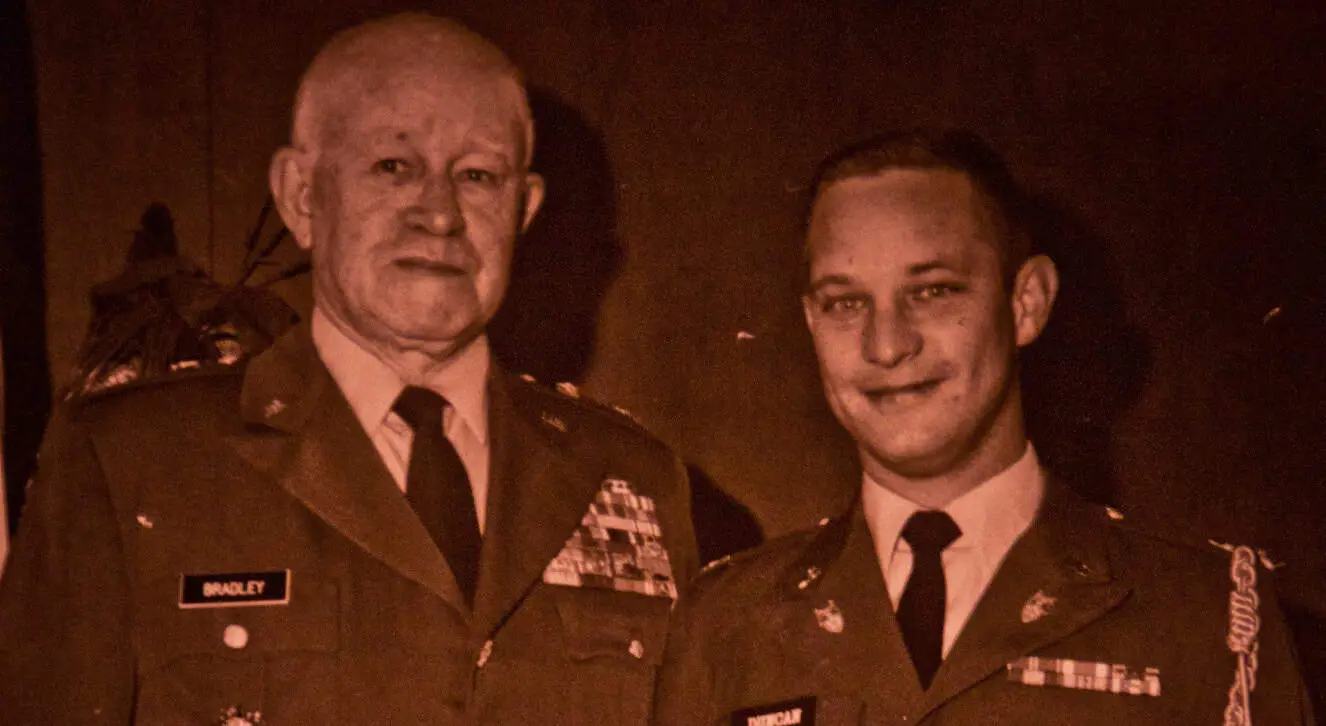
In fact, there hasn't been a living five-star officer in the United States since 1981. That was the year General Omar Bradley passed away, taking the last of those silver pentagonal clusters with him to Arlington National Cemetery. While the rank technically still exists on paper, it's effectively been put into a deep freeze.
The Exclusive Club of Five-Star Legends
To understand why we don't have them now, you've gotta look at who actually earned them. This wasn't a "time-in-service" promotion. You didn't just get five stars because you stayed in the Army for thirty years and didn't mess anything up.
The rank—officially called General of the Army—was created in December 1944. Why then? Because World War II was massive. American generals were commanding millions of troops and, more importantly, they were commanding Allied officers from countries like Great Britain who already had the rank of "Field Marshal."
The U.S. didn't want its top guys like George Marshall or Dwight Eisenhower being outranked by their British counterparts while they were trying to run the whole show. It was a matter of protocol and ego, but also practical command.
Here is the "Mount Rushmore" of the five-star world:
- George C. Marshall: The strategist who basically organized the entire global war effort.
- Douglas MacArthur: The man in the Pacific who famously promised to return to the Philippines.
- Dwight D. Eisenhower: Supreme Allied Commander in Europe (and later, you know, President).
- Henry "Hap" Arnold: The only person to hold five stars in two branches (Army and then Air Force).
- Omar Bradley: Known as the "GI's General," he was the last one promoted in 1950 during the Korean War.
On the Navy side, they had Fleet Admirals. Guys like Nimitz and Halsey. Same level, different uniform. But since then? Silence.
Why the Rank is "Dormant" Today
You might wonder why someone like Norman Schwarzkopf after the Gulf War, or more recently, generals like David Petraeus or Mark Milley, never got that fifth star.
Basically, the U.S. government decided that the five-star rank should be reserved for a "state of war" where the scale of the conflict is so vast that it requires a General of the Army to oversee multiple theaters. Since 1950, we haven't had a Congressionally declared war on the scale of World War II.
There’s also a bit of a financial and logistical headache involved. A five-star general never actually retires.
Technically, they stay on active duty for life. They keep an office, a small staff, and full active-duty pay until the day they die. That’s a huge commitment from the taxpayers. In 2026, the current crop of four-star generals—like General Randy George (Army Chief of Staff) or General David Allvin (Air Force Chief of Staff)—operates at the peak of the modern pay scale, but even they "retire" in the traditional sense.
Is There Something Higher Than Five Stars?
This is where it gets kinda weird. People often ask about a "six-star general."
There is no official six-star rank with a fancy six-star insignia, but there is a title called General of the Armies of the United States. Only three men have ever held it, and it's mostly a "super-rank" used for historical honors:
- John J. Pershing: Given the title after World War I.
- George Washington: Promoted posthumously in 1976 during the Bicentennial so that he would always be the highest-ranking officer in U.S. history.
- Ulysses S. Grant: Recently promoted posthumously (authorized in 2023, finalized in 2024) to match Washington.
If you’re looking for a living person with this status, you’re out of luck. It’s a title for the history books, not the battlefield.
Will We Ever See Another 5 Star General?
It’s possible. The law still allows for it. If the United States were to enter a massive, multi-front global conflict where we had to coordinate dozens of four-star generals across the planet, the President could nominate someone for that fifth star.
But modern warfare has changed. We use smaller, more specialized forces. Technology lets a four-star general in Washington or Tampa communicate instantly with units across the globe. The "need" for a General of the Army to represent the U.S. in a massive international coalition of Field Marshals just hasn't come up.
If you want to dive deeper into military history, the next step is looking at the National Defense Authorization Act (NDAA). This is where Congress actually sets the limits on how many generals are allowed to exist at any one time. Currently, the number of four-star slots is strictly capped, which makes the jump to five stars even more of a political and legislative mountain to climb.
Actionable Insight for History Buffs: If you're ever in Washington D.C., visit the Pentagon’s Hall of Heroes or Arlington National Cemetery. You can see the actual uniforms and markers for these nine men. It puts into perspective just how rare this rank is—out of the millions who have served, only nine have ever pinned on those five stars in the history of the modern American military.