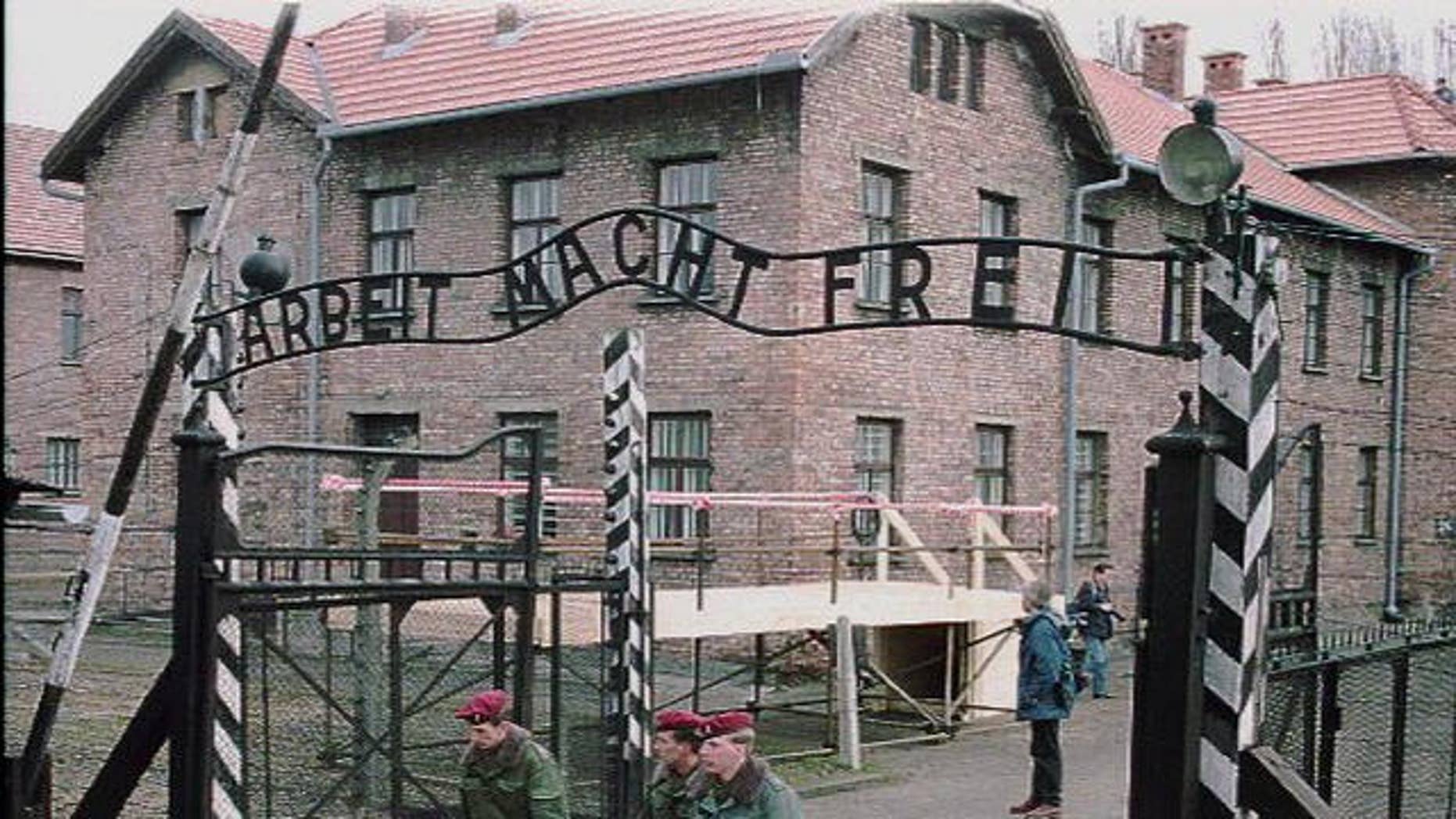
Seeing is believing, right? Not always. When you look at Auschwitz concentration camp photos, you aren't just looking at historical records; you're looking at a battlefield of propaganda, secret resistance, and the raw, terrifying logistics of industrial murder.
Most people think of the grainy, black-and-white shots of the "Arbeit Macht Frei" gate. Or maybe the piles of shoes. But the visual history of Auschwitz is actually split into three very different worlds. There is the world the SS wanted us to see, the world the prisoners risked their lives to document, and the world the liberators stumbled into when the nightmare finally ended.
Honestly, it’s a miracle we have any of this. The Nazis were obsessed with record-keeping until they realized they were losing the war. Then, they tried to burn everything. They failed.
The SS Album: A lie caught on film
The most famous collection of images is known as the Auschwitz Album. It wasn't found in a dusty archive or a government building. Lili Jacob, a survivor, found it in a cupboard in a different concentration camp (Mittelbau-Dora) after she was liberated. Imagine that. She opens a drawer and finds photos of her own family arriving on the ramp at Auschwitz-Birkenau.
These photos were taken by SS photographers, likely Ernst Hofmann or Bernhard Walter.
They show the "selection" process. You see people stepping off the trains. They look tired. Confused. Some are carrying heavy suitcases. The SS wanted these photos to look orderly. In these Auschwitz concentration camp photos, there is no screaming. There is no blood. There is just the cold, bureaucratic process of deciding who would work and who would be sent immediately to the gas chambers.
The terrifying part? The people in the photos have no idea what is about to happen. They are walking toward the "baths," which were actually Gas Chambers II and III. The photographer knew. The guards knew. Only the subjects were in the dark. This is why these images are so haunting—they capture the final moments of innocence before the machinery of death took over.
The Sonderkommando: Photography as resistance
Then there are the "Sonderkommando" photographs. These are the only photos that actually show the process of the Holocaust from the inside, taken by the victims themselves.
In August 1944, members of the Sonderkommando—prisoners forced to work in the crematoria—decided the world needed to know the truth. They couldn't wait for the SS to document their own crimes. They smuggled a camera into the camp.
Alberto Errera is often credited as the man who took these four blurred, tilted shots. He hid in a chimney or behind a door. He had to be fast. One photo shows a group of naked women being driven toward the gas chamber. Another shows the burning of bodies in an open pit because the crematoria couldn't keep up with the volume of victims from the Hungarian transports.
The quality is terrible. They are out of focus. They are framed poorly.
But they are the most important Auschwitz concentration camp photos in existence. They prove that the SS Album was a curated lie. They show the smoke. They show the indignity. They show the desperation of men who knew they were going to die but wanted to make sure their deaths weren't silent.
What the liberation photos changed
When the Soviet army rolled into Auschwitz in January 1945, they brought cameras. But by then, the camp was mostly empty. The SS had forced 60,000 prisoners on death marches just days before.
The Soviets found about 7,000 sick and dying people. They found warehouses full of hair. Tons of it. They found 7,000 kilograms of human hair packed into sacks, ready to be shipped to Germany to make cloth.
They also found children. Some of the most recognizable Auschwitz concentration camp photos come from the Soviet filming of the liberation. You’ve seen the kids showing the tattooed numbers on their arms. This wasn't just "news." It was evidence for the Nuremberg Trials.
Why we still argue about these images
Some historians, like Georges Didi-Huberman, argue that these images are "truth" in its purest form. Others worry that looking at them too much "normalizes" the horror.
There's also the issue of the "Auschwitz ID" photos. Before the Nazis realized they were killing people too fast to photograph everyone, they took mugshots of prisoners. These were professional, three-way portraits. Wilhelm Brasse, a prisoner-photographer, took thousands of them.
Brasse later talked about how he tried to calm the subjects. He wanted to give them a second of humanity before the shutter clicked. When you look at those specific Auschwitz concentration camp photos, look at the eyes. They aren't just "victims." They are individuals. Brasse was ordered to destroy the negatives at the end of the war, but he stuffed them into the stoves without lighting them, preserving the faces of thousands who would have otherwise been forgotten.
How to view this history responsibly
If you are researching or looking for these images today, you have to be careful. The internet is full of mislabeled photos. Sometimes shots from Majdanek or Buchenwald are labeled as Auschwitz.
Accuracy matters.
- Use the Auschwitz-Birkenau State Museum archives. They have the most verified collection of photographs and documents.
- Understand the source. Is it an SS photo? Then it's propaganda. Is it a Sonderkommando photo? Then it's a cry for help.
- Check the context. Many photos used in documentaries are actually "re-enactments" filmed by the Soviets shortly after the liberation for a film called The Chronicle of the Liberation of the Camp.
Basically, don't just consume the image. Question who held the camera and why.
The sheer volume of visual evidence is overwhelming. We have the "Höcker Album," found by an American intelligence officer in 2006. It shows SS officers at a retreat near Auschwitz. They are laughing. They are eating blueberries. They are singing. These photos are just as chilling as the ones of the camp because they show that the people running the "factory of death" were perfectly capable of being "normal" human beings when they weren't on duty.
The takeaway? Auschwitz concentration camp photos aren't just about the past. They are a warning about how easily a society can turn human beings into numbers and statistics.
To dig deeper into this history, you should start by visiting the digital archives of the Yad Vashem World Holocaust Remembrance Center. They have digitized the Auschwitz Album in its entirety, allowing you to see the sequence of arrival and selection as it happened. If you are ever in Poland, the Museum itself houses the original prints and the physical evidence—the hair, the suitcases, the shoes—that turn a flat photograph into a heavy, undeniable reality. Study the Brasse portraits specifically; they restore the names to the faces that the SS tried so hard to erase.