Most people think James Watson and Francis Crick just woke up one day, saw a double helix in a dream, and suddenly biology changed forever. It's a clean narrative. It's also wrong. Long before the 1953 structural breakthrough, a trio of scientists at the Rockefeller Institute for Medical Research—Oswald Avery, Colin MacLeod, and Maclyn McCarty—had to do the dirty work of proving that DNA wasn't just "junk" inside a cell. They were the ones who finally settled the debate on what carries our genetic instructions.
For decades, everyone "knew" proteins were the hereditary material. It made sense at the time. Proteins are complex, diverse, and built from twenty different amino acids. DNA? It seemed too simple, just a repetitive chain of four bases. Scientists thought DNA was a boring structural scaffold. They were dead wrong.
The Messy Reality of the Avery-MacLeod-McCarty Experiment
The story doesn't start in a sterile lab with high-tech sequencers. It starts with pneumonia. Back in 1928, Frederick Griffith noticed something weird. He had two strains of Streptococcus pneumoniae: a "Smooth" (S) strain that killed mice and a "Rough" (R) strain that was harmless. When he heat-killed the deadly S strain and mixed it with the live, harmless R strain, the mice still died. Somehow, the "dead" bacteria had passed a "transforming principle" to the living ones.
Griffith didn't know what that "principle" was. He just knew it existed.
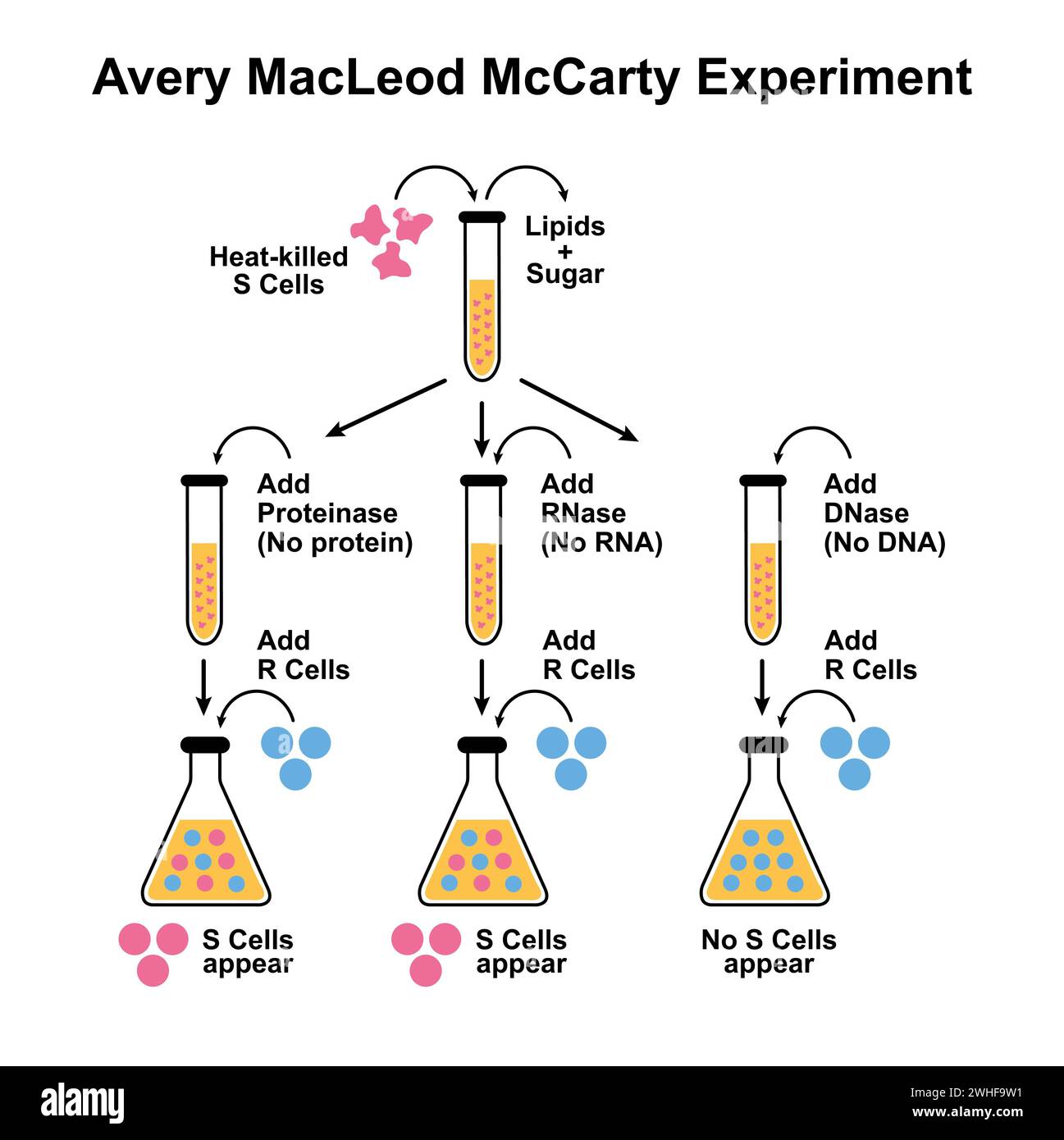
Fast forward to the early 1940s. Avery, MacLeod, and McCarty spent years—literal years—trying to purify this mysterious transforming factor. They weren't looking for a "eureka" moment. They were performing tedious, repetitive biochemical eliminations. Honestly, it was a bit of a grind. They took large batches of heat-killed S-strain bacteria and systematically broke them down.
Stripping the Cell Bare
They had to be sure. To prove it was DNA, they had to prove it wasn't anything else. They used enzymes to eat away at the different components of the bacteria. It was a process of elimination that would make Sherlock Holmes proud.
First, they used proteases to destroy all the proteins. The transformation still happened. The harmless bacteria still turned deadly.
Then, they used ribonuclease to destroy the RNA. Again, the transformation happened.
They even stripped away the fats (lipids) and the sugary coats (polysaccharides). Nothing stopped the transformation. The "dead" instructions were still getting through.
Finally, they used deoxyribonuclease—an enzyme that specifically shreds DNA.
The transformation stopped. That was it. When the DNA was gone, the "magic" disappeared. The Avery-MacLeod-McCarty experiment had found the smoking gun. DNA was the transforming principle. It was the molecule of heredity.
Why Nobody Believed Them at First
You’d think the world would have cheered. They didn't.
When they published their findings in the Journal of Experimental Medicine in 1944, the reception was... lukewarm. Many scientists were skeptical. They figured the DNA samples were just "contaminated" with trace amounts of protein. "It has to be protein," they argued. "DNA is too simple to hold the blueprints for a human being."
Avery was a cautious man. He didn't go on a press tour. He didn't shout from the rooftops. He just kept refining the data. He knew the chemistry was solid. The Avery-MacLeod-McCarty experiment wasn't a flash in the pan; it was a decade of rigorous, boring, undeniable chemistry.
It actually took another eight years and a totally different experiment involving a kitchen blender (the Hershey-Chase experiment) for the scientific community to finally give up on the protein theory. But Avery and his team were there first. They did the heavy lifting.
The Chemistry That Changed the World
What Avery, MacLeod, and McCarty discovered was that DNA had the power to change the very identity of a cell. This wasn't just a chemical reaction. It was a transfer of information.
Think about that for a second.
By adding a specific molecule to a living organism, you could rewrite its biological destiny. That is the fundamental basis for everything we do today in biotechnology. CRISPR, mRNA vaccines, genetic engineering—it all traces its lineage back to that lab at Rockefeller.
They proved that DNA was a large, complex molecule, even if they didn't know its shape yet. They used ultracentrifugation to show it had a high molecular weight. They used electrophoresis to check its electrical charge. They even used ultraviolet spectroscopy to see how it absorbed light. Every single test pointed to the same conclusion: DNA is the boss.
Looking Back: The Legacy of 1944
It's a bit of a tragedy that Oswald Avery never won a Nobel Prize. Many people in the scientific community consider it one of the biggest snubs in history. By the time the world fully caught on to the importance of his work, he had passed away.
But his work lived on through McCarty and MacLeod, and eventually through Watson, Crick, and Franklin. Without the Avery-MacLeod-McCarty experiment, the search for the structure of DNA wouldn't have even started. Scientists would still have been chasing proteins, looking in the wrong place for the secrets of life.
Key Takeaways from the Experiment
- DNA is the "Transforming Principle": It carries the instructions that define an organism's traits.
- Proteins are the workhorses, not the blueprints: While vital, they don't carry the hereditary code.
- Biochemical purification works: By systematically destroying parts of a cell, you can isolate the function of a single molecule.
- Skepticism is part of science: Even with rock-solid evidence, it takes time for a "paradigm shift" to occur.
How to Apply This Knowledge Today
Understanding the Avery-MacLeod-McCarty experiment isn't just for passing a biology quiz. It’s about understanding the logic of discovery.
If you're looking to dive deeper into genetics or even just understand the news about gene editing better, start by looking at the raw data of these early experiments. Real science is rarely about "aha!" moments and mostly about the meticulous removal of doubt.
Next Steps for Enthusiasts:
- Read the original 1944 paper: It's surprisingly readable. Look for "Studies on the Chemical Nature of the Substance Inducing Transformation of Pneumococcal Types."
- Compare with Hershey-Chase: Look up how the 1952 "blender experiment" finally convinced the holdouts using radioactive isotopes.
- Trace the timeline: Map out the years between Griffith (1928), Avery (1944), and Watson/Crick (1953) to see how slowly scientific consensus actually moves.
- Explore modern transformation: Research how "competent cells" are used in labs today to take up foreign DNA—it's the exact same process Avery studied, just refined for the 21st century.
The work of Avery, MacLeod, and McCarty proved that the "blueprint" of life wasn't some mystical force or a complex protein web. It was a specific, tangible chemical. Once we knew what it was, we could finally start figuring out how it worked. That changed everything.