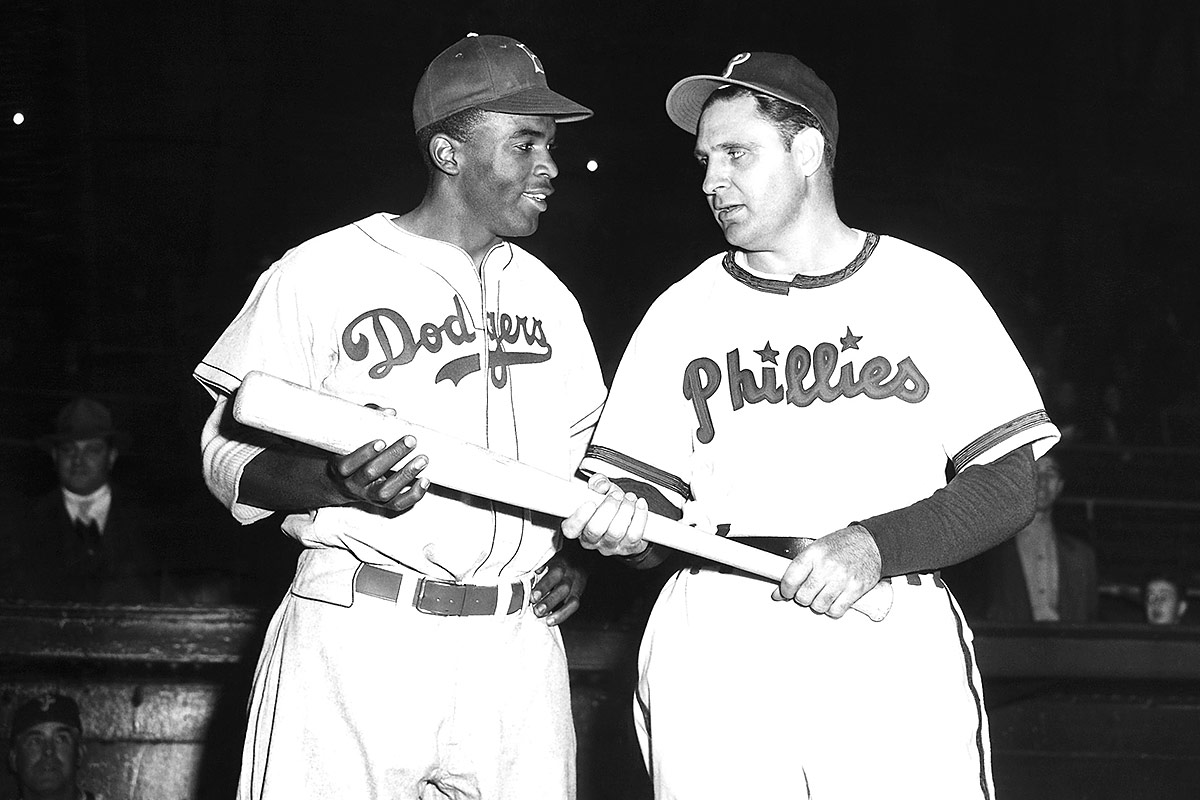
If you’ve seen the movie 42, you probably remember the guy in the Philadelphia Phillies dugout. He’s the one screaming things so vile the theater audience usually goes quiet. That was Ben Chapman.
Most people know him as the "villain" of the Jackie Robinson story. Honestly, that’s a fair label. But the real history of what went down between Ben Chapman and Jackie Robinson in April 1947 is actually weirder and more uncomfortable than the Hollywood version. It wasn't just a one-off shouting match. It was a calculated, sustained attempt to break a man’s spirit, and it nearly worked.
The Ebbets Field Meltdown
The date was April 22, 1947. Jackie Robinson had been in the big leagues for exactly one week.
When the Phillies rolled into Brooklyn, Chapman didn’t just let his players heckle Robinson. He led the charge. We aren't talking about "hey batter batter" stuff here. Chapman and his bench jockeys spent nine innings screaming racial slurs, questioning Robinson’s humanity, and making disgusting comments about his wife, Rachel.
It was brutal.
Harold Parrott, the Dodgers' traveling secretary, later wrote that Chapman’s voice carried across the whole park. He talked about "thick lips" and "extra-thick skulls." He told Robinson to go back to the jungle.
Why did he do it?
Chapman’s defense was basically the "it was a different time" excuse, though even for 1947, he was way over the line. He claimed it was just "bench jockeying." In his mind, if you could get under a guy’s skin, you did it. He pointed out that people called Joe DiMaggio "dago" and Hank Greenberg "kike."
But there’s a difference between a taunt and a crusade.
Robinson later admitted in his autobiography that this specific series brought him closer to "cracking up" than anything else in his life. He wanted to throw down his bat, storm the dugout, and start swinging. But he’d promised Branch Rickey he wouldn't fight back. He had to stand there and take it while the Phillies dugout acted like a lynch mob in pinstripes.
The Backfire That Saved the Season
Here is the irony: Ben Chapman might be the reason Jackie Robinson succeeded.
Before that series, the Dodgers weren't exactly a united front. Some of Robinson’s own teammates had signed a petition trying to keep him off the team. They were cold. They were indifferent.
But when they heard the sheer, unhinged hatred coming from the Phillies' dugout, something shifted. Eddie Stanky, a guy who wasn't exactly a civil rights crusader, eventually leaned out of the Dodgers' dugout and yelled back at Chapman, "Pick on somebody who can fight back!"
Branch Rickey later said Chapman did more to unite the Dodgers in three days than he could have done in two years. By making Robinson a martyr, Chapman forced the other Dodgers to choose a side. They chose their teammate.
That Awkward "Reconciliation" Photo
By May, the public outcry was huge. Fans were writing letters to Commissioner Happy Chandler. Even the press, which wasn't always kind to Robinson, thought Chapman was a disgrace.
The Commissioner eventually told Chapman to shut up.
To "fix" the PR nightmare, the league forced a meeting on May 10, 1947. They made Chapman and Robinson pose for a photo together. If you look at that picture today, you can see the tension. They’re both holding a bat—one on each end—because Robinson refused to shake Chapman’s hand.
Robinson later called it one of the most difficult things he ever had to do. He had to swallow his pride for "the good of the game" and stand next to a man who had spent days dehumanizing him.
What Happened to Ben Chapman?
Chapman didn't last long after the 1947 season. The Phillies were terrible, and his reputation was shot. He was fired in 1948 and never managed in the Major Leagues again.
He lived until 1993, and interestingly, he never really apologized in the way we’d expect today. In interviews later in life, he’d say he "mellowed," but he mostly stuck to the story that he was just trying to win a ballgame. He’s a guy who hit .302 over 15 seasons and was a four-time All-Star, yet his entire baseball legacy is tied to those few days in April.
Key Takeaways from the 1947 Incident
- The Power of the Pivot: Robinson used the abuse as fuel. He went on to win Rookie of the Year despite the Phillies' attempt to rattle him.
- Silence is Support: The Dodgers' eventual defense of Robinson proves that sometimes it takes a common enemy to build a team.
- PR vs. Reality: The famous 1947 photo was a staged event, not a sign of friendship. It’s a reminder that history isn't always as clean as the pictures suggest.
If you want to understand the Robinson story, you have to look at the people who stood in his way. Chapman wasn't just a random bigot; he was a symptom of a system that wasn't ready to change until it was forced to.
To get a better sense of the atmosphere Robinson faced, you should check out the box scores from that April 1947 series. Seeing the "0-for-4" or "1-for-3" next to his name puts into perspective that he was still trying to hit a curveball while a manager was screaming for his head. You can also look into the career of Branch Rickey to see how he navigated the political fallout of the Chapman incident.