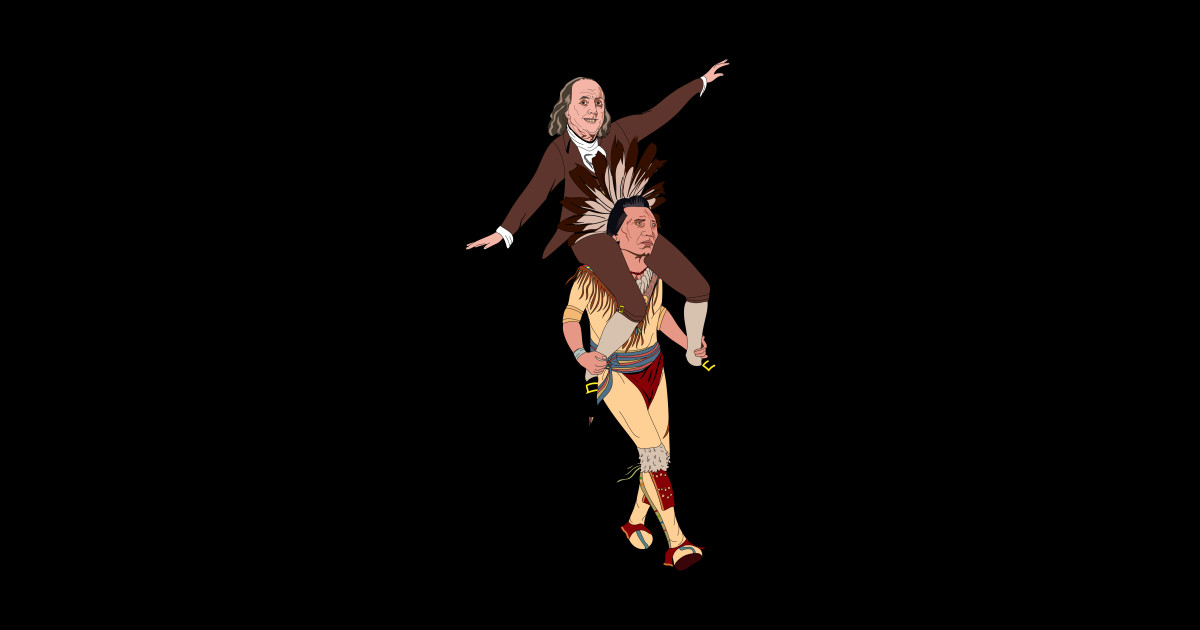
History is messy. Most people think the United States Constitution just dropped out of the sky because a bunch of guys in powdered wigs sat in a hot room in Philadelphia. But that’s not really how it went down. If you look at the paper trail left by the Founders, especially the stuff written by a young, ambitious printer named Ben Franklin, you start to see a very different picture. Benjamin Franklin and the Iroquois shared a connection that predates the Revolution by decades, and it basically changed the trajectory of how we think about "union."
Franklin wasn’t just a kite-flyer; he was an observer. He spent years watching how the Haudenosaunee (the "People of the Longhouse," commonly known as the Iroquois Confederacy) managed to keep six distinct nations from killing each other. It fascinated him. He saw a system that was older and, frankly, more stable than the bickering colonies he lived in.
The Albany Plan and the "Ignorant Savages" Quote
Let’s talk about that one quote everyone gets wrong—or at least, everyone uses to prove Franklin was either a hero or a jerk. In 1751, Franklin wrote a letter to his partner, James Parker. He was complaining about how the British colonies couldn't seem to agree on anything. He wrote:
"It would be a very strange Thing, if ignorant Savages should be capable of forming a Scheme for such an Union, and be able to execute it in such a Manner, as that it has subsisted Ages, and appears indissoluble; and yet that a like Union should be impracticable for ten or a dozen English Colonies..."
People argue over this. Was he being racist? Was he being complimentary? Honestly, it’s a bit of both. He was using the Iroquois as a "shame" tactic against his own people. He was basically saying, "If these guys, who we think are beneath us, can figure out how to run a massive federalist system, why can’t we?" It’s a backhanded compliment that reveals just how much he actually admired their political structure.
How the Great Law of Peace Actually Worked
The Haudenosaunee weren't just a loose group of friends. They followed the Gayaneshakgowa, or the Great Law of Peace. This was a sophisticated oral constitution. It had been around for centuries—some historians say since 1142, others say 1450. Regardless, it was old.
It solved a problem the American colonies would later face: how do you give power to a central government without erasing the identity of the individual states? The Iroquois had "Sachems" (leaders) who represented their specific nations—the Mohawk, Oneida, Onondaga, Cayuga, and Seneca (and later the Tuscarora). But when it came to "federal" issues like war or trade, they met as a Grand Council.
Franklin saw this. He attended Indian treaty councils. He printed the records of these meetings. He was literally steeped in the rhetoric of Iroquois diplomacy. When he showed up to the Albany Congress in 1754, he brought a plan for a "Plan of Union." It looked a whole lot like the Iroquois model. It had a "Grand Council" and a "President General."
It failed. The colonies weren't ready to give up their local power yet. But the seed was planted.
Canasatego: The Man Who Told the Colonists to Get Their Act Together
In 1744, a decade before Albany, an Onondaga leader named Canasatego gave the colonists some unsolicited advice. He told them they were weak because they were divided. He famously used the metaphor of the arrows—one arrow is easy to break, but a bundle of arrows is nearly impossible to snap.
If that sounds familiar, it should. It’s the same logic behind E Pluribus Unum. Franklin was the one who published Canasatego’s speeches. He was the one disseminating this specific brand of political philosophy to the American public. To suggest that Benjamin Franklin and the Iroquois were ships passing in the night is just factually wrong. They were in constant dialogue.
The "Great Law" vs. The Constitution: The Nuance
Now, we have to be careful here. There’s a popular theory called the "Iroquois Influence Thesis." Some people claim the U.S. Constitution is a direct copy of the Great Law of Peace. That’s an oversimplification.
The Founders were also obsessed with the Roman Republic, the Greeks, and British Common Law. They were magpies—they stole the best ideas from everywhere. But the Iroquois provided the only living example of federalism they could actually see in action. You couldn't go visit Ancient Rome. You could, however, walk into the woods of New York and Pennsylvania and see the Haudenosaunee Grand Council in session.
What the Americans Borrowed
- Federalism: The split between local and national power.
- Impeachment: The Iroquois had a process for removing leaders who went rogue (often initiated by the Clan Mothers, a level of gender equality the Founders sadly ignored).
- Symbolism: The bundle of arrows held by the eagle on the Great Seal of the United States.
What They Didn't
- The Role of Women: The Iroquois were matrilineal. Women chose the leaders. The Founders? Yeah, they weren't there yet. Not even close.
- Consensus: The Iroquois worked on total consensus. The U.S. went with majority rule, which is a very different beast.
The Tragic Irony of 1776
The tragedy of the relationship between Benjamin Franklin and the Iroquois is that the very union Franklin helped build eventually turned around and destroyed the people who inspired it. During the Revolutionary War, the Iroquois Confederacy was forced to pick sides. Some went with the British, some with the Americans. It broke the Great Law of Peace.
By the time the Constitution was actually signed in 1787, the influence of the Haudenosaunee was being intentionally minimized. The new Americans wanted to see themselves as the heirs to Europe, not the students of the "forest."
Why This Matters in 2026
We’re living in a time where people are looking for the roots of American democracy. Understanding that our "Founding" wasn't just a European import is vital. It was a uniquely American product, cooked up in a landscape where Indigenous political thought was just as influential as John Locke or Montesquieu.
Franklin was a pragmatist. He didn't care where a good idea came from. If it worked, he used it. He saw the Iroquois as a model of strength through unity. He saw their ability to maintain peace across a massive geographic area. He spent his life trying to convince his fellow colonists that they could do the same.
Actionable Insights for History Buffs and Researchers
If you want to dig deeper into this history, don't just stick to the standard textbooks. The real story is in the primary documents.
1. Read the Treaty Records
Franklin’s printing press produced the "Treaty of Lancaster" (1744). This is where you can find the actual words of Canasatego. It’s eye-opening to see how the Iroquois leaders spoke to the colonial governors—they weren't "primitive"; they were the smartest diplomats in the room.
2. Visit the Haudenosaunee Sites
If you're in the Northeast, go to the Onondaga Nation or the Iroquois Museum in Howes Cave, NY. Seeing the Wampum belts—which are essentially legal documents—changes your perspective on what "literacy" and "law" mean.
3. Contrast the Albany Plan with the Constitution
Look at Franklin's 1754 draft. You’ll see the Iroquois influence much more clearly there than in the final 1787 version. The 1787 version is more "European," but the 1754 version is the raw, Indigenous-inspired original.
4. Check out the 1988 Concurrent Resolution
Few people know this, but in 1988, the 100th Congress passed H.Con.Res. 331. It was a formal resolution acknowledging the contribution of the Iroquois Confederacy to the development of the U.S. Constitution. It’s a rare moment of the U.S. government actually admitting where its ideas came from.
History isn't a straight line. It’s a messy, overlapping web of cultures. Ben Franklin knew that. He was smart enough to look around him, rather than just looking back at the Old World. That’s probably why he was the most successful diplomat of his age. He knew how to listen.