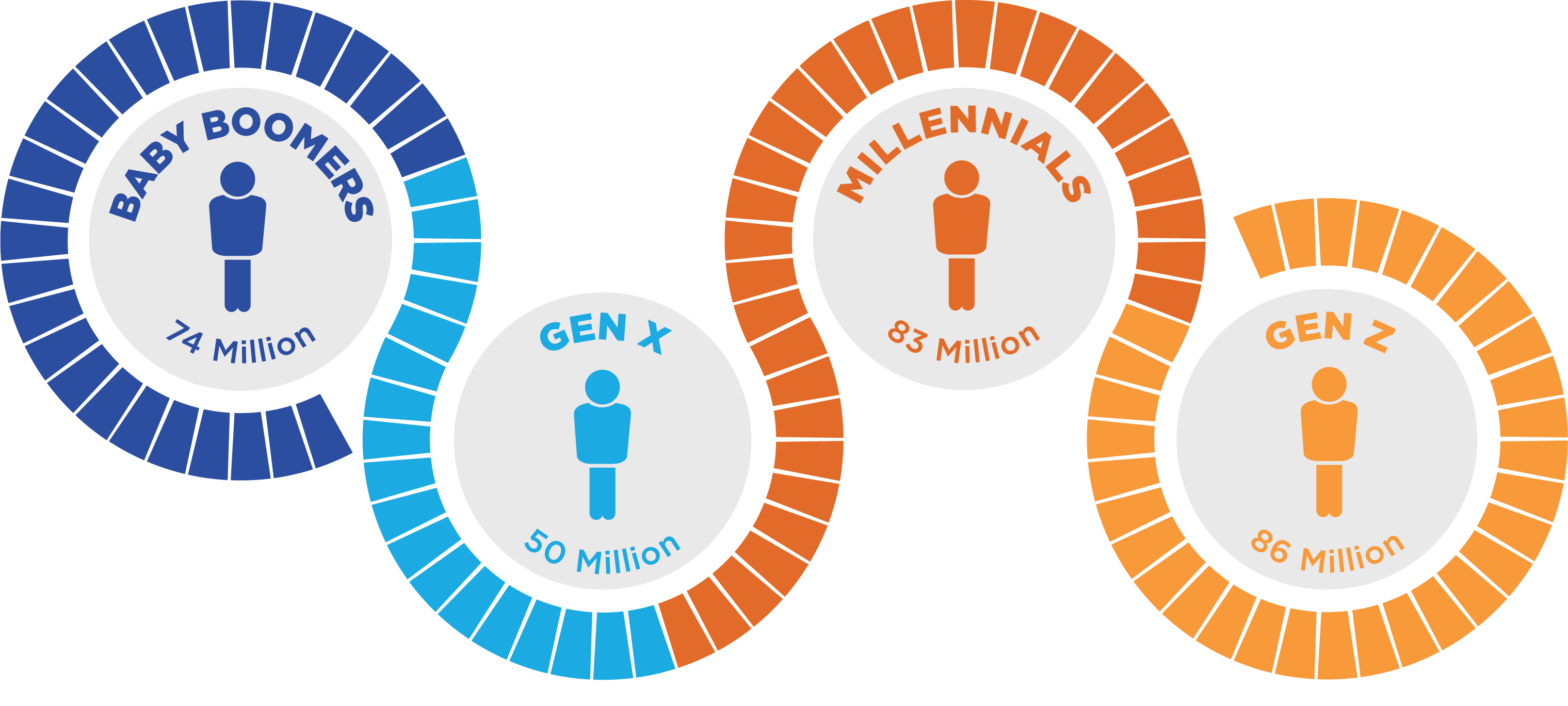
You’ve probably seen the memes. One side of the internet claims if you remember using a floppy disk, you're a Millennial. The other side says if you were born after 1995, you're Gen Z. It’s a mess. Honestly, the birth years of millennials have become one of the most debated topics in modern sociology, mostly because being a Millennial carries a lot of cultural baggage.
Some people wear the label like a badge of honor. Others? They’d rather be called literally anything else.
But if we’re looking at the actual data, the boundaries aren't as blurry as Twitter makes them out to be. Most reputable demographic researchers, like the folks at the Pew Research Center, have settled on a very specific window. If you want the short answer: it’s 1981 to 1996. That’s it. That is the definitive bracket used by most economists, marketers, and the U.S. Census Bureau. If you were born in 1980, you are a Gen Xer. If you were born in 1997, you are Gen Z.
Does a single year really change your entire personality? Of course not. But those years matter because they define the world you woke up to as a child.
Where did these dates actually come from?
It wasn't just some guy picking numbers out of a hat. The term "Millennial" was actually coined by authors Neil Howe and William Strauss back in 1987. They wrote a book called Generations that basically predicted how these kids would grow up. At the time, they were looking at the class of 2000. They figured the kids graduating high school at the turn of the millennium were a distinct breed. They weren't the cynical, "grunge" Gen Xers. They were supposedly more optimistic, more team-oriented, and—this is the big one—digitally native.
Pew Research Center eventually stepped in to formalize this because, frankly, businesses needed to know who they were selling to. They settled on the 1981-1996 range to keep the generation at a manageable 16-year span.
Think about the 1996 cutoff for a second. It isn't random.
It’s about 9/11.
Most people born in 1996 were about five years old when the towers fell. They have some shadow of a memory of what the world was like before heightened airport security and the War on Terror. People born in 1997 or 1998? They generally don't. They grew up in the aftermath. That shift in global security and "American exceptionalism" is a massive psychological divider.
The "Elder Millennial" and the Xennial struggle
If you were born between 1977 and 1983, you probably feel like a ghost. You’re technically a Millennial (or a late Gen Xer), but you don't fit the "avocado toast" stereotype. This is where we get the "Xennial" micro-generation.
It’s a tiny slice of time.
These are the people who had an analog childhood but a digital adulthood. You remember life before the internet—actual landlines, rotary phones, and writing letters—but you were young enough to master social media before you hit your 30s. You're the "Oregon Trail" generation. You lived through the transition from VHS to DVD to streaming.
This group is important because they bridge the gap. They have the work ethic often associated with Gen X but the tech-savviness of Millennials. If you find yourself explaining to a 22-year-old why you couldn't use the phone and the internet at the same time, you’re likely in this "Elder" camp.
The core traits that define the 1981-1996 bracket:
- The Great Recession: Most Millennials entered the workforce or were in college during the 2008 financial crash. This nuked their earning potential for a decade.
- The Mobile Revolution: They remember the "brick" Nokia phones but were the primary adopters of the first iPhone in 2007.
- Student Debt: This is the first generation where a college degree became both "mandatory" for a middle-class life and prohibitively expensive.
- Social Media Pioneers: They didn't just use MySpace and Facebook; they built the culture of those platforms from the ground up.
Why the birth years of millennials keep shifting in the media
Go to any major news site and you'll see different dates. Some say 1982 to 2000. Others say 1980 to 1995. Why can't we agree?
Mostly, it’s about marketing.
If you're a car company trying to sell a "Millennial-focused" SUV, you want that demographic to be as large as possible. You’ll stretch the dates. If you're a political pollster, you might narrow the dates to focus on "Young Professionals" vs. "College Students."
The U.S. Census Bureau has been notoriously vague about it, too. For a long time, they didn't officially define the end date, which let everyone else just make it up. However, the 1996 cutoff has become the "gold standard" in 2026 because it creates a clear 15-to-16-year rhythm between generations. It makes the data cleaner.
There's also the "Zillennial" factor.
Just like the Xennials at the start of the generation, those born between 1994 and 1999 are in a weird limbo. They grew up with TikTok and MySpace. They are the transition point. But for the sake of high-level demographics, they are usually split down the middle at '96.
How to actually use this information
If you're trying to figure out where you land, don't just look at the year on your birth certificate. Look at your "cultural milestones."
Did you have a cell phone in high school? If the answer is "no" until your senior year or college, you're likely an early-to-mid Millennial. If you were using an iPad in elementary school, you’re Gen Z, regardless of what that one weird article from 2012 told you.
Understanding the birth years of millennials is basically about understanding the economy. We are looking at a group that is currently in their prime earning years (the oldest are in their mid-40s, the youngest are nearing 30). They are the ones buying houses (or trying to), starting families, and moving into senior management roles.
They are no longer the "kids" everyone complains about. That's Gen Z. Millennials are the ones complaining about their backs hurting and wondering why nobody uses emails anymore.
Actionable insights for navigating generational gaps:
- Stop using "Millennial" as a synonym for "Young Person." If you are talking about a 19-year-old in 2026, you are talking about Gen Z. Using the wrong term makes you look out of touch in professional settings.
- Acknowledge the Xennial/Zillennial "Cusps." If you're managing a team, realize that a 1982 birth year and a 1994 birth year have vastly different relationship styles with technology and authority.
- Check the source. When you see a "Millennial Study," look at their methodology. If they include people born in 2002, the data is probably skewed and less useful for serious business planning.
- Value the "Analog-Digital" bridge. Millennials are uniquely positioned to understand both old-school business logic and new-school tech. Use that perspective to translate between Boomer leadership and Gen Z entry-level staff.
The reality is that these dates are tools, not cages. But if you want to be factually accurate in 2026, stick to the 1981-1996 range. It’s the only one that stands up to rigorous sociological scrutiny. Every other "range" is usually just someone trying to sell you something or a writer who didn't do their homework.