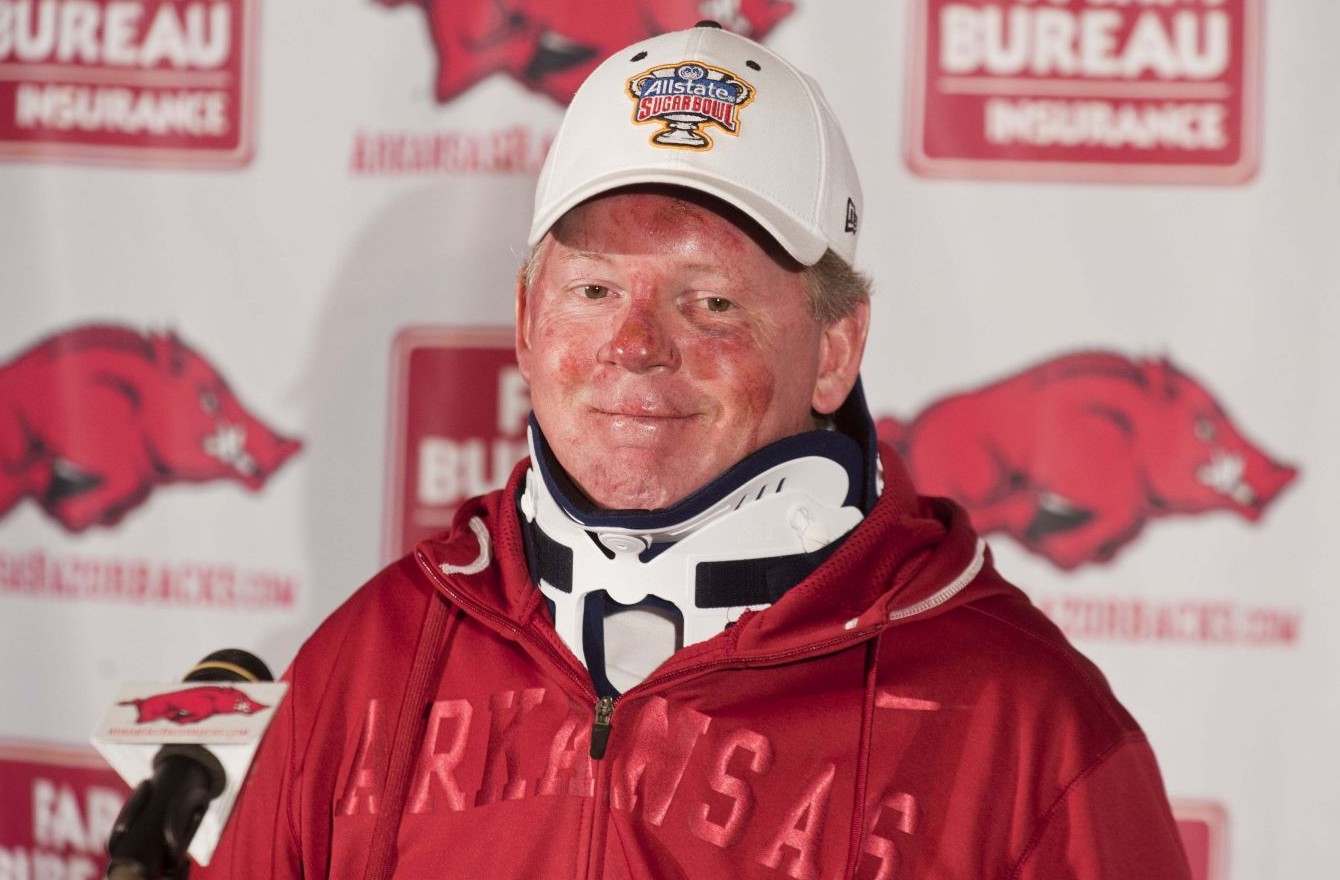
It is the image that won't die. You know the one. Bobby Petrino, then the head football coach at the University of Arkansas, standing at a podium in 2012 looking like he just went twelve rounds with a heavyweight champion. His face was a map of red, raw road rash. His eyes were puffy. And, of course, there was the Bobby Petrino neck brace—that bulky, white plastic collar that launched a thousand memes and changed the trajectory of SEC football forever.
Honestly, it’s rare to see a piece of medical equipment become a cultural shorthand for "I'm lying to you," but that's exactly what happened.
Most people remember the visual, but the details of how we got to that press conference are actually wilder than the photo itself. It wasn't just a bike crash. It was a calculated attempt to hide a massive scandal that was unraveling in real-time. If you’ve ever wondered how a $25 million career goes up in smoke in less than ten days, this is the blueprint.
The Ride That Changed Everything
It was April 1, 2012. April Fools' Day. You couldn't make that up if you tried.
Petrino was an avid rider. He’d been on bikes since he was ten years old. He owned a Harley and a handful of other motorcycles. That evening, he took his Harley-Davidson Road King out for a spin on Arkansas Highway 16, a winding, two-lane road near the tiny community of Crosses.
Around 6:45 PM, he lost control. He claimed a gust of wind and the setting sun caused him to skip off the pavement. He went into a ditch. Hard.
The Initial Cover-Up
The first official word from the University of Arkansas was that the coach had been in a solo accident. The statement literally said "no other individuals" were involved. Petrino even told his boss, Athletic Director Jeff Long, the same thing.
Two days later, Petrino showed up for that infamous press conference. He was nursing four broken ribs and a cracked C2 vertebra. He joked about not having brain damage. He looked like a man who had survived a brush with death and was ready to get back to spring practice.
But there was a problem. A big one.
The Arkansas State Police were about to release the actual accident report. And that report mentioned a passenger.
Who Was on the Back of the Bike?
While Petrino was telling everyone he was alone, the police report told a different story. The passenger was Jessica Dorrell. She was 25. Petrino was 51.
Dorrell wasn't just some random "lady that flagged down a car," as Petrino had initially described her. She was a former Arkansas volleyball player who had recently been hired by Petrino as the student-athlete development coordinator for the football program.
She beat out 150 other applicants for that job.
Wait, it gets worse. As the investigation deepened, it came out that Petrino had given Dorrell $20,000 in cash as a "gift." She used it to buy a black Acura.
Why the Bobby Petrino Neck Brace Became a Symbol
The reason that image of the neck brace is so iconic isn't just because of the injuries. It’s because of the audacity.
Think about it: he stood there in front of the world, wearing that brace, looking the public in the eye, and told a story that he knew was a total fabrication. He was trying to protect his marriage, his reputation, and his $3.5 million-a-year salary.
But in the SEC, the truth has a way of coming out, usually via a FOIA request.
By April 5, the police report went public. By April 10, Petrino was fired "for cause." No buyout. No golden parachute. Just a box for his office and a permanent spot in the Hall of Fame of Bad PR Moves.
The Fallout and the Meme-ification
For years, the Bobby Petrino neck brace was the go-to joke for any coach caught in a lie. It represented the ultimate "unforced error."
Arkansas fans were devastated. Under Petrino, the Razorbacks were actually good. Like, top-ten good. They had just finished an 11-2 season and won the Cotton Bowl. They were legitimate national title contenders. Then, in one Sunday evening ride, the whole thing evaporated.
The program went into a tailspin that lasted a decade.
- They hired John L. Smith (a disaster).
- They hired Bret Bielema (started okay, ended poorly).
- They hired Chad Morris (the dark ages).
Throughout all of it, fans would look back at the photo of Petrino in the brace and wonder "What if?"
A Strange Homecoming
Fast forward to 2024 and 2025. In one of the most "college football" moves of all time, Arkansas actually brought Petrino back. Not as the head coach, but as the offensive coordinator under Sam Pittman.
When the news broke, social media didn't talk about his play-calling. They didn't talk about his time at Louisville or Missouri State. They posted the picture of the neck brace.
It’s been over a decade, and the image is still the first thing people think of. It’s a testament to how visceral that press conference was. It wasn't just a sports story; it was a soap opera that played out in the Ozarks.
Lessons from the Brace
So, what can we actually learn from this whole mess? Beyond "don't ride a motorcycle without a helmet" (Petrino wasn't wearing one, which he later admitted was a "bad call"), there are some real takeaways here.
- The Cover-Up is Always Worse: If Petrino had just admitted there was a passenger from the start, he might have kept his job. The firing wasn't just about the affair; it was about the "misleading of the university" and the unethical hiring practices.
- Reputation is Fragile: You can be the best in the world at your job—and Petrino was an elite offensive mind—but if people can't trust you, you're a liability.
- Visuals Matter: If there were no cameras at that press conference, we probably wouldn't be talking about this today. That specific visual of the bruised face and the white brace burned the event into our collective memory.
Basically, the Bobby Petrino neck brace is a reminder that in the high-stakes world of major college sports, the wheels can come off at any moment. Sometimes literally.
If you're ever in a situation where you're tempted to "tweak" the truth to save face, just remember Bobby at that podium. It’s usually better to just own the mistake before the police report does it for you.
Keep your eyes on the road and maybe, just maybe, wear the helmet.
Next Steps for Understanding the Petrino Era:
- Review the original 2012 Arkansas State Police accident report to see the specific timeline of the "third-party" pickup.
- Compare Arkansas's win-loss record in the four years before the crash versus the four years following his dismissal.
- Research the University of Arkansas's specific "for cause" termination clauses that allowed them to void his multi-million dollar contract.