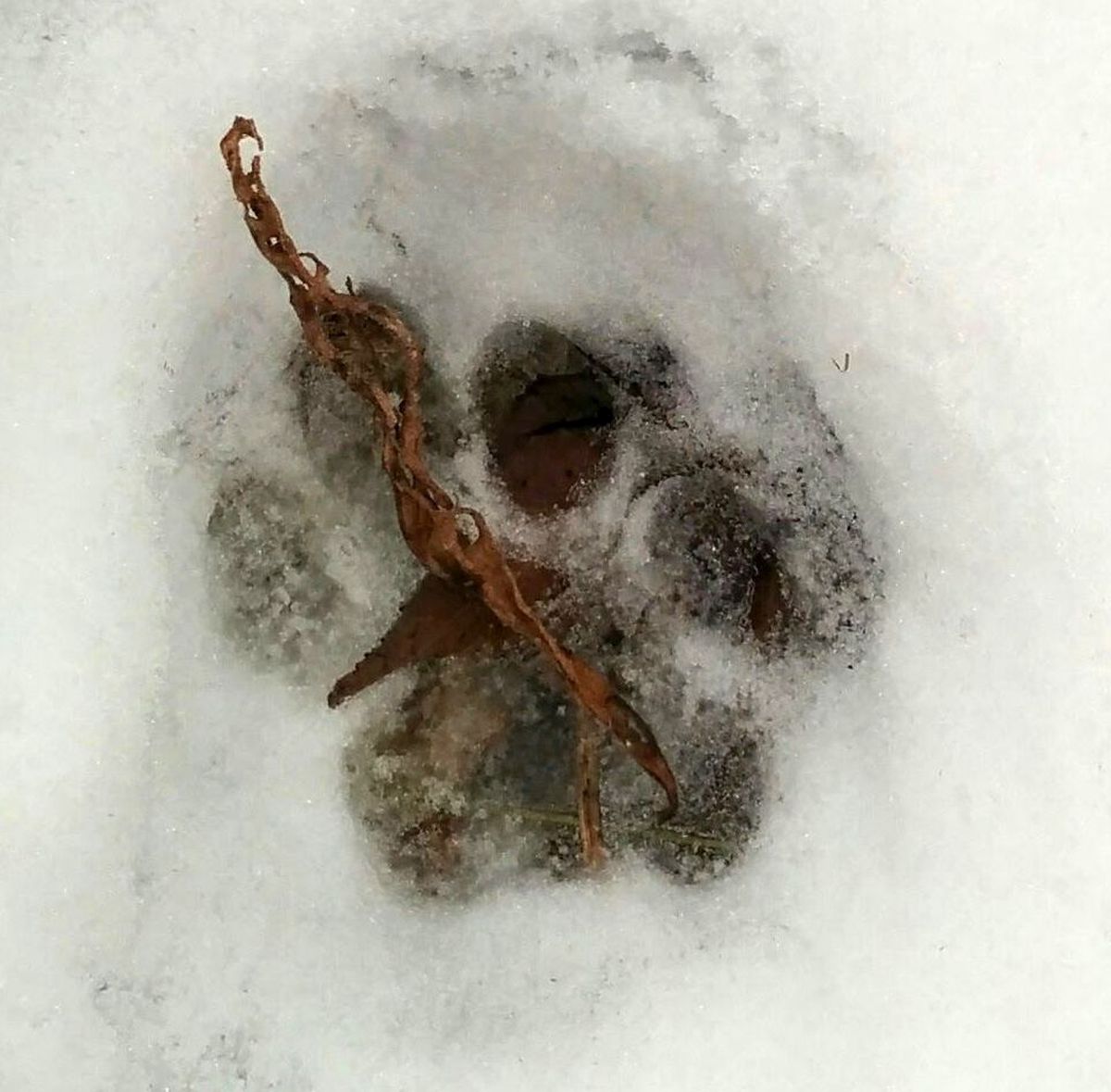
You’re trekking through the woods after a fresh powder dump, and there they are. A trail of perfectly round depressions leading right into a dense thicket of cedar. Your heart beats a little faster. Is it a mountain lion? A stray neighborhood tomcat that’s lost its way? Or maybe it’s a bobcat. Identifying bobcat prints in the snow isn't as straightforward as the field guides make it look, mostly because snow is a messy medium. It melts, it crusts over, and it stretches.
Honestly, most people misidentify these tracks. They see a round paw and immediately jump to "big cat," or they see a bit of a nail mark and assume it's a coyote. But nature is rarely that clean. To really know what you’re looking at, you have to look at the "stride" and the "straddle" as much as the individual toe pads.
The Anatomy of a Cold Trail
A bobcat (Lynx rufus) is a master of efficiency. When they move through deep snow, they aren't just wandering; they are usually hunting or patrolling a territory that can span up to 30 square miles for a male.
The first thing you’ll notice about a bobcat track is the shape. It’s round. If the print looks like a long oval, you're likely looking at a canine—a fox, coyote, or dog. Cats have a wide heel pad with two lobes at the top and three at the bottom. Think of it like a stylized "M." Canines, on the other hand, have a single lobe at the top of their heel pad.
But here’s the kicker: the "C-shape."
If you can draw a clean "C" between the leading toes and the heel pad without hitting any pads, it’s a cat. Canines have a "X" shape of negative space. This rule holds up surprisingly well even when the snow is starting to slush.
Why You Won't See Claws (Usually)
Bobcats have retractable claws. They keep them tucked away to stay sharp for the kill. If you see clear, deep nail marks at the tip of every toe, it’s almost certainly a coyote or a domestic dog.
However, don't let a tiny claw mark fool you. In very deep or slippery snow, a bobcat might extend its claws just a tiny bit for extra traction—sort of like us putting on crampons. It’s rare, but it happens. Usually, though, a bobcat print in the snow looks like a clean, soft "muff" pressed into the white surface.
Direct Registering: The Stealth Walk
This is where it gets cool.
Bobcats use a walking pattern called "direct registering." This basically means their hind paw lands exactly in the spot where their front paw just was. Why do they do this? It's all about energy and noise. By stepping into their own tracks, they minimize the sound of crunching snow and reduce the effort of breaking new trail.
If you see a long line of tracks that looks like a two-legged animal walked through the woods, you’re looking at a feline.
Measuring the Stride
Size matters. A typical bobcat track is about 2 inches wide. It's significantly larger than a house cat (usually 1 to 1.5 inches) but way smaller than a mountain lion (which starts at 3 inches and goes up).
If you have a ruler or even just your phone, measure the distance between the steps.
- Bobcat: Stride is usually 10 to 14 inches.
- Coyote: Stride is much longer, often 18 to 22 inches.
- House Cat: Tiny, choppy steps, usually under 8 inches.
I once followed a set of tracks in the Adirondacks that I swore were bobcat. They were the right size, and they were round. But the trail was erratic. It zigzagged, looped back, and stopped to sniff every single stump. That’s dog behavior. Bobcats are purposeful. They move from cover to cover. They don't waste calories "playing" in the snow unless they're kittens.
When Snow Lies to You
Snow is a terrible witness. If the sun hits a track, the heat gets trapped in the dark shadow of the print, melting the edges. A 2-inch bobcat print can expand into a 4-inch "mountain lion" print in a single afternoon. This is called "sun-scald."
Always look for tracks in the shade of trees to get the most accurate measurement.
The Bottom-Heavy Heel Pad
If you’re lucky enough to find a crisp print in "perfect" snow—that slightly damp, packing snow—look at the bottom of the heel pad. A bobcat's heel is huge compared to its toes. It takes up about one-third to one-half of the total print area.
In the Pacific Northwest, researchers like those at the Cascade Carnivore Project often use these subtle ratios to distinguish between bobcats and the rarer Canada Lynx. Lynx have massive, furry "snowshoe" paws that can be double the size of a bobcat's, even though the cats themselves aren't that much heavier.
Behavior Behind the Tracks
Finding bobcat prints in the snow tells a story of survival. If the tracks lead to a downed log and then disappear, the cat likely jumped up to gain a vantage point. If the tracks suddenly shorten and the "straddle" (the width between left and right tracks) widens, the cat was crouching. It was stalking something.
Maybe a ruffed grouse or a snowshoe hare.
You might even see a "tail drag" if the snow is deep enough, though bobcats have famously short tails (hence the name "bobbed"). It’ll look like a faint, thin line between the paw prints.
Practical Tips for Your Next Trek
If you really want to get good at this, stop looking at individual prints. Look at the "gait."
- The String of Pearls: A straight line of tracks is almost always a cat.
- The Double-Register: Look for the slight "double" mark where the back foot didn't quite perfectly land in the front foot's hole.
- Check the Scat: If you find tracks, look for droppings. Bobcat scat is dense, segmented, and often contains hair or small bones. Like house cats, they often try to "scrape" snow over it, though they aren't always successful in frozen ground.
Basically, if the trail looks like it was made by a ghost that knew exactly where it was going, you've found your bobcat.
What to do if you find fresh tracks
First, don't follow them too closely. If the tracks are crisp and the edges haven't crumbled at all, the cat is nearby. Bobcats are incredibly shy and won't attack humans under normal circumstances, but pushing a predator in winter—when their caloric margins are razor-thin—is a jerk move.
Take a photo with an object for scale. A lip balm tube or a glove works perfectly.
Actionable Identification Checklist
- Check for a Leading Toe: Bobcats have one toe that sits slightly further forward than the others (usually the "inner" toe), similar to a human's middle finger but off-center.
- Examine the Negative Space: Can you draw an 'X' through the middle? If yes, it's a dog/coyote. If no, it’s a cat.
- The Overall Trail: Is it a straight line? (Cat). Is it a messy, staggered pattern? (Dog).
- The "M" Shape: Look at the back of the heel pad. Two lobes at the top, three at the bottom.
Winter is the only time these secretive predators truly "show" themselves to us. By learning to read their prints, you aren't just looking at holes in the snow; you're reading a map of a hidden life.
Next time you're out, bring a small tape measure. Knowing the difference between 2 inches and 3 inches is the difference between spotting a local bobcat and reporting a mountain lion sighting that'll have the whole neighborhood panicking for no reason. Keep your eyes on the shadows and your camera ready. If you see a trail that enters a culvert or a rocky overhang, leave it be—that’s a bedroom, and even bobcats deserve some privacy when it's sub-zero out.