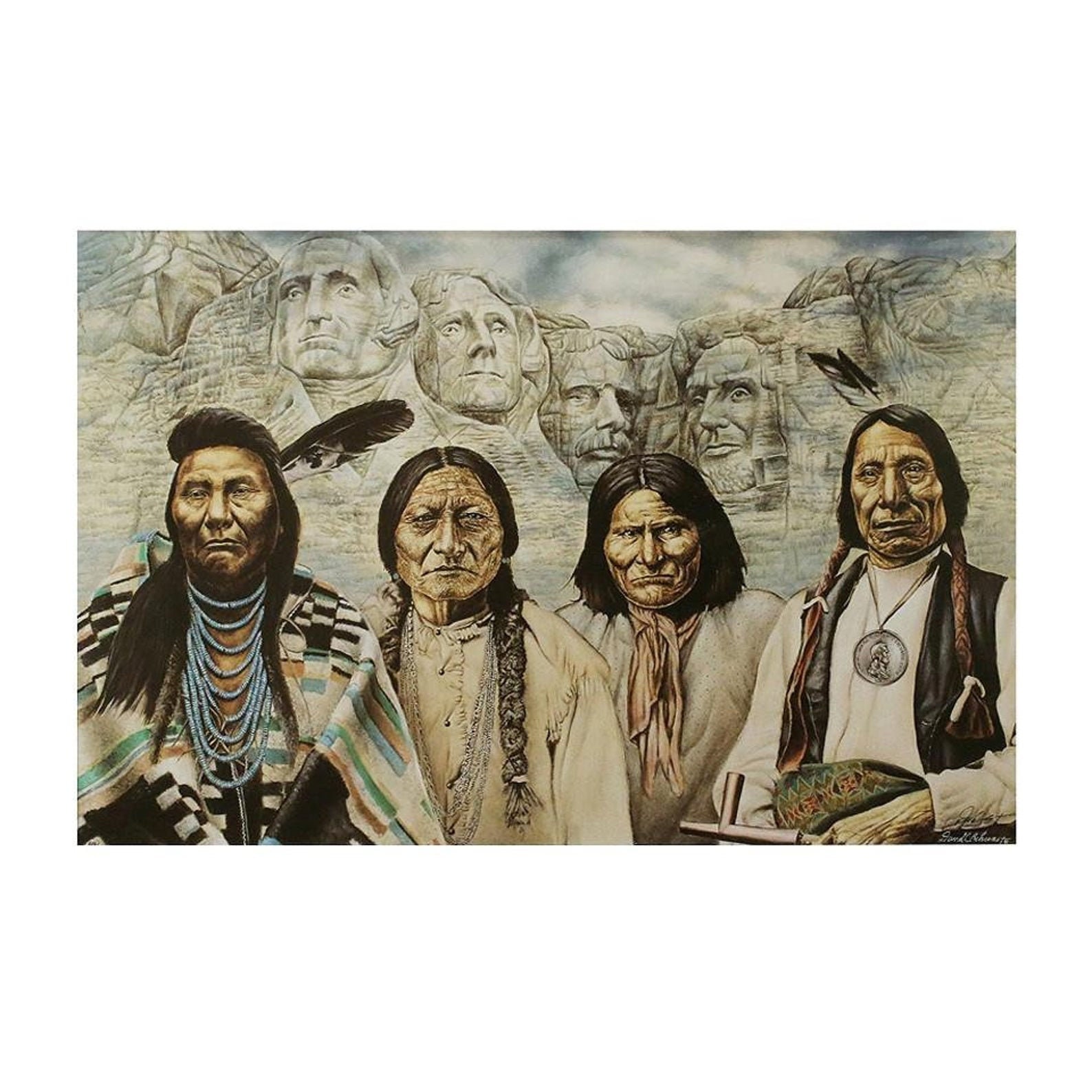
You’ve seen the photos of those four massive stone heads in South Dakota. Most people call it Mount Rushmore. But if you drive just seventeen miles down the road, you’ll find something even bigger. Way bigger. It’s a mountain being turned into a man on a horse. People often call it the Native American Mount Rushmore, but its real name is the Crazy Horse Memorial.
It’s been under construction since 1948.
Think about that. They’ve been blasting granite for nearly eighty years, and it's nowhere near finished. It’s a project defined by stubbornness, scale, and a very complicated relationship with the land it sits on. Honestly, calling it the "Native American version" of Rushmore is a bit of an oversimplification. For some, it’s a tribute. For others, it’s a secondary scar on a sacred mountain range.
The Story Behind the Stone
The whole thing started because of a letter. In 1939, Lakota Chief Henry Standing Bear wrote to a Polish-American sculptor named Korczak Ziolkowski. Ziolkowski had actually worked on Mount Rushmore for a bit under Gutzon Borglum. Standing Bear was blunt. He told the sculptor, "My fellow chiefs and I would like the white man to know the Red man has great heroes, too."
He wasn't just asking for a statue. He was asking for a response to the four faces carved into the Paha Sapa—the Black Hills.
The Lakota consider the Black Hills the "Heart of Everything That Is." To have the faces of four American presidents carved into a mountain there was, to put it lightly, a slap in the face. Standing Bear wanted something that reclaimed that narrative. Ziolkowski arrived in the Black Hills with almost nothing. He started with a tent and a dream that many locals thought was completely insane. He was forty years old when he hit the first chisel. He died at seventy-four, and the work passed to his wife, Ruth, and their ten children.
Why is it Taking So Long?
This is the question everyone asks. If you visit, you'll see the face of Crazy Horse—it was finished in 1998. It’s 87 feet tall. For context, the heads on Mount Rushmore are only 60 feet tall. But the rest of the mountain? It still looks like a mountain.
The scale is hard to wrap your head around.
When it's done—if it's ever done—the sculpture will be 641 feet long and 563 feet high. Crazy Horse’s outstretched arm alone will be 263 feet long. You could fit all of Mount Rushmore inside the mane of the horse.
Here’s the kicker: they don't take federal money.
The Ziolkowski family has famously turned down millions in government grants multiple times. Why? Because they don't want the government telling them how to run the project or when to finish. They rely entirely on admission fees and private donations. That’s why progress feels like it’s moving at a glacier's pace. It’s a slow-motion explosion. They use precision blasting to move thousands of tons of rock, then they spend years refining the surface.
The Controversy You Won't See in the Gift Shop
You might assume every Native American loves the idea of the Native American Mount Rushmore. They don't.
It’s complicated.
Crazy Horse himself was a man who hated having his picture taken. He lived a life of humility. He was a warrior who defended his people’s way of life against the very government that carved the presidents nearby. Some Lakota, like the late activist Russell Means, argued that carving any mountain is a violation of the Earth. They see it as double-downing on the desecration of the Black Hills.
Essentially, the argument is: "The white man carved up our mountain, so now we’re going to carve up another one to show them up?"
To some, it feels like fighting fire with fire, but both sides end up with a burnt mountain. However, many others see it as a vital educational tool. The site isn't just a statue. It’s home to the Indian Museum of North America and a university and medical training center for Native Americans. The mission expanded far beyond just rock and dynamite.
What Most People Get Wrong About the Design
If you look at the model in the visitor center, Crazy Horse is pointing toward the horizon. Legend says a white man once asked him, "Where are your lands now?" and he pointed over his horse's head and said, "My lands are where my dead lie buried."
That’s what the statue depicts.
But there’s no actual photo of Crazy Horse. He never sat for a portrait. The face you see on the mountain is an interpretation—a conceptual image of a "Great Spirit" rather than a literal likeness. Ziolkowski spent years studying Lakota culture and talking to elders to try and capture the essence of the man, rather than a forensic reconstruction.
The Engineering Nightmare
Granite isn't easy to work with. It’s full of "vugs"—pockets of air or softer minerals that can cause the rock to crack unexpectedly. In the early days, Ziolkowski had to climb 741 wooden steps every morning just to get to the top. He used a heavy, hand-cranked compressor that often broke down.
Today, they use lasers and sophisticated geological mapping.
They’ve moved millions of tons of rock. To give you an idea of the math, they are currently focusing on the "Thin Plate" (the horse's mane) and the hand. The hand alone is a massive engineering feat because it’s an outcrop that has to support its own weight against South Dakota's brutal winters and high winds.
Planning Your Visit: The Real Experience
If you go, don't expect a quick 20-minute photo op like the roadside pullouts at Rushmore.
- The Laser Show: During the summer, they do a "Legends in Light" show at night. They project animations onto the mountain. It’s a bit touristy, but it’s actually a great way to see what the finished product is supposed to look like.
- The Bus To The Base: You can pay a few extra dollars to take a bus to the base of the mountain. It’s worth it. Seeing the scale from the bottom is a totally different experience than looking through the telescopes at the center.
- The Museum: Honestly, the museum is the best part. It houses thousands of artifacts from dozens of tribes. It’s one of the best collections of indigenous history in the Midwest.
- The Rock: You can actually take a piece of the "blasted" granite home with you. There’s a giant pile of it near the exit. It’s a small thing, but it’s a tangible piece of a project that will likely outlive everyone reading this article.
The Future of the Mountain
When will it be finished? Nobody knows.
The Ziolkowski family doesn't give dates. They just say "work continues." Some critics say it’s a "perpetual construction site" designed to keep the donation money flowing. Others see it as a multi-generational masterpiece that shouldn't be rushed.
Whether you see the Native American Mount Rushmore as a noble tribute or a controversial landmark, you can't deny the sheer audacity of it. It is a man-made mountain being born in a place that has seen more conflict than almost anywhere else in the American West.
It stands as a reminder that history isn't just something that happened in the past—it’s something people are still actively carving out of the earth today.
Actionable Insights for Travelers
- Avoid the Crowds: Visit in late September. The weather is crisp, the bikers from the Sturgis rally are gone, and the visibility is usually perfect.
- Check the Blast Schedule: They don't blast every day, but when they do, they usually announce it on their social media or website. Seeing a mountain explode in person is something you don't forget.
- Budget for Both: If you’re doing the "Black Hills Loop," visit Mount Rushmore in the morning for the light, then head to Crazy Horse in the afternoon. The sun hits the face of Crazy Horse better in the late day.
- Support the Education: If you want your money to go toward the mission rather than just the gift shop, look into the scholarship programs at the Indian University of North America, which is located right on the grounds.
The Black Hills hold many secrets, and this giant stone warrior is just the most visible one. It’s a place of deep silence, massive explosions, and a story that is still being written—one inch of granite at a time.