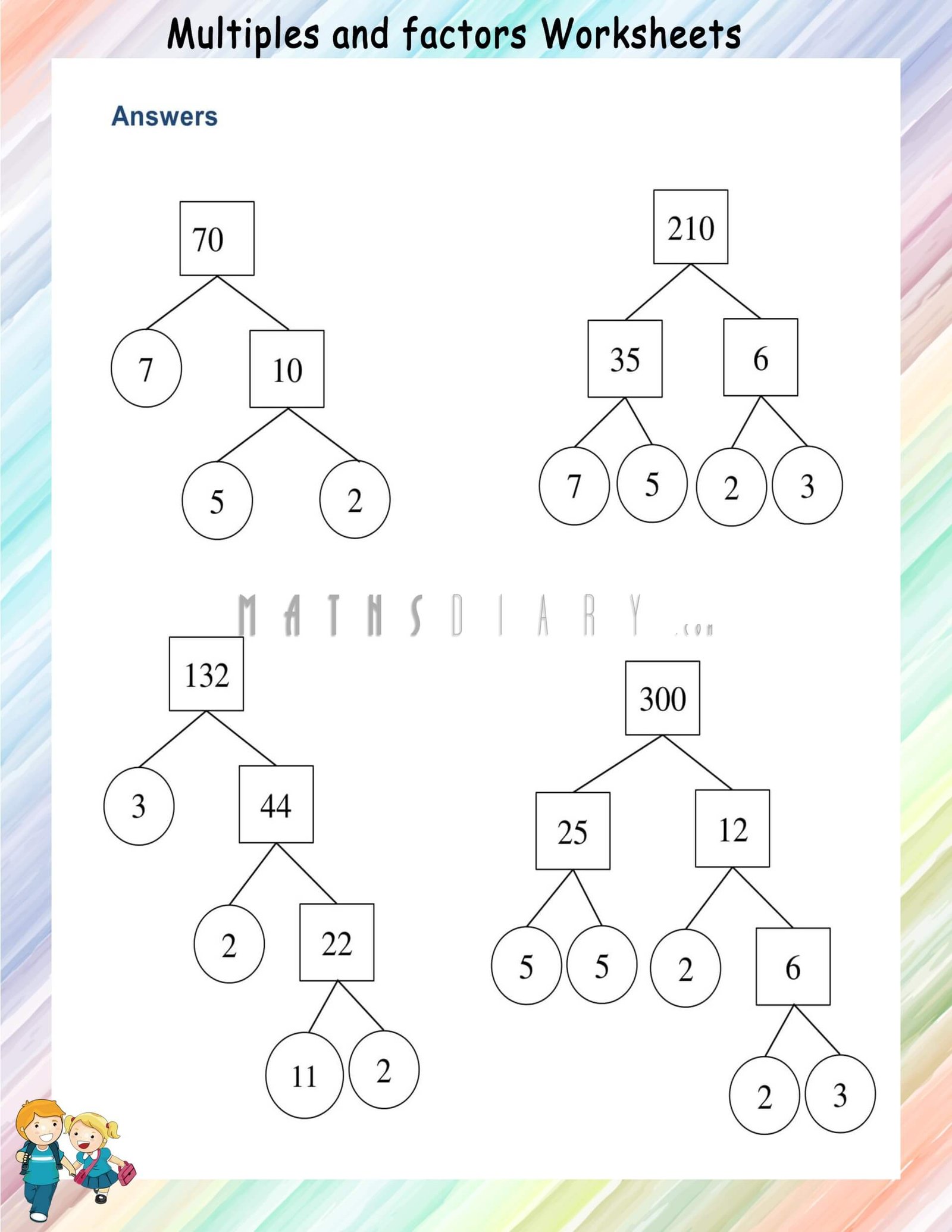
You probably haven’t thought about a factor tree since you were sitting in a cramped plastic chair, staring at a chalkboard and wondering when lunch was. It’s one of those math concepts that feels like busywork. You draw some branches, split a number into two smaller ones, and keep going until you hit a dead end. But honestly? Understanding what a factor tree is—and more importantly, how it helps you see the "DNA" of a number—is the secret to making sense of everything from digital encryption to high-level data science.
Numbers aren't just random digits. They have structures. A factor tree is basically a visual map that breaks a composite number down into its most basic, unbreakable building blocks: prime numbers. It’s the skeleton of the number. If you know the prime factors, you know exactly how that number behaves in the wild.
What is a Factor Tree and How Does it Work?
At its core, a factor tree is a diagram used to find the prime factorization of a number. You start with a number at the top. Then, you branch out into two factors—any two numbers that multiply together to give you that top number. You keep branching until every "leaf" at the bottom of the tree is a prime number.
A prime number, for a quick refresher, is a number greater than 1 that can only be divided by 1 and itself. Think 2, 3, 5, 7, 11, and so on. Once you hit these, the branch stops growing. It's dead.
Let’s look at an illustrative example with the number 48. You could start by splitting 48 into 6 and 8. Then, you split 6 into 2 and 3. Since 2 and 3 are prime, those branches are done. Now, go back to the 8. You split that into 2 and 4. The 2 is done, but the 4 splits one last time into 2 and 2.
When you gather all those bottom numbers, you get $2 \times 2 \times 2 \times 2 \times 3$, or $2^4 \times 3$. That’s the "prime signature" of 48. It doesn't matter if you started with $4 \times 12$ instead of $6 \times 8$; you always end up at the same destination. Math is cool like that. It’s predictable.
Why We Use Trees Instead of Just Listing Numbers
Lists are boring. They’re hard for our brains to process quickly. The factor tree works because it utilizes spatial reasoning. When you see the hierarchy, you understand the relationship between the parts and the whole.
It’s also about the Fundamental Theorem of Arithmetic. That sounds incredibly fancy, but it basically states that every integer greater than 1 is either a prime number itself or can be represented as a unique product of prime numbers. There is only one way to break down 48 into primes. The factor tree is just the shovel we use to dig up that specific, unique root system.
The Prime Factorization Connection to Real Life
You might think this is just for kids learning fractions. It’s not.
Cryptography—the stuff that keeps your credit card info safe when you buy stuff on Amazon—relies heavily on the difficulty of factoring massive numbers. While a factor tree for a 100-digit number would be physically impossible to draw on paper, the logic remains the same. Computer scientists use algorithms to do what we do with factor trees, looking for those prime building blocks. If factoring were easy for computers, the entire internet's security would collapse overnight.
In music theory, factorization helps explain why certain intervals sound "pure" to our ears. The physics of sound is based on frequency ratios. When those ratios involve small prime factors, the sounds harmonize. When the factors are messy or large, things start to sound dissonant.
Common Mistakes People Make with Factor Trees
People mess this up all the time. The most common error? Forgetting that 1 is not a prime number. If you put 1 in your factor tree, you could literally keep branching forever. It’s a mathematical "hall of mirrors" that leads nowhere.
Another hiccup is stopping too early. Just because a number is large doesn't mean it's prime. Take 91. It looks prime. It feels prime. But it’s actually $7 \times 13$. If you don't know your divisibility rules—like checking if the digits add up to a multiple of 3—you’ll end up with a "stunted" tree that isn't actually finished.
Quick Divisibility Hacks for Better Trees
To make your factor tree move faster, you need shortcuts.
- If a number ends in an even digit, start with 2.
- If it ends in 0 or 5, use 5.
- If the sum of the digits is divisible by 3, the whole number is divisible by 3.
These aren't just tricks; they are the mechanics of number theory in action.
Different Ways to Visualize Factors
The factor tree isn't the only game in town. Some teachers prefer the "ladder method" or "upside-down division." In that version, you stack the divisions like a cake.
Is one better? Not really. It’s about how your brain organizes data. The factor tree is more organic and visual, whereas the ladder is more linear and organized. For most visual learners, the tree wins every time because you can see the "weight" of the number as the branches get heavier on one side.
Moving Toward Advanced Math
Once you master the factor tree, you can find the Greatest Common Factor (GCF) and the Least Common Multiple (LCM) in seconds.
To find the GCF of two numbers, you draw trees for both and see which prime factors they have in common. Multiply those shared factors, and boom—there’s your GCF. For the LCM, you take the highest power of every prime factor that appears in either tree. It’s a systematic way to handle numbers that otherwise feel overwhelming.
Taking Action: Practice for Mental Sharpness
If you want to keep your brain sharp or help a kid with their homework without looking confused, start with these steps.
First, memorize the first ten prime numbers: 2, 3, 5, 7, 11, 13, 17, 19, 23, 29. Having these locked in makes the "stops" on your tree obvious.
Second, try factoring a random number in your head while you're waiting in line. Take a number like 60. $6 \times 10$. 6 becomes $2 \times 3$. 10 becomes $2 \times 5$. Total: $2^2 \times 3 \times 5$.
Finally, use digital tools to verify your work if you’re dealing with massive numbers, but don’t rely on them for the logic. The value isn’t in the answer; it’s in the process of breaking a complex system down into its simplest parts. That’s a skill that applies to coding, logic, and even managing your personal finances.
Understanding what a factor tree is gives you a deeper appreciation for the hidden order in the world of mathematics. It’s not just a school drawing—it’s a map of the universe’s numerical DNA.
Next Steps for Mastery:
- Practice drawing trees for numbers between 100 and 200 to test your divisibility rule knowledge.
- Review the difference between composite and prime numbers to ensure you know exactly where to end your branches.
- Explore how prime factorization is used in the RSA encryption algorithm if you're interested in cybersecurity.