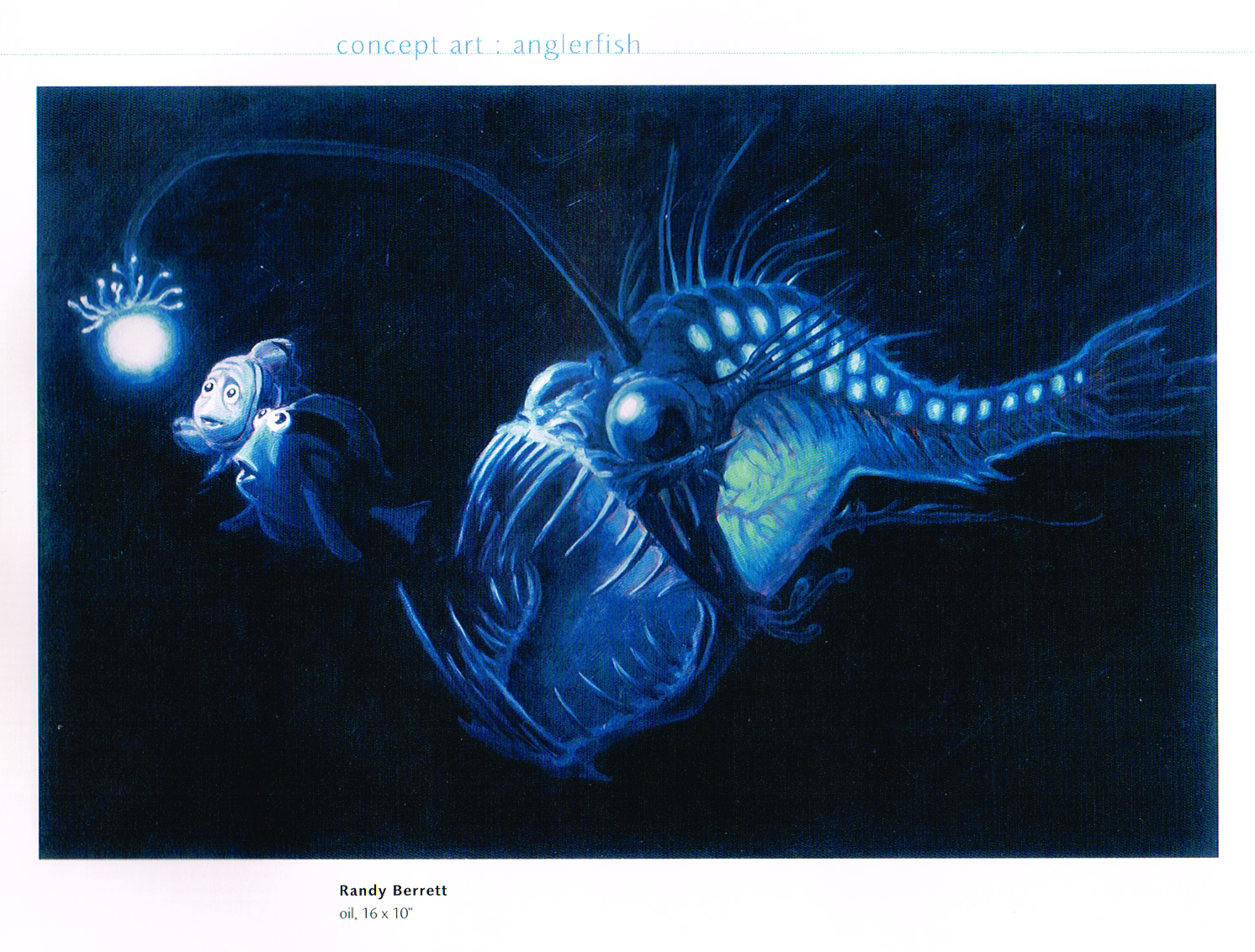
You remember the light. It starts as a tiny, flickering speck in the oppressive ink of the midnight zone. Dory, ever the optimist, thinks it’s a soul or something spiritual. Marlin just wants to go home. Then the music shifts—Thomas Newman’s score gets jagged and sharp—and suddenly, there are teeth. Huge, translucent, needle-like teeth. The finding nemo anglerfish isn't just a jump scare; it's a core memory for an entire generation of kids who realized, right then and there, that the ocean is basically a giant, wet haunted house.
Honestly, Pixar didn’t have to go that hard. But they did.
They captured something visceral about the deep sea that most nature documentaries at the time were still trying to figure out how to film. It’s the contrast that gets you. You have these two brightly colored, "safe" characters drifting into a void where physics and biology start playing by different, much meaner rules. The anglerfish represents the moment Finding Nemo stops being a cute fish-out-of-water story and starts being a survival horror movie.
What Pixar Got Right (and What They Changed)
When the animation team at Pixar started looking into the Melanocetus johnsonii—better known as the Humpback Blackdevil—they realized they didn't need to invent a monster. Nature had already built one. Real-life anglerfish live in the bathypelagic zone, roughly 3,000 to 13,000 feet down. Up there, near the surface, there's sunlight and coral. Down there, it’s 35 degrees Fahrenheit and the pressure is enough to crush a human like a soda can.
In the film, the finding nemo anglerfish is massive. It’s depicted as being significantly larger than Marlin and Dory combined. In reality? Most of these deep-sea terrors are tiny. A female Humpback Blackdevil usually tops out at about five or six inches. You could hold one in your hand, though you probably wouldn’t want to. Pixar scaled it up for dramatic effect, making it feel like a hulking beast, which works perfectly for the pacing of the chase.
Then there’s the light. The "fishing pole" is called an illicium, and the glowing bulb at the end is the esca. It doesn't just glow because of magic; it's a symbiotic relationship with bioluminescent bacteria. This isn't a steady, warm glow like a bedside lamp. It’s a flickering, eerie lure designed to trick starving creatures into thinking they’ve found a snack, only to realize they are the snack.
The Biology of a Nightmare
Let's talk about those teeth. If you look closely at the finding nemo anglerfish, the teeth are everywhere. They're even on the tongue. In the real world, these teeth are often angled inward. It’s a one-way street. Once a prey item enters that mouth, there is no physical way to swim back out. The fish basically "walks" its jaws over the prey.
What's really wild is how they eat. Because food is so scarce in the deep, anglerfish are opportunistic feeders. They have distensible stomachs, meaning they can expand to hold prey much larger than themselves. If Pixar had been 100% accurate, that anglerfish could have swallowed Marlin and Dory in one go and just sat there for a month digesting them.
- Gender Roles: The fish in the movie is definitely a female. You can tell because she’s huge and has the lure.
- The Male Problem: Male anglerfish are tiny, pathetic little things. They don't even have functional digestive systems in some species. Their only job is to find a female, bite her, and literally fuse into her body until they become a parasitic sperm-producing appendage.
- Vision: Despite having those big, glowing eyes in the movie, most deep-sea anglerfish have pretty poor eyesight. They rely more on their lateral line system to detect vibrations in the water.
Why the Animation Still Holds Up
Look at the texture. If you rewatch that scene in 4K today, the skin of the finding nemo anglerfish looks leathery, scarred, and wet. It doesn't have scales like Marlin. Deep-sea fish often have skin that absorbs light rather than reflecting it, making them nearly invisible until they want to be seen. Pixar’s artists captured that "unpleasant to touch" vibe perfectly.
The lighting was a massive technical hurdle in 2003. They had to create a "volumetric" light source that felt like it was passing through murky, sediment-heavy water. Every time the fish moves, the shadows dance across the canyon walls. It creates a sense of claustrophobia even though they're in the vast ocean. It’s a masterclass in using "negative space"—the darkness is just as much a character as the fish itself.
The Midnight Zone is Actually More Terrifying
As scary as the finding nemo anglerfish is, the actual midnight zone is weirder. We’ve only explored a tiny fraction of it. There are things down there like the barreleye fish, which has a transparent head, or the giant isopod, which is basically a two-foot-long underwater cockroach.
Pixar chose the anglerfish because it’s the "icon" of deep-sea dread. It’s the perfect foil for Dory’s lightheartedness. When she sings "just keep swimming" while staring into the maw of a literal demon, it highlights her character's biggest strength and her biggest flaw: she’s fearless because she doesn’t understand the stakes.
Beyond the Movie: Real World Impact
Interestingly, Finding Nemo actually helped deep-sea biology. Before the movie, most people had never even heard of an anglerfish. The film sparked a massive wave of interest in marine biology. Suddenly, kids wanted to know about the Mariana Trench and bioluminescence.
However, it also painted a bit of a "villain" picture. In reality, these fish are struggling. Climate change is warming the oceans, and even the deep-sea currents are changing. Deep-sea mining is also a growing threat, kicking up sediment that can choke the delicate filters of the organisms these fish rely on for food. The finding nemo anglerfish might be a monster on screen, but in the real world, it's a fragile part of an ecosystem we're only just beginning to understand.
Common Misconceptions About the Scene
People often ask why the fish didn't just eat them immediately. From a narrative standpoint, we need the chase. From a biological standpoint, deep-sea predators are often slow. They are built for "sit and wait" predation, not high-speed pursuits. If an anglerfish misses its first strike, it has wasted a massive amount of energy. In the movie, the fish is surprisingly agile, which is a bit of "movie magic." Real ones are more like floating traps than guided missiles.
Also, the "mask" Dory finds—the one that says "P. Sherman, 42 Wallaby Way, Sydney"—is the only reason they survive. The light from the anglerfish allows them to read it. It’s a brilliant bit of writing. The very thing trying to kill them is the only thing providing the clarity they need to find Nemo.
How to Learn More (The Right Way)
If you're genuinely fascinated by the creature that inspired the finding nemo anglerfish, don't just stick to the movie. There are some incredible resources out there that show these animals in their actual habitat.
- MBARI (Monterey Bay Aquarium Research Institute): They have some of the best high-definition footage of deep-sea anglerfish ever recorded. Their YouTube channel is basically a real-life version of the "trench" scene, minus the talking fish.
- The Blue Planet Series: Specifically the "Deep" episodes. It provides the context of how these fish survive without a consistent food source.
- National Geographic: They’ve done extensive work on the "Black Sea Devil" species, which is the closest match to the Pixar design.
The next time you’re watching that scene, pay attention to the silence right before the attack. That’s the most accurate part. In the deep ocean, there is no sound. Just the pulse of your own blood and the faint, glowing promise of something that definitely wants to eat you.
Actionable Insights for Ocean Lovers
- Support Deep-Sea Research: Organizations like the Ocean Conservancy work to protect these habitats from industrial runoff and unregulated mining.
- Check Out Local Aquariums: While you won't find a living deep-sea anglerfish in a tank (the pressure change would kill them instantly), many exhibits like the Monterey Bay Aquarium have incredible deep-sea "Spirit" collections (preserved specimens) that let you see the scale of these creatures up close.
- Educate Others: Share the "Male Parasitism" fact at your next trivia night. It’s weird, gross, and 100% true—the kind of thing that makes people realize nature is stranger than any movie script.
- Reduce Plastic Use: Even the deep-sea trenches are showing signs of microplastic pollution. Protecting Marlin's home helps protect the anglerfish's home too.
The finding nemo anglerfish remains one of the most effective uses of biology in animation history. It took a nightmare from the bottom of the world and turned it into a cinematic icon. Whether you find it terrifying or fascinating, it's a testament to the weird, wild reality of our oceans.