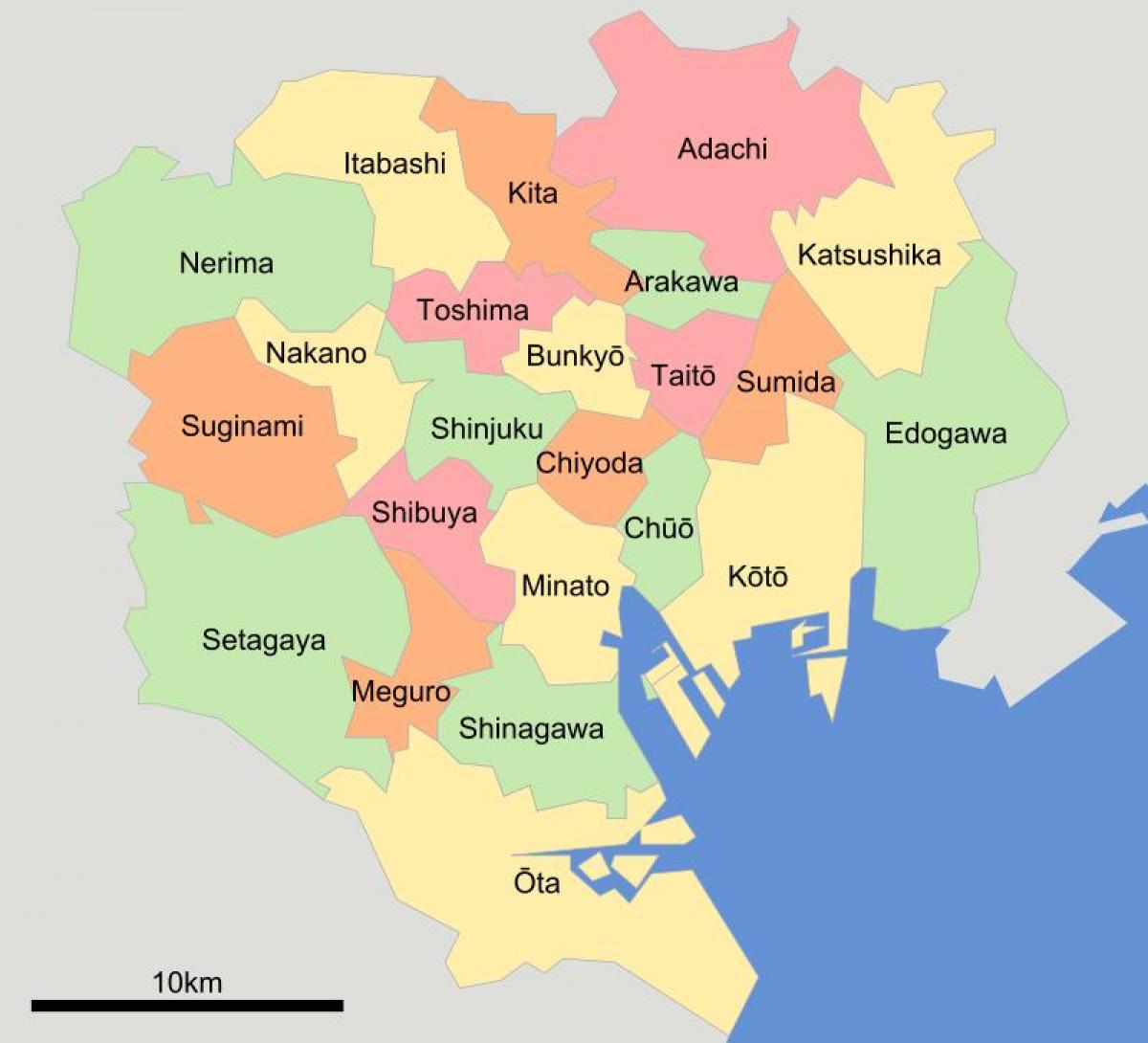
Tokyo is huge. Like, mind-bogglingly huge. If you’ve ever looked at a map of Tokyo with districts and felt your brain start to melt, you aren't alone. It’s not just one city; it’s a massive collection of 23 special wards, dozens of cities, and even some far-flung islands that somehow all fall under the "Tokyo" umbrella.
Honestly, most people get it wrong because they treat Tokyo like New York or London. It isn't. It’s a network of "villages" that grew until they bumped into each other. If you want to actually understand the layout, you have to stop looking at the lines and start looking at the hubs.
The 23 Special Wards: The Core of the Map
When people talk about Tokyo, they usually mean the 23 Special Wards (tokubetsu-ku). This is the heart of the beast. If you're looking at a map of Tokyo with districts, this central cluster is where the action is.
Shinjuku is the big one. It’s the administrative heart. You've got the Tokyo Metropolitan Government Building there, which is free to enter and gives you a bird's-eye view of the sprawl. It’s also home to the world's busiest train station. Over 3.5 million people pass through Shinjuku Station every single day. That's more than the entire population of Chicago squeezed into one transit hub.
Then there's Shibuya. You know the crossing. It’s the "youth" district, but it’s becoming much more corporate lately with the "Shibuya Scramble Square" development. Just a stone's throw away is Minato, which is where the money is. Think Roppongi, Akasaka, and the iconic Tokyo Tower. Minato is home to most of the foreign embassies, so it feels a bit more international, though sometimes a bit sterile compared to the grit of the northern wards.
The Yamanote Line: Your Secret Navigation Tool
The easiest way to read a map of Tokyo with districts is to find the green circle. That’s the JR Yamanote Line. It’s a loop train that hits almost every major district you’d actually care about.
If it's on the loop, it's central. If it's inside the loop, it's expensive.
Chiyoda sits right in the middle. This is where the Emperor lives in the Imperial Palace. You won't find much nightlife here because it’s mostly government offices and historical sites. It’s the quiet, dignified center of a very loud city. Contrast that with Taito, home to Ueno and Asakusa. This is the "Low City" or Shitamachi. It feels older. The buildings are shorter. The streets are narrower. Senso-ji Temple is the big draw here, and it’s one of the few places where you can still feel the ghost of the Edo period.
West vs. East: The Great Divide
There’s a real vibe shift when you cross from the west side of the map to the east.
The West (Setagaya, Suginami, Nakano) is where people actually live. Setagaya is the most populous ward. It’s leafy, residential, and has that "cool neighborhood" vibe in places like Shimokitazawa. People there wear a lot of linen and carry expensive cameras.
The East (Adachi, Katsushika, Edogawa) is different. It’s traditionally working-class. It’s lower-lying land—literally, some parts are below sea level—and it's where you find the Tokyo Skytree in Sumida. Life moves a bit slower here. It’s less "Instagrammable" in the neon-lights sense, but it’s way more authentic if you want to see how a Tokyoite actually spends their Sunday.
Why Chuo Ward Isn't Just "Central"
Don't let the name fool you. Chuo means central, but it’s not the geographical center. It’s the commercial center. This is where Ginza lives.
Ginza is fascinating because it was the first place to modernize. It has the oldest department stores like Wako and Mitsukoshi. If you're looking at your map of Tokyo with districts, Chuo hugs the water. This matters because it was built on reclaimed land. Even today, the district of Tsukiji (famous for the old fish market) reminds you that Tokyo is, and always has been, a port city. The fish market moved to Toyosu in Koto ward, but the outer market in Chuo still hums with energy every morning.
The Outliers: Western Tokyo and the Islands
If you zoom out on a map of Tokyo with districts, you'll see a big tail wagging to the west. This is the Tama Area. It’s technically Tokyo, but it feels like the suburbs or even the mountains.
Places like Mitaka (home of the Ghibli Museum) and Musashino are technically cities, not wards. They have their own local governments. Further west, you hit Ome and Okutama. You can actually go hiking and see waterfalls in Tokyo. It sounds fake, but it's true. You’re still on the same map, still using the same Suica card, but you’re surrounded by cedar trees instead of skyscrapers.
And then there are the islands.
Did you know Tokyo has tropical islands? The Izu Islands and the Ogasawara Islands are part of Tokyo. The Ogasawara chain is about 1,000 kilometers south of the city. You have to take a 24-hour ferry to get there. There are no airports. You're still in Tokyo, but you're looking at dolphins and palm trees. It’s the ultimate trivia fact to annoy your friends with.
How to Actually Use This Information
Navigating the map of Tokyo with districts requires a shift in perspective. Stop trying to memorize the whole thing. It’s too big. Instead, pick a "base" ward that fits your personality.
- For the Night Owl: Stick to Shinjuku or Minato. The lights never go out.
- For the History Buff: Spend your time in Taito or Chiyoda.
- For the Hipster: Head west to Setagaya or Nakano.
- For the Luxury Shopper: Chuo is your playground.
The real magic happens in the transition zones. The walk from Shibuya to Harajuku (which is in Shibuya ward but feels like its own planet) takes you through Omotesando—the "Champs-Élysées of Tokyo." It’s a short walk, but you cross three distinct sub-cultures in twenty minutes.
Common Misconceptions About Tokyo Geography
A lot of people think Akihabara is its own district. It's not. It’s actually split between Chiyoda and Taito, though most of the "Electric Town" is in Chiyoda.
Another one? Roppongi isn't a ward. It’s a neighborhood inside Minato.
Understanding these hierarchies helps when you're looking at addresses. A typical Tokyo address works backward: Postal code, Prefecture (Tokyo-to), Ward or City (like Shinjuku-ku), Neighborhood (like Kabukicho), then the block and building numbers. It’s a logic puzzle.
The complexity of the map of Tokyo with districts is actually what makes the city work. Because it’s so decentralized, every ward has its own "downtown." You don't have to commute to one single center to find work or fun. Every district is a self-contained ecosystem.
Actionable Steps for Navigating Tokyo
- Download a specialized transit app. Google Maps is fine, but Japan Transit by Jorudan or NAVITIME often give better platform-specific info for those massive district stations.
- Learn the "Ku" suffix. If a place ends in -ku (like Shinjuku-ku), it’s one of the 23 special wards. If it ends in -shi (like Machida-shi), it’s a separate city in the western suburbs.
- Use the major hubs as anchors. If you get lost, just find the nearest JR Yamanote station. It will eventually take you back to a district you recognize.
- Look for the "Chome". Neighborhoods are divided into numbered sections called chome. Usually, 1-chome is the area closest to the main station or government office.
- Walk the boundaries. Some of the coolest cafes and shops are located right on the edge where two districts meet, like the border between Meguro and Setagaya near Daikanyama.
Tokyo isn't meant to be "solved." It’s meant to be wandered. Use the map as a suggestion, not a law. The best parts of the city are usually the ones that don't have a famous name on the district label.