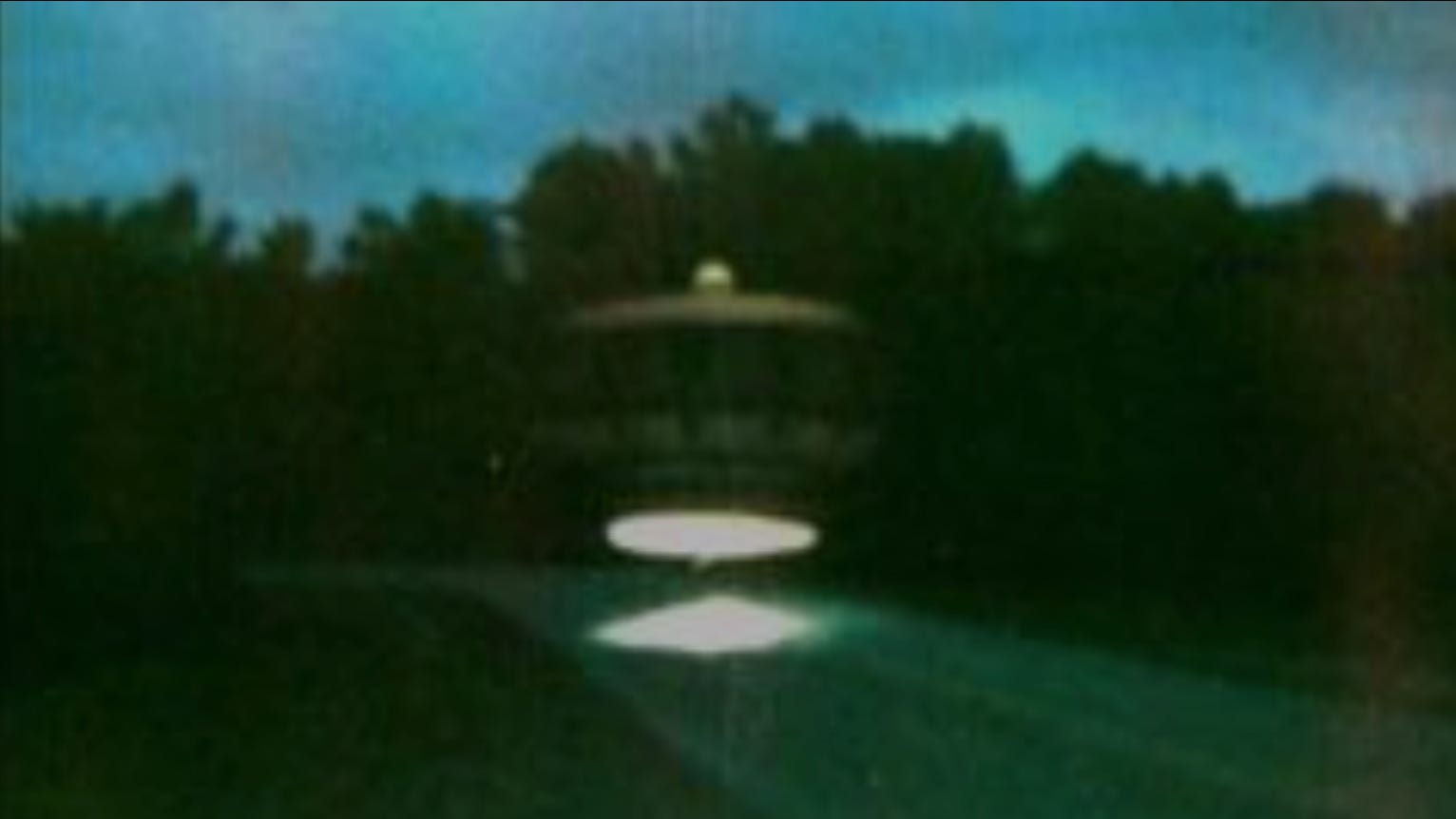
Ed Walters was just a local builder in a quiet Florida panhandle town. Then, on November 11, 1987, he stepped out his back door and saw something that would basically change the trajectory of UFO research forever. He grabbed a Polaroid camera. He started snapping. What he captured were the Gulf Breeze UFO photos, a series of images showing a distinct, glowing, bell-shaped craft hovering over the trees.
It wasn’t just one photo. It was dozens.
Most UFO sightings are grainy blobs. They’re distant lights or "out of focus" smudges that could be anything from a high-altitude balloon to a smudge on the lens. But the Gulf Breeze images were different. They were crisp. They were close. They looked like something straight out of a big-budget sci-fi movie, complete with a glowing "power source" at the bottom and portholes along the side.
Naturally, the world lost its collective mind.
The Night Everything Changed in Gulf Breeze
Gulf Breeze is a scenic little spot near Pensacola. It’s the kind of place where people move for the water and the quiet. But in late 1987 and throughout 1988, the quiet vanished. Ed Walters claimed that not only was he seeing these crafts, but he was also experiencing telepathic communication with the entities inside them.
He described a humming sound. A blue beam of light that once lifted him off the ground. It sounds wild, right? It sounds like the plot of an X-Files episode—which, funny enough, the show eventually referenced.
The local newspaper, the Gulf Breeze Sentinel, started publishing the photos. People were divided immediately. You had the MUFON (Mutual UFO Network) investigators, like Walter Andrus and Dan Wright, who spent hundreds of hours vetting Ed’s story. They actually believed him at first. They looked at the double-exposure possibilities and the physical evidence at the site. For a while, Gulf Breeze became the UFO capital of the world. Thousands of people flocked there with binoculars and cameras, hoping to catch a glimpse of the "bubba" (the nickname locals gave the craft).
Why the photos looked so "Real"
The sheer volume of the Gulf Breeze UFO photos is what makes the case so sticky. Usually, a hoaxer does one or two and calls it a day. Walters produced a literal stack of them. Some showed the craft behind trees. Others showed it reflecting off the water of the sound.
Walters used a Polaroid Sun 600. Back then, people thought Polaroids were "un-fakeable" because the film developed right in front of your eyes. There was no darkroom trickery involved, or so the logic went. If you see the photo develop and the UFO is there, it must have been in front of the lens. Simple. Or maybe not.
The Model in the Attic and the Skeptical Turn
Everything started to unravel in 1990. Ed Walters had moved out of his house on Silverthorn Road. The new owners, Robert and Sarah Menzer, were doing some routine work when they found something tucked away in the insulation of the attic.
It was a model.
Specifically, it was a model made of foam plastic, drafting paper, and gelled windows that looked suspiciously like the craft in the Gulf Breeze UFO photos. The discovery was a bombshell. Skeptics like Philip J. Klass, a legendary UFO investigator and noted debunker, had already been picking apart the physics of the photos. He pointed out that in some shots, the "UFO" seemed to be missing the correct perspective or lighting for an object of its alleged size.
The defense of Ed Walters
Walters, for his part, never backed down. He claimed the model was planted by people—possibly government agents—trying to discredit him. He even suggested that he had been warned that a "fake" craft would be placed in his home.
It sounds like a convenient excuse. But here’s the thing: Other people in Gulf Breeze saw stuff too.
That’s the part that keeps the mystery alive. If Ed was just a guy with a model and a Polaroid, how do you explain the dozens of other witnesses? People like Patrick Cyr, a local resident, and even city officials claimed to have seen strange lights in the sky during that same period. Were they all in on it? Was there a mass contagion of sightings? Or was Ed Walters just the most visible part of a very real phenomenon that he decided to "help along" with some creative photography?
Analyzing the "Blue Beam" and Double Exposures
If you look closely at the Gulf Breeze UFO photos, some of them have a strange, ethereal quality. The "blue beam" photos are particularly famous. In these shots, a solid column of blue light appears to be shooting down from the craft.
Optical experts have spent years arguing over whether these could be created using double exposures. In the late 80s, you could do this with a Polaroid by partially covering the lens, taking a shot, and then taking another shot on the same frame. It’s tricky. It requires a steady hand and a lot of practice.
The complexity of some of Walters' shots would have required him to be an absolute master of primitive "in-camera" special effects. Some say he was. Others say the light signatures in the photos—the way the light "blooms" around the edges—suggest a physical object that was actually emitting light in the environment.
The Legacy of the Florida UFO Craze
We have to look at the context of the time. The 80s were a boom time for UFO lore. Communion by Whitley Strieber had just been published. The "gray alien" archetype was becoming part of the zeitgeist. Gulf Breeze tapped into that perfectly.
The case changed how organizations like MUFON handled evidence. It taught investigators to be more cynical, to look for the "model in the attic" before jumping to extraterrestrial conclusions. But even now, if you go to a UFO convention and bring up Gulf Breeze, you’ll get into a heated debate within five minutes.
It’s a polarizing case. It’s either the greatest hoax in the history of ufology or the most documented series of sightings we’ve ever seen. There isn’t much middle ground.
Why we still care
Honestly, we care because we want to believe. The idea that a regular guy in a baseball cap could walk out and see the "Grand Truth" of the universe is a powerful narrative. The Gulf Breeze UFO photos represent that dream. They are tactile. You can hold them. They aren't a digital file that can be AI-generated in three seconds. They are physical objects from a specific time and place.
Actionable Insights for UFO Enthusiasts
If you’re interested in diving deeper into the Gulf Breeze mystery or doing your own skywatching, here’s how to handle it like a pro:
- Read the source material: Get a copy of The Gulf Breeze Sightings by Ed Walters, but pair it with Philip J. Klass’s critiques. You need both sides to see the full picture.
- Investigate the "Multi-Witness" sightings: Focus less on Ed’s photos and more on the reports from other Gulf Breeze residents during 1987-1988. These are often much harder to explain away than a single man's photography.
- Understand the camera tech: If you’re looking at old UFO photos, learn how the cameras of that era worked. Knowing the limitations of a Polaroid Sun 600 or a 35mm film camera is the only way to spot a double-exposure hoax.
- Check the weather and flight paths: Many sightings in the Florida panhandle are easily attributed to Eglin Air Force Base or Pensacola Naval Air Station. Always cross-reference sightings with military training schedules.
- Keep an open but critical mind: The Gulf Breeze case proves that even a "proven" hoax (to some) can contain elements that remain unexplained.
The story of the Gulf Breeze UFO photos isn't just about aliens. It's about a small town, a charismatic witness, and the thin line between reality and what we desperately want to see in the night sky. Whether it was foam models or visitors from another star system, Gulf Breeze changed the way we look at the stars forever.
There’s no "closing the book" on this one. The photos exist. The witnesses are still around. And the lights over the Florida coast haven't entirely gone away.