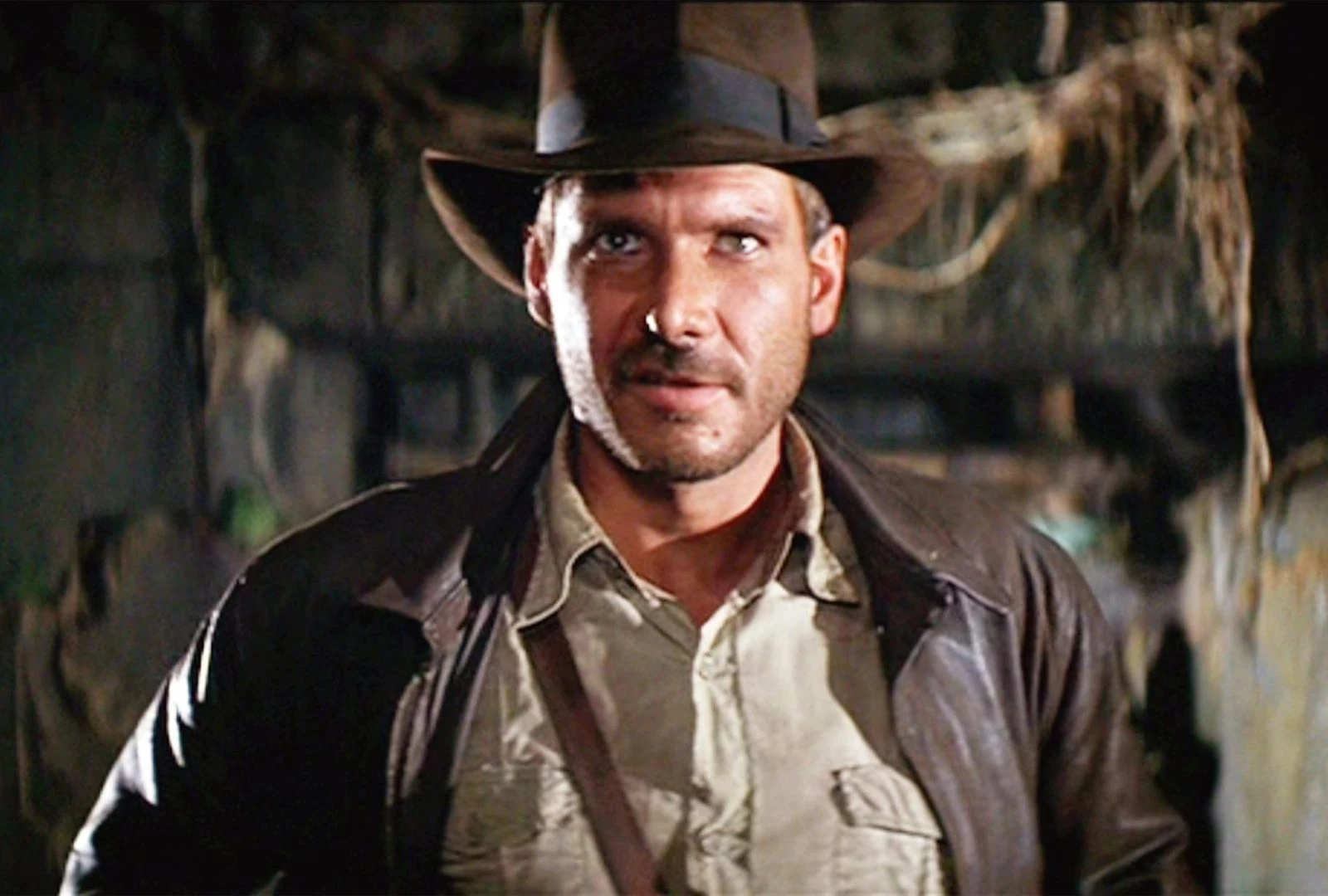
In the early nineties, George Lucas was obsessed with history. He didn't just want to make more blockbusters; he wanted to educate America’s youth through the lens of everyone’s favorite archaeologist. That’s how we got The Young Indiana Jones Chronicles. But for years, there was one major piece of the puzzle missing for casual fans: Harrison Ford.
Most people remember Sean Patrick Flanery as the teenage Indy or George Hall as the 93-year-old version with the eye patch. Yet, tucked away in 1993, Harrison Ford on Young Indiana Jones became a reality for exactly one episode. It wasn't a PR stunt or a deep-fake (thank God). It was a bearded, 50-year-old Indy hiding in a Wyoming cabin, and honestly, it’s one of the coolest—and weirdest—moments in the entire franchise.
The Mystery of the Blues: Why the Beard?
If you go back and watch the episode "Mystery of the Blues," the first thing you’ll notice is that Indy looks... different. He’s got a full, salt-and-pepper beard. For a character who is almost always clean-shaven (save for some rugged stubble), it’s a jarring sight.
There’s a very practical, non-story reason for this. In December 1992, Harrison Ford was right in the middle of filming The Fugitive. You know the one—Dr. Richard Kimble on the run, "I didn't kill my wife!"
Ford couldn't shave the beard because he was still playing the fugitive. So, when George Lucas called in a favor to get him on the show to boost ratings, the beard had to stay. Lucas didn't care. He actually sent a small crew out to Ford's own ranch in Jackson Hole, Wyoming. They filmed Ford’s scenes in just two days. Because they were on his property, the "Wyoming" setting in the show wasn't a set—it was basically Ford's backyard.
What Actually Happens in the Episode?
The episode starts in 1950. This is significant because, at the time, we had never seen Indy in the fifties. This was over a decade before Kingdom of the Crystal Skull came out.
Ford’s Indy is with a Native American friend named Greycloud, played by the late Saginaw Grant. They are being chased by guys with guns through a blizzard. Why? Because they’ve recovered a sacred peace pipe. Classic Indy.
They end up crashing their truck and hiking to a remote cabin. To pass the time while they're snowed in, Indy finds a soprano saxophone. He starts playing, Greycloud looks confused, and Indy begins reminiscing about his time in Chicago in 1920. That’s the "hook" that leads us into the main story with Sean Patrick Flanery.
A Star-Studded 1920s Chicago
The meat of the episode is actually wild. You’ve got:
- Jeffrey Wright (long before Westworld) playing jazz legend Sidney Bechet.
- Jane Krakowski as a lounge singer.
- A young Al Capone showing up before he was "Al Capone."
- Eliot Ness as Indy's roommate.
It sounds like fan fiction, but it was just a typical Tuesday for this show. The 1920s segment is about Indy learning to play the blues and getting caught up in a mob murder investigation.
Why Harrison Ford Said Yes (And No)
Originally, George Lucas wanted Harrison Ford to do the "bookends" for every single episode. He wanted the movie star to lead the audience in and out of the history lessons.
Ford said no.
Back then, movie stars didn't do TV. It was seen as a step down. Plus, Ford was one of the biggest actors on the planet; he didn't have 22 weeks to spend on a television set. He eventually agreed to this one-off appearance as a favor to Lucas. They were friends, and the show was struggling in the ratings.
When the episode aired on March 13, 1993, it actually worked. Ratings spiked by about 10 million viewers. People wanted to see the "real" Indy. But the boost was temporary. The show was just too expensive to produce—it was costing about $1.5 million per episode in early 90s money—and it was cancelled shortly after.
The "Lost" Footage and the DVD Changes
Here is where it gets frustrating for collectors. When Lucas re-released the series on DVD as The Adventures of Young Indiana Jones, he edited the episodes into feature-length TV movies. In that process, he cut out almost all of the "Old Indy" segments featuring George Hall.
Fortunately, he kept the Harrison Ford on Young Indiana Jones footage. Since Ford’s segment was already part of a two-hour special called Mystery of the Blues, it survived the edit.
If you watch it today on Disney+, you can still see Ford’s performance. It’s a bridge between the young adventurer we see in the show and the weary professor we see in the later films.
Is it actually good?
Honestly? Yeah.
Ford isn't phoning it in. He brings that grumpy, slightly annoyed charisma that defines the character. Seeing him play the saxophone to trigger an avalanche (yes, that actually happens at the end) is the kind of campy fun the franchise thrives on.
It also gave us a glimpse of an older, wiser Indy long before the 2000s sequels. The beard makes him look like a Western hero, which fits the Wyoming setting perfectly. Some fans even argued that he should have kept the beard for the later movies, calling it his "American Gandalf" look.
Actionable Next Steps for Fans
If you want to track down this piece of Indiana Jones history, here is exactly how to do it without getting lost in the various edits:
- Check Disney+: Look for The Adventures of Young Indiana Jones. You want to find "Volume 3."
- Locate "Mystery of the Blues": This is usually listed as the seventh "movie" in the third volume.
- Watch the Intro/Outro: The Harrison Ford scenes are at the very beginning and the very end. Don't skip the 1920s part, though—it’s actually one of the better episodes of the series.
- Look for the "The Fugitive" Connection: If you watch The Fugitive right after, you’ll see it’s the exact same beard and hair length. It’s a fun piece of "production synchronicity."
While it’s just a few minutes of screen time, this cameo remains the only time Harrison Ford played Indiana Jones on a scripted television show. For a franchise that spans decades, it’s a vital, if often overlooked, chapter.