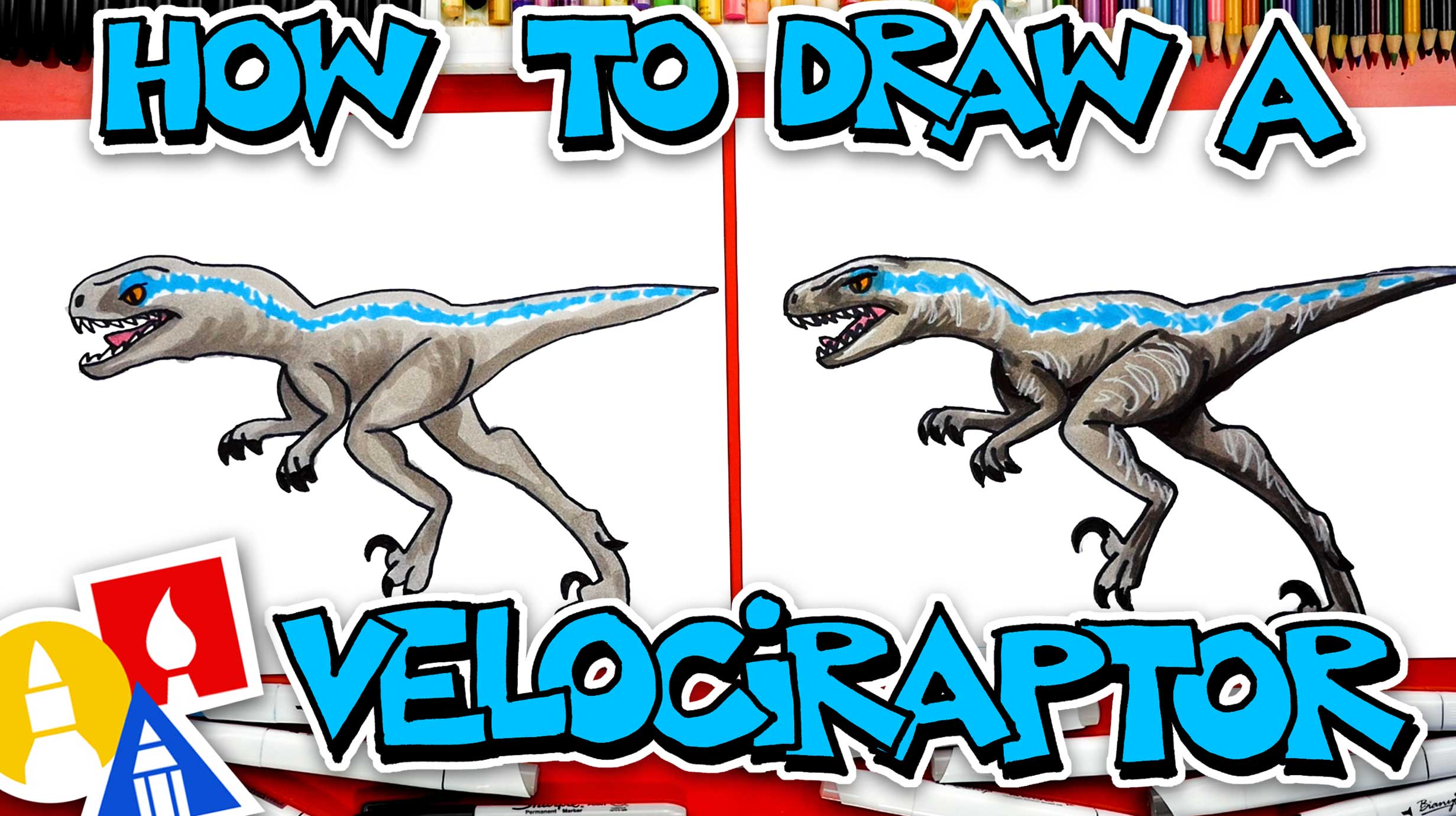
Let’s be real for a second. When most people sit down to figure out how to draw a raptor dinosaur, they’re usually thinking about Jurassic Park. They want that scaly, snarling, "clever girl" look that haunted everyone’s nightmares in the nineties. But if you actually want to draw a Velociraptor—or its bigger cousins like Deinonychus or Utahraptor—you’ve got to unlearn a lot of Hollywood tropes. Modern paleontology has basically flipped the script on what these animals looked like.
If you draw a naked, leathery lizard, you’re basically drawing a 1993 vintage movie monster, not a biological animal.
Drawing a raptor is actually a masterclass in bird anatomy. You aren't just sketching a reptile. You’re sketching a predator that is fundamentally more "hawk" than it is "crocodile." Honestly, the hardest part isn't the teeth or the terrifying toe claw; it’s getting the feathers to look like they belong on a living, breathing creature rather than a glued-on craft project.
The Skeleton is the Only Place to Start
You can't just wing it.
Start with the "S" curve. Every dromaeosaurid (that’s the fancy scientific family name for raptors) has a neck that functions like a spring. It’s elegant. If you draw the neck coming straight out of the shoulders like a dog, it’ll look wonky. You want a graceful, curved line that connects a relatively small, narrow skull to a sturdy ribcage.
The hips are huge. Seriously. Raptors had massive pelvic bones to support the heavy leg muscles needed for jumping and pinning prey. When you’re blocking out the shapes, think of the torso as an egg, but the "butt" area—the ischium and ilium—needs to be substantial.
Then there’s the tail. This is where most beginners mess up.
A raptor’s tail wasn't a wiggly whip. It was a counterbalance. Thanks to specialized bony rods called ossified tendons, the tail was actually quite stiff. It worked like a rudder. If you’re drawing a raptor in a turn, the tail should be a straight, stiff beam leaning into the curve, not a floppy snake tail.
The "Death Claw" and Foot Mechanics
We have to talk about the sickle claw. It’s the Velociraptor’s brand identity. This was the second digit on the foot, and in life, it was held retracted off the ground to keep it sharp.
When you draw the feet, remember:
Raptors were functional bipeds that walked on only two toes (the third and fourth). The "big" killing claw stayed tucked up. If you draw it dragging on the dirt, you're drawing a dull-clawed dinosaur that wouldn't last a day in the Cretaceous. The claw itself was covered in a keratin sheath, making it much longer and sharper than the fossilized bone suggests. Think of a literal meat hook.
Why Feathers Change Everything
If you’re still resistant to the idea of a "fluffy" dinosaur, look up a Golden Eagle. There is nothing cuddly about a Golden Eagle. Feathers make a predator look bigger, more intimidating, and way more realistic.
Raptors had primary feathers on their "arms." These weren't just random fuzz; they were arranged like wings. A key detail that many artists miss is that the feathers attached to the second finger of the hand, not just the forearm. When the arm is folded, it looks exactly like a bird’s wing.
Don't just draw scales. Even if you want a "scaly" face, modern research—specifically the work of paleoartists like Mark Witton—suggests that feathers likely covered most of the body for thermoregulation. You can leave the area around the eyes and the snout bare or covered in fine, pebbly scales, which gives it a more menacing, vulture-like vibe.
The tail feathers are another big one. Many species had a "fan" or a "tuft" at the very end of that stiff tail. It wasn't just for show; it probably helped with stability during high-speed chases. Use long, sweeping strokes for these. Avoid short, choppy lines that make the dinosaur look like it has a bad haircut.
Getting the Pose Right (Avoid the "Bunny Hands")
This is the biggest "tell" of an amateur dinosaur drawing.
In the old movies, raptors are often shown with their palms facing down, like they’re playing a piano or begging like a dog. This is anatomically impossible. A raptor’s wrists couldn't rotate that way. Their palms always faced each other—sort of like they were about to clap.
If you draw a raptor with "bunny hands," you’re breaking its wrists.
Instead, draw the hands "clapping." The claws should be facing inward toward the chest. This makes the raptor look ready to grab something, which is way more dynamic anyway. It changes the whole silhouette of the front of the body.
Eyes, Snouts, and the "Fear Factor"
Where do the eyes go? On the side of the head like a lizard?
Nope. Raptors had some degree of binocular vision. Their eyes faced forward enough that they could judge distances. This is a predator trait. When you’re drawing the head from a front-on or three-quarters view, make sure both eyes can see "you." It creates a much more intense, predatory stare.
The pupils are a point of debate. Some artists go with vertical slits (like a cat), but many experts argue that for an animal of that size, round pupils (like a hawk) are more likely. Round pupils feel more "intelligent" and piercing, which fits the raptor's reputation.
Texture and Coloring
Stop using just green and brown.
Nature is vibrant. Look at modern ground-dwelling birds like the Secretary Bird or the Roadrunner. They have incredible patterns—stripes, spots, and iridescent patches. Since raptors were likely hunters in scrubland or forests, camouflage would be key.
Try "countershading." This is where the top of the animal is dark and the underside is light. It’s a classic trick that predators use to disappear into the landscape. Use a dry brush technique or a speckled pen to create the illusion of complex feather patterns without having to draw every single quill.
Common Mistakes to Avoid
- The "Tripod" Stance: Raptors did not sit on their tails. The tail should be off the ground.
- The Shrink-Wrap Effect: Don't just draw skin tight over bone. Dinosaurs had muscles, fat, and connective tissue. Give them some bulk!
- Missing the Propatagium: This is the skin flap on the front of the wing/arm. Birds have it, and raptors had it too. It fills the gap in the "elbow" area.
- Generic Teeth: Raptor teeth were serrated and slightly curved backward. They weren't just straight spikes.
Actionable Steps for Your Next Raptor Sketch
If you want to move beyond a basic doodle and create something that looks like it belongs in a museum (or a really cool graphic novel), follow this workflow:
- Skeleton First: Sketch the "S" curve of the spine and the stiff line of the tail using a light 2H pencil.
- The "Bird" Box: Block in the chest and hips as two separate masses. Connect them with a powerful core.
- The Wing-Arms: Draw the arms in a folded "V" shape. Remember: palms face each other!
- Feather Mapping: Instead of drawing individual feathers, map out the "tracts." Where do the long wing feathers start? Where does the fuzzy down go?
- Refine the Head: Focus on the antorbital fenestra—that’s the big hole in the skull in front of the eye. Even in a fleshy drawing, there’s usually a slight depression there.
- Final Ink: Use bold lines for the weight-bearing parts of the legs and the sharp curves of the claws. Use lighter, "fuzzier" lines for the feathered sections to show texture.
The best way to get better is to look at modern birds of prey. Watch a hawk land or a heron hunt. The way they move their necks and tuck their wings is the closest we’ll ever get to seeing a living raptor. Study the anatomy of a chicken wing—seriously, it's the best reference for a dinosaur arm you'll ever find in your kitchen.
Get those wrists turned in, put some feathers on that tail, and stop drawing them like giant iguanas. Your art will thank you for it.