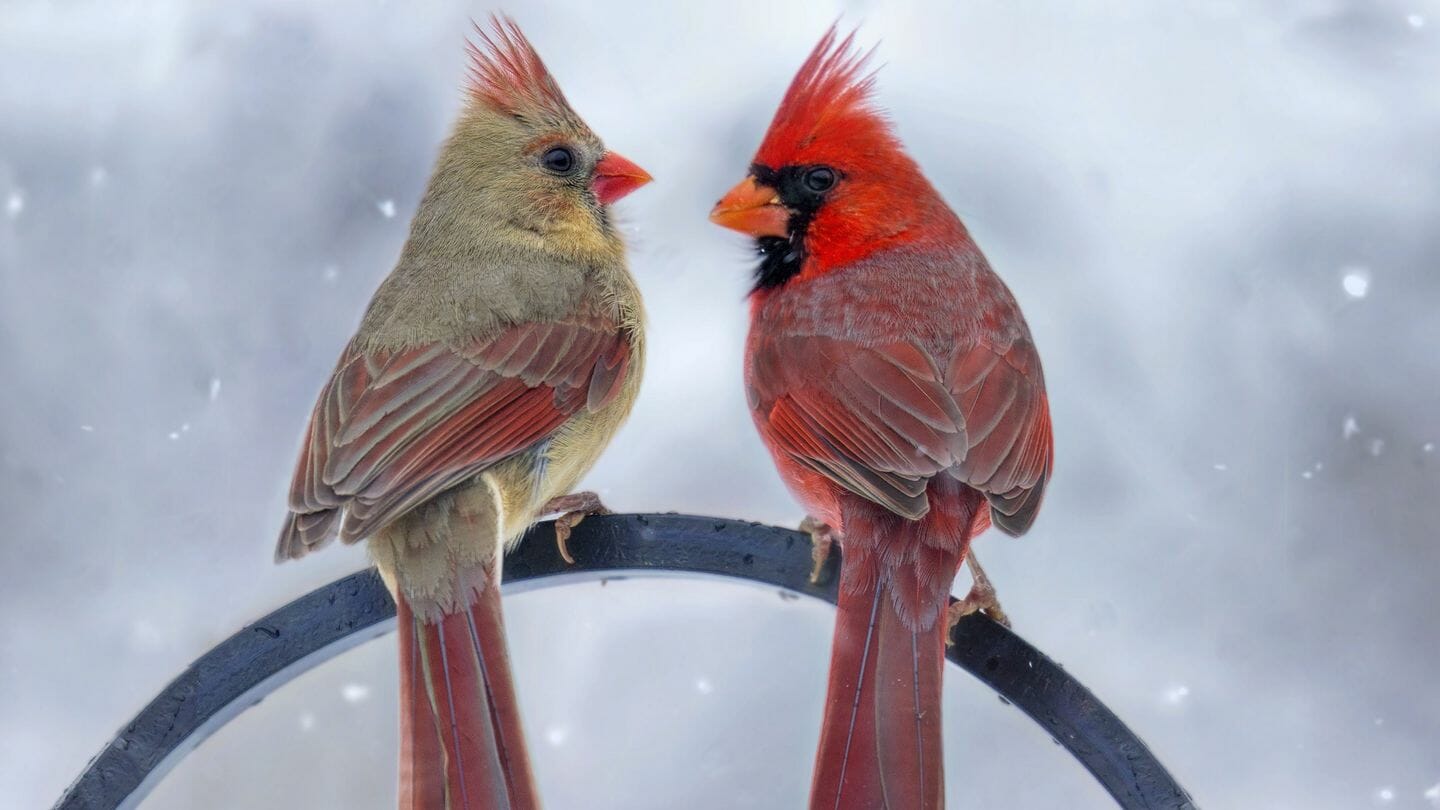
You’re looking out the window at the bird feeder, and there it is. A flash of red so bright it almost looks fake against the snow. That’s the male Northern Cardinal, the bird everyone recognizes instantly. But then, a few minutes later, this buff-brown, tan-ish bird with a sharp crest and a red-orange beak lands in the same spot. It’s subtle. It’s elegant. And honestly, it’s the bird people usually get confused about.
Images of male and female cardinals tell a story of survival, biology, and some pretty intense evolutionary trade-offs. While we all love that iconic crimson "angry bird" look, the female’s muted palette is actually a masterpiece of camouflage. It’s not just about being "pretty" or "plain." It’s about not getting eaten while sitting on a nest for two weeks straight.
The Visual Gap: More Than Just Red vs. Brown
When you browse through high-quality photos, the first thing that hits you is the sheer intensity of the male's plumage. It’s a literal biological signal. These birds don't just wake up red; they manufacture that color through their diet. They eat berries and insects rich in carotenoid pigments. If a male cardinal doesn't get enough of the right food, he looks dull. He looks sick. And to a female cardinal, a dull male is a hard pass.
The female is different. She’s mostly a warm, toasted-marshmallow brown. But look closer at a high-res photo. You’ll see these delicate, almost painterly washes of red in her wings, her tail, and that tall crest on her head. She isn't "plain." She’s nuanced.
Why the Difference Matters
This is called sexual dimorphism. In the bird world, it’s usually the guys who have to do all the heavy lifting when it comes to visual displays. He wants to be seen. He wants to defend his territory. He wants to scream, "I am healthy and I own this backyard!"
She, on the other hand, is the one who spends the most time on the nest. If she were bright red, she’d be a neon sign for every hawk, owl, and outdoor cat in the neighborhood. By being brown and grey, she disappears into the twigs and dried leaves. It’s a life-saving wardrobe choice.
Identifying the Nuances in Photos
Sometimes, you might see a bird that looks like a weird mix of both. Don't panic; you haven't discovered a new species.
Young cardinals—the juveniles—actually look a lot like the females, but with one massive giveaway: their beak. Adult cardinals have that bright, almost glowing orange-red beak. Juveniles have a dark, dusky, almost black beak. As they mature, that beak changes color first, then the males start getting their "splotchy" red feathers. It looks like they’re going through a very awkward teenage phase.
Lighting Can Cheat Your Eyes
I’ve seen dozens of photos where people swear they’ve found a "yellow" cardinal. Now, those do exist—it’s a rare genetic mutation called xanthochroism—but 99% of the time, it’s just bad lighting. Late afternoon "golden hour" light can make a female cardinal look incredibly yellow or even orange.
Always check the beak color and the mask. Both males and females have a black "mask" around their eyes and beak, but it’s much more pronounced and "jet black" on the male. On the female, it’s often a softer charcoal or dark grey.
Behavior You’ll See in the Wild
If you’re out trying to take your own images of male and female cardinals, you’ll notice they have a very specific social dynamic. They aren't just random birds hanging out.
- The "Mate Feeding" Ritual: This is probably the cutest thing you’ll ever see through a camera lens. During the spring, the male will pick up a seed, hop over to the female, and tilt his head to feed it to her. It looks like they’re kissing. It’s actually a way for him to prove he’s a good provider. If you see this, get your camera ready. It’s the ultimate "pair" shot.
- The Sentinel Strategy: Usually, the male will sit higher up in a tree, singing his heart out, while the female feeds on the ground or at a low tray. He’s the lookout. He’s the distraction.
- Winter Flocks: Unlike many other birds that get super territorial and fight year-round, cardinals will actually "hang out" in large groups during the winter. You might see ten or twenty of them in a single evergreen tree. The contrast of the red males and tan females against green needles is a photographer's dream.
Misconceptions About the Female Cardinal
People often think the female is the "quiet" one. Total myth.
In many songbird species, only the males sing. But female Northern Cardinals are actually quite vocal. They sing from the nest, often to tell the male when it’s safe to bring food or to warn him to stay away because a predator is nearby. Their songs are just as complex as the males', which is actually pretty rare in the bird world.
Another weird thing? The "bald" cardinal. Every year, someone posts a photo of a cardinal with no feathers on its head, looking like a tiny vulture. It looks terrifying. Usually, it’s just a particularly heavy molt or a case of feather mites. The feathers eventually grow back, but for a few weeks, those images of male and female cardinals look like something out of a horror movie.
Capturing the Perfect Shot: Pro Tips
If you want to get better photos of these birds, you need to understand their "flightiness." Cardinals are twitchy. They don't sit still for long.
- Focus on the eye: Because they have that black mask, it’s really easy for the camera’s auto-focus to get confused. If the eye isn't sharp, the whole photo feels "off."
- The Beak Factor: That orange beak is often the brightest part of the image. In bright sunlight, it can "blow out" (become a white blob of light). You might need to turn down your exposure just a hair.
- Backgrounds: A red bird on a green background is a classic color theory win. Look for evergreens like hollies or pines. For the females, try to find a background with some blue or deep brown to help her subtle red accents pop.
The Rare "Half-and-Half" Cardinal
Okay, we have to talk about the "Gynandromorph." This is the holy grail of cardinal photography.
Once in a very long while, a cardinal is born that is literally male on one side of its body and female on the other. This is a legitimate biological fluke. One half of the bird will be bright red with a black mask, and the other half will be brownish-tan.
It’s not a hybrid. It’s a bilateral gynandromorph. If you ever see a photo of one, it’s not Photoshop—it’s a rare glimpse into a chromosomal "glitch" that results in a bird that is both sexes at once. These birds are usually treated as outsiders by other cardinals, but they survive just fine.
Actionable Steps for Bird Enthusiasts
If you're looking to attract more cardinals so you can see these differences for yourself, there are a few things that actually work.
First, stop buying the "cheap" birdseed mix with all the tiny round millet. Cardinals mostly ignore it. They want black oil sunflower seeds or safflower seeds. Safflower is great because squirrels usually hate it, but cardinals love it.
Second, provide "thick" cover. Cardinals don't like open spaces. They want dense bushes—think privet, viburnum, or thick evergreens—where they can dive in if a hawk flies over.
Finally, put out a heated birdbath in the winter. Finding liquid water is a massive chore for birds when everything is frozen. If you have the only open water on the block, every cardinal in the neighborhood will be at your house by 8:00 AM.
Watching these birds isn't just a hobby; it’s a way to tune back into the rhythm of the seasons. Whether it's the fiery red of the male or the sophisticated tan of the female, they’re a reminder that nature doesn't do anything by accident. Every feather has a purpose.