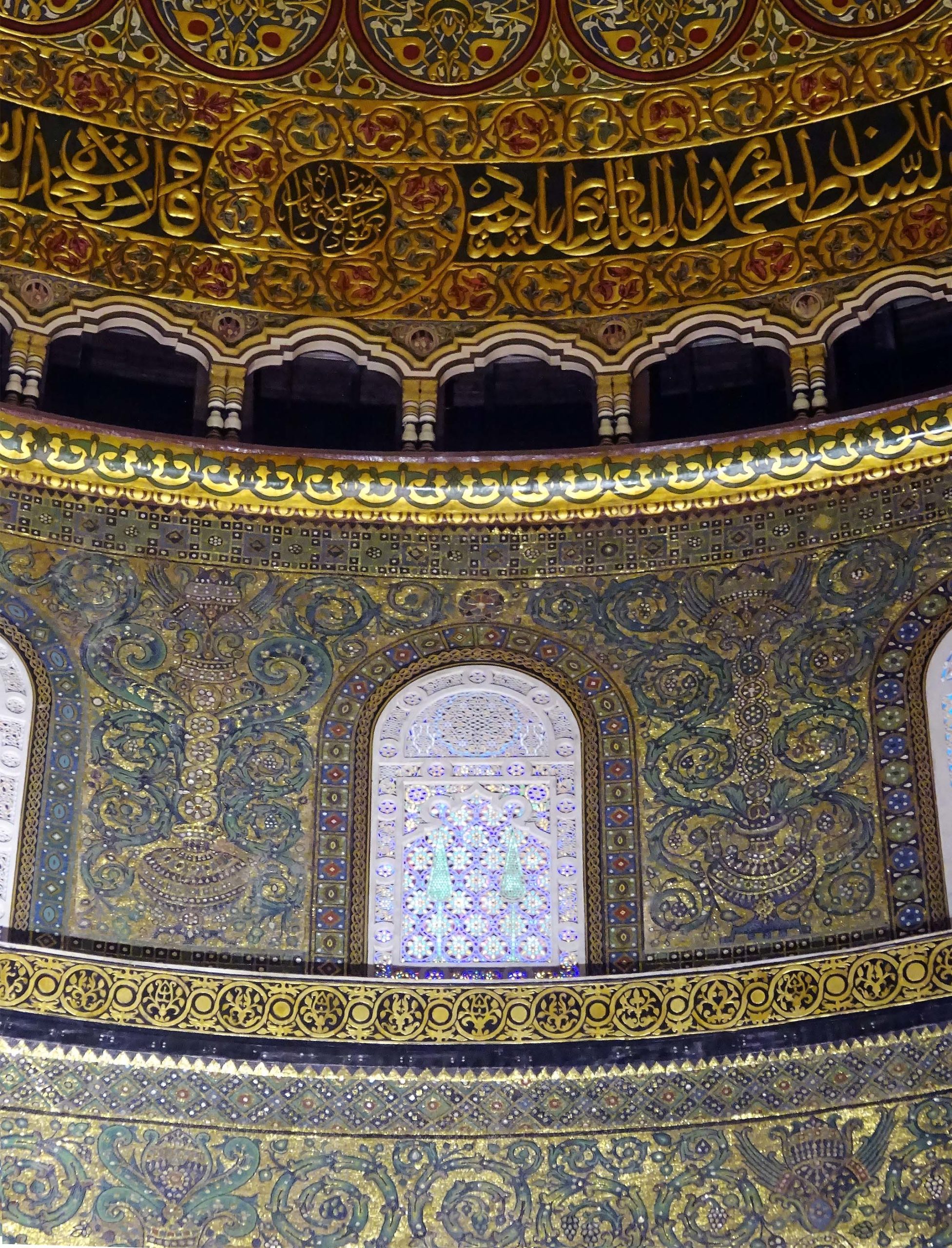
You see it in every single postcard of Jerusalem. That massive gold dome sitting on the horizon like a permanent sunrise. It is arguably the most recognizable building on the planet, yet for most people, the story stops at the exterior. We know the gold. We know the blue tiles. But inside Dome of Rock, things get a lot more complicated, a lot more hushed, and honestly, way more interesting than the tourist brochures let on.
Most folks call it a mosque. It’s not. Not technically. While Muslims have prayed there for over 1,300 years, the building was designed as a mashhad—a shrine or a place of commemoration. It doesn’t have a minbar for Friday sermons. It doesn't have the typical layout of a congregational mosque like the neighboring Al-Aqsa. Instead, the whole thing is built in a giant circle (well, an octagon) specifically to force you to walk around a single, massive piece of limestone.
The Rock That Anchors Three Faiths
The centerpiece of the interior is the Foundation Stone. It’s raw. It’s rugged. It’s a stark, beige contrast to the dizzying mosaics above it. If you’re standing right there, you’re looking at what many believe is the literal "center of the world."
For Muslims, this is the spot where the Prophet Muhammad ascended to heaven during the Night Journey (Isra and Mi'raj). If you look closely at the rock—though you usually can't get close enough to touch it anymore—tradition says there’s a footprint left behind from that moment. Jewish tradition holds that this is the Even ha-Shetiya, the point from which the world was created and the site of the Holy of Holies in the Second Temple.
It’s heavy stuff. You can feel the weight of it in the air. The interior isn't bright and airy like a modern cathedral; it’s dim, lit by 56 stained-glass windows that filter the Jerusalem sun into deep purples, reds, and golds. The smell is a mix of old dust, expensive rosewater, and the faint scent of the wool carpets that line the floor around the central wooden balustrade.
Walking the Octagon: Mosaics and Math
The layout is a bit of a head-trip. You have two rows of columns (ambulatories) that create a circular path around the rock.
The architecture is basically a giant math problem solved in stone. Byzantine craftsmen were brought in by the Umayyad Caliph Abd al-Malik in 691 CE to do the mosaics, and they didn't hold back. We’re talking about 1,200 square meters of glass and mother-of-pearl tesserae. Unlike Christian churches of that era, you won't find a single face or animal inside. Instead, it’s a garden of stone—vines, palm trees, and jeweled crowns that some historians, like Oleg Grabar, argued represented the spoils of the Byzantine and Persian empires offered to God.
There is a specific rhythm to the walls. You see the Quranic inscriptions—some of the oldest surviving examples of Arabic calligraphy—running along the top of the inner octagon. These verses specifically emphasize the oneness of God, a direct theological conversation with the Christian Holy Sepulchre just a few hundred yards away. It’s basically a 7th-century architectural "mic drop."
The Cave Beneath the Surface
Most people don't realize there’s a basement.
Underneath the main rock, there’s a small staircase leading down into a natural cave known as the Bir el-Arwah, or the Well of Souls. It’s small. Maybe 15 people can fit comfortably. The ceiling of the cave is just the underside of the Foundation Stone itself.
There’s a small hole in the floor of the cave that supposedly leads to a deeper cavity. Legend says you can hear the voices of the dead or the rushing waters of paradise down there, but honestly? It mostly just feels like a very quiet, very cool refuge from the heat of the plaza outside. There are small prayer niches dedicated to David, Solomon, and Abraham. It’s one of those rare places where the history is so thick you can almost taste it.
The Reality of Access in 2026
Let’s get real about actually getting in.
If you aren't Muslim, you probably won't see the inside Dome of Rock in person. Since 2003, the Waqf (the Islamic trust that manages the site) has generally restricted the interior to Muslim worshippers only. This wasn't always the case—back in the 90s, you could buy a ticket and walk right in—but politics and security shifted things.
Even for those who do get in, the experience is strictly regulated. No photos are officially allowed inside. If you see high-res shots of the interior online, they’re usually from official Waqf photographers or older archives. This exclusivity has turned the interior into a sort of "forbidden fruit" for travelers, which is a shame, because the sensory experience of the acoustics—the way a whisper echoes off the dome—is something a photo can't capture.
Why the Colors Change
The interior aesthetics aren't static. Over the centuries, almost every ruling power in Jerusalem has tinkered with the decor.
- The Ottomans added the heavy carpets and some of the later tilework.
- The Crusaders turned it into a church (the Templum Domini) and actually chipped off pieces of the rock to sell as relics in Europe.
- The 20th-century renovations (funded largely by Jordan) replaced the inner lead dome with aluminum and later gold leaf, which changed how light reflects onto the inner mosaics.
If you look at the columns, you’ll notice they don't all match. That’s because the original builders "recycled" them from older Roman and Byzantine ruins. Some are marble, some are breccia; some have Corinthian capitals, others are more simple. It’s a literal patchwork of the city’s history.
What Most People Miss
The "Drum."
That’s the technical term for the circular wall directly under the dome. It’s covered in 16th-century tiles on the outside, but on the inside, it’s a masterclass in Umayyad mosaic work. If you have a pair of binoculars (and you’re lucky enough to be inside), look at the transition between the windows and the dome. The patterns become more geometric and abstract the higher you go, meant to represent the transition from the physical world to the divine.
Also, look for the "Suleiman the Magnificent" glass. The stained glass isn't original 7th-century stuff; much of it was replaced during the Ottoman era, but the way they used plaster to hold the glass creates these deep, thick shadows that make the colors pop way more than the lead-lining you see in European cathedrals.
Practical Steps for the Curious
Since the inside Dome of Rock is currently off-limits to the general public, how do you actually engage with it without just looking at a gold roof from a distance?
- Visit the Islamic Museum: It’s located in the southwest corner of the Al-Aqsa compound. They have original wooden beams from the dome’s early renovations and pieces of the older mosaics. It’s the closest you’ll get to the "guts" of the building.
- Timing the Plaza: If you want to experience the "vibe" without going inside, go to the Temple Mount (Haram al-Sharif) during the non-Muslim visiting hours (usually early morning). Stand near the northern doors. When the doors open for worshippers, the sound of the chanting and the cool air rushing out gives you a visceral sense of the space.
- Virtual Archives: The Khalili Collections and the Creswell Archive have the most detailed interior photography ever taken. If you’re a nerd for the details of the Kufic script or the specific mineral composition of the mosaics, that’s your gold mine.
- Respect the Dress Code: If you’re on the plaza, it doesn't matter how hot it is—cover your shoulders and knees. This isn't just about rules; it’s about not being "that tourist" in one of the most sensitive spots on earth.
Jerusalem has a way of hiding its best parts in plain sight. The Dome of the Rock is the ultimate example of that. We see the gold, but the real soul of the place is that rugged, unpolished rock and the thousand-year-old math surrounding it. It’s a reminder that even in a city defined by conflict, there’s a persistent, quiet beauty that’s managed to survive every empire that tried to claim it.