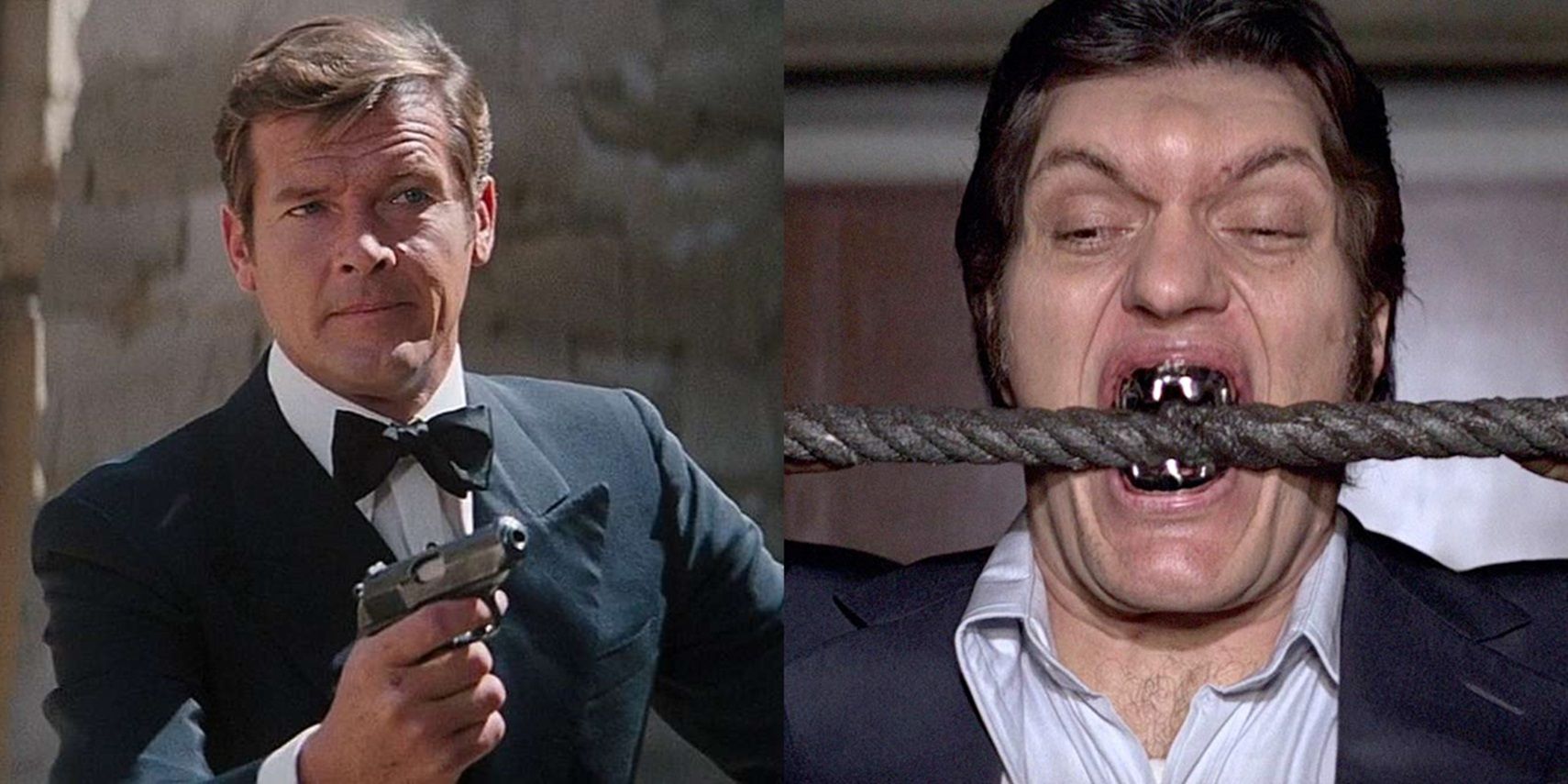
When you think of 007, you think of the tuxedo, the Aston Martin, and maybe a martini that’s been shaken a bit too much. But if you grew up watching the Roger Moore era, there’s one image that probably sticks in your brain more than any gadget: a 7-foot-2 giant with a mouth full of gleaming, razor-sharp steel. Jaws in James Bond movies wasn't just another henchman. He was a phenomenon.
Honestly, he shouldn't have even survived his first movie. In the original script for The Spy Who Loved Me (1977), Jaws was supposed to die in that shark tank. But during a test screening, something weird happened. The audience actually cheered when he popped his head out of the water after killing the shark. People loved him. The producers, seeing the "whooping and hollering," realized they had a goldmine on their hands and let him live.
He didn't just survive; he became the only henchman in Bond history to return for a second film as the same character. Richard Kiel, the man behind the metal, turned a silent assassin into one of the most beloved figures in cinema history. It’s a wild legacy for a guy who spent most of his screen time trying to bite people to death.
The Man Behind the Metal: Richard Kiel’s Sacrifice
Richard Kiel was a mountain of a man, standing at roughly 7 feet 1.5 inches. He was a former bouncer and cemetery plot salesman who found his calling playing "heavies" in Hollywood. But playing Jaws wasn't exactly a walk in the park.
Those famous teeth? They were a nightmare. Designed by Katharina Kubrick (daughter of Stanley Kubrick), the dentures were made of stainless steel. They were incredibly heavy and sat in Kiel’s mouth in a way that made him gag almost instantly.
He could only wear them for about 30 seconds at a time. Every time you see that iconic, menacing glint on screen, know that Kiel was likely counting down the seconds until he could spit them out. It’s actually one of the reasons Jaws is so silent; it was physically difficult for the actor to speak while wearing the appliance.
Despite the pain, Kiel brought a surprising amount of soul to the role. He used his eyes and his massive frame to convey a sort of "unstoppable force" vibe that felt more like a slasher villain than a traditional spy movie goon. Whether he was biting through a van roof or surviving a fall from a plane without a parachute, Jaws felt indestructible.
Why Moonraker Changed Everything
By the time Moonraker (1979) rolled around, the producers knew Jaws was a hit with kids. They started getting tons of fan mail asking why Jaws couldn't be a "goodie" instead of a "baddie."
So, they leaned into the comedy. Hard.
In The Spy Who Loved Me, Jaws is legitimately terrifying. Think back to that scene in Egypt where he stalks Fekkesh through the ruins. It’s atmospheric and genuinely creepy. But in Moonraker, we see him falling in love with a petite woman named Dolly, played by Blanche Ravalec.
The Redemption Arc
The turning point for Jaws happens on Hugo Drax’s space station. Bond (Roger Moore) manages to convince Jaws that he and Dolly don’t fit Drax’s vision of "perfect" human specimens. Basically, Drax wanted to wipe out everyone and start over with a master race, and Jaws—with his physical gigantism and metal teeth—was never going to be part of that future.
It’s a surprisingly poignant moment for a movie that features a laser battle in space. Jaws switches sides, helps Bond, and eventually speaks his only line in the entire franchise:
"Well, here's to us."
They share a bottle of champagne in an escape pod, and the audience gets the happy ending they wanted. It’s pure 70s camp, but it works because of the chemistry between the actors.
The Mandela Effect and the Braces Mystery
If you ask a casual fan about Jaws’ girlfriend Dolly, they will almost certainly tell you she had braces. It makes sense, right? He has metal teeth, she has metal braces—it’s the "cute" reason they fall in love.
Except she didn't have braces. If you go back and watch the high-definition versions of Moonraker today, Dolly’s teeth are perfectly clear. There isn't a wire in sight. This has become one of the most famous examples of the Mandela Effect in film history. People remember the braces so vividly that they’re often shocked to see she’s just a regular woman in pigtails and glasses.
Some fans theorize that a version with braces existed for a TV cut or a specific region, but there’s no hard evidence. Most likely, our brains just "filled in the gap" to make the visual joke more symmetrical.
Jaws: Beyond the Silver Screen
The character was so massive (literally and figuratively) that he didn't stop with the movies. Jaws became a staple of the Bond video games, most notably as a playable character in the legendary GoldenEye 007 on Nintendo 64.
He also popped up in:
- 007: Everything or Nothing: Reprising his role with Richard Kiel providing the voice and likeness.
- 007 Legends: Appearing in missions based on the classic films.
- James Bond Jr.: The 90s cartoon where he was a recurring villain (and actually talked a lot more).
It’s rare for a secondary character to have that much staying power. Most Bond henchmen are forgotten by the time the credits roll, but Jaws is right up there with Oddjob in the pantheon of icons.
What You Should Do Next
If you're looking to dive back into the world of classic Bond villains, don't just stop at the movies.
- Watch the Egypt sequence in The Spy Who Loved Me: It’s arguably the best Jaws scene and shows him at his most menacing before the character became more comedic.
- Look for Richard Kiel’s memoir: It’s called Making it BIG in the Movies and offers a really humble, funny look at what it was like to be 7 feet tall in Hollywood.
- Check out Silver Streak: Kiel actually played a very similar character with metal teeth in this 1976 Gene Wilder film right before he was cast as Jaws. It’s a great piece of trivia for movie buffs.
Jaws proved that you don't need a single word of dialogue to become a legend. You just need a memorable look, a bit of heart, and a very high tolerance for painful dental work.