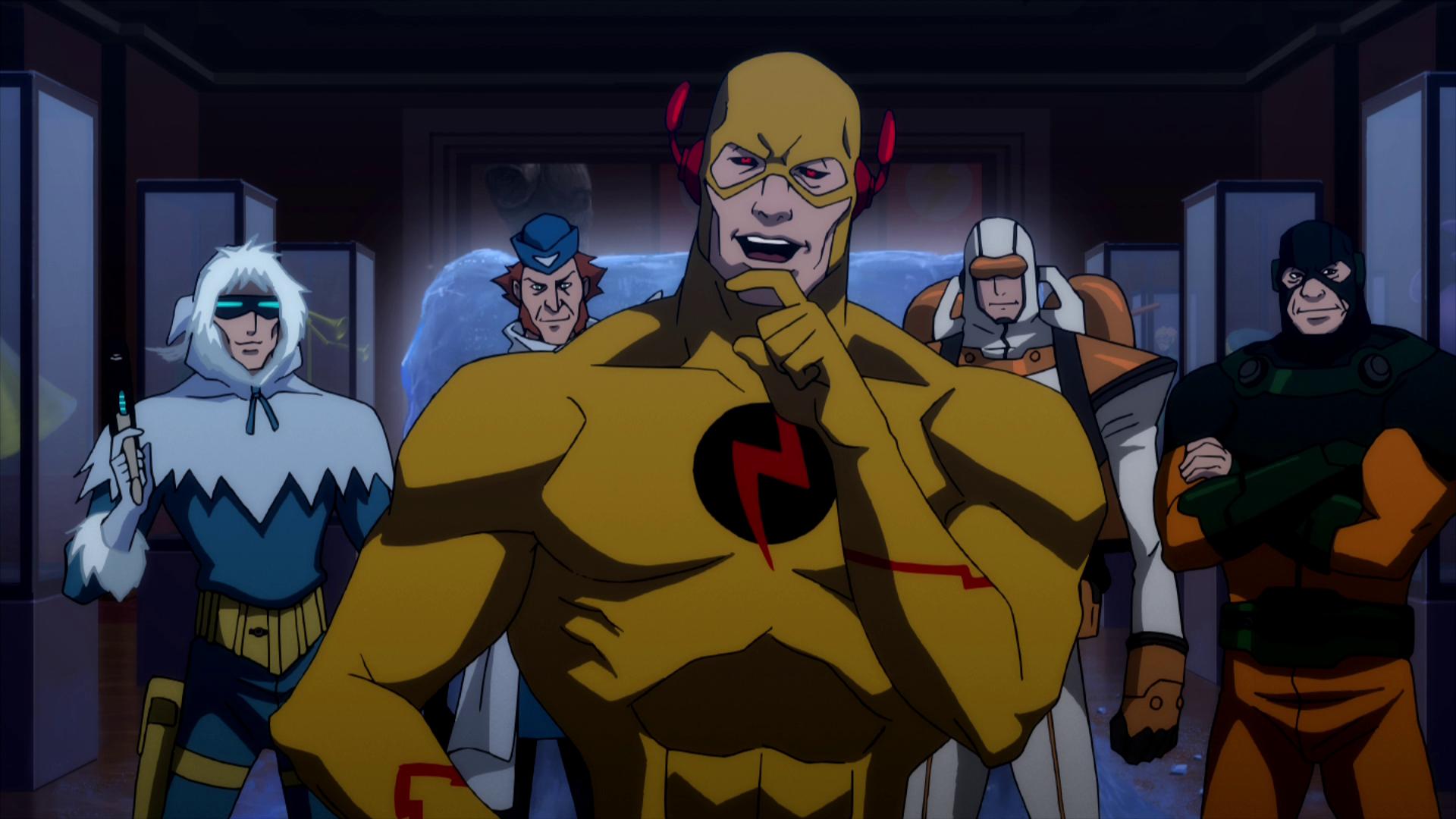
Honestly, if you haven't seen it, the opening of Justice League The Flashpoint Paradox feels like a standard Tuesday for Barry Allen. He’s running. He’s late. He’s feeling the weight of a world that won’t stop spinning. But within twenty minutes, everything you think you know about the DC Universe gets tossed into a blender and set to "pulverize." This isn't your Saturday morning cartoon. It’s a dark, jagged, and surprisingly emotional look at what happens when a hero decides that "just one change" to the past won't hurt anyone.
Barry Allen wakes up in a world where his mother is alive. That’s the dream, right? But the cost is a nightmare.
The Justice League doesn't exist. Superman is a skeleton locked in a basement. Wonder Woman and Aquaman are currently genocidal warlords tearing Europe and the UK to pieces. It’s bleak. It’s also arguably the most influential animated comic book movie ever made, not just because of the gore—and there is plenty—but because it fundamentally shifted how DC handled its own continuity across all media.
The Night Everything Broke
The plot of Justice League The Flashpoint Paradox follows the 2011 Flashpoint comic event by Geoff Johns and Andy Kubert, but the movie directed by Jay Oliva hits different. It’s visceral. When Barry realizes he’s lost his speed and that the world is on the brink of a literal apocalypse because of his own selfishness, the stakes feel heavier than a typical "Save the World" trope.
You’ve got a version of Batman who isn't Bruce Wayne. It’s Thomas Wayne. In this timeline, the boy died in the alley, and the father became a gun-toting, alcoholic vigilante while the mother—Martha—spiraled into becoming the Joker. It’s a heavy concept that the film handles with a surprising amount of grace. Thomas Wayne is the heartbeat of this movie. His desperation to give his son a life, even if it means he himself ceases to exist, provides the emotional anchor that keeps the high-concept sci-fi from feeling too cold.
The world-building here is fast and aggressive. We see a war between Atlantis and Themyscira that has claimed millions of lives. This isn't a diplomatic spat. It’s a scorched-earth campaign. Seeing Wonder Woman behead Mera or Aquaman use a captured Captain Atom as a living nuclear bomb is shocking, even years after the film’s 2013 release. It challenged the "hero" archetype in a way that paved the way for grittier live-action takes like Zack Snyder’s Justice League.
Why the Animation Style Divides Fans
Let's talk about the character designs. They’re chunky.
Character designer Phil Bourassa went for a hyper-masculine, almost "top-heavy" look for characters like Aquaman and Superman. Some fans love the gritty, rugged aesthetic because it fits the brutal tone of a world at war. Others find the proportions a bit distracting, especially when you see a Superman who looks like he’s been skipping leg day for a decade.
But where the art really shines is in the action choreography.
Jay Oliva is a master of "storyboarding for impact." The fights in Justice League The Flashpoint Paradox have a kinetic energy that most modern CGI battles lack. When Flash fights Reverse-Flash (Eobard Thawne), you actually feel the speed. It’s not just blur effects; it’s about the environment breaking around them. Thawne, voiced with chilling perfection by C. Thomas Howell, is a standout. He doesn't just want to kill Barry; he wants to psychologically dismantle him. His explanation of the "Shatterpoint" remains one of the best monologues in DC animation history.
The Ripple Effect on the DC Multiverse
This movie was the "Patient Zero" for the DC Animated Movie Universe (DCAMU). Before this, DC’s animated films were mostly standalone projects like All-Star Superman or Wonder Woman. After the credits rolled on Flashpoint, we got a "New 52" inspired shared universe that lasted for over a decade, ending with Justice League Dark: Apokolips War.
It set a precedent:
- Violence was on the table. This was one of the first PG-13 DC animated films to really push the rating.
- Continuity mattered. The ending of this film leads directly into Justice League: War.
- Barry Allen became the central axis. The Flash was no longer just the comic relief; he was the guy who could break and fix reality.
Interestingly, this story is so potent that DC keeps coming back to it. The 2023 The Flash live-action movie borrowed the core DNA of this narrative, though many fans argue the animated version handled the emotional stakes better. There’s something about the simplicity of the animated medium that allows the horror of the Flashpoint world to breathe without the distraction of uncanny valley VFX.
The Truth About Barry’s Choice
One thing people often overlook is that Barry isn't just a victim of circumstance. He’s the antagonist of his own story for a good portion of the film. By saving his mother, Nora, he effectively murdered billions of people who died in the ensuing wars of the new timeline.
The movie doesn't let him off easy.
When he finally decides to "fix" it, he has to run back and literally stop himself. He has to tackle his past self and allow his mother to die. It’s a brutal lesson in the "Grandfather Paradox." You can't change one thing without changing everything.
Key Character Divergences in Flashpoint:
- Superman: Instead of landing in Kansas, his pod crashed in Metropolis, destroying the city. The government kept him in an underground bunker without sunlight. He’s skinny, terrified, and has the social skills of a feral cat.
- Cyborg: He’s actually the world’s greatest hero in this timeline. He’s the only one trying to hold the crumbling U.S. government together, acting as a bridge between the warring factions.
- Shazam (Captain Thunder): In this world, the power of Shazam is split between several children. To transform, they all have to say the word together. It’s a tragic twist on the "Power of Family" trope when things go south for them.
Impact on Modern Media and E-E-A-T
When analyzing the impact of Justice League The Flashpoint Paradox, it’s essential to look at how writers like Geoff Johns reshaped the DC landscape. Johns often uses the Flash as a way to explore the fragility of time. Critics have noted that while the Flashpoint event was polarizing in the comics—mainly because it erased decades of beloved history—the movie is often viewed more favorably because it functions as a tight, self-contained tragedy.
Expert reviewers from outlets like IGN and The A.V. Club have frequently cited this film as the gold standard for "Elseworlds" storytelling. It asks the question: "Are these characters heroes because of their powers, or because of their circumstances?" In Flashpoint, we see that without the right upbringing or the right friends, these 'gods' can become monsters very quickly.
What You Should Do Next
If you’ve watched the movie and want to go deeper, don't just stop at the credits. There is a lot of context that the film has to skip for time.
- Read the "Batman: Knight of Vengeance" Tie-in: This is a three-issue comic miniseries that dives deep into Thomas Wayne’s Batman and the horrifying truth about the Joker of this timeline. It’s arguably better than the main Flashpoint story.
- Watch Justice League Dark: Apokolips War: If you liked the "everything is going to hell" vibe of Flashpoint, this is the bookend. It shows the end of the universe that Flashpoint created.
- Compare the "Snyder Cut": Watch the scene in Zack Snyder's Justice League where Barry enters the Speed Force. It’s a direct thematic descendant of the "running through time" visuals established in the Paradox movie.
- Check out the 2023 Flash film: See how the live-action world interpreted the same tragedy. It's a fascinating study in how different mediums handle the same "Choice vs. Fate" dilemma.
The legacy of Justice League The Flashpoint Paradox isn't just about cool fights or dark themes. It’s a reminder that even the fastest man alive can’t outrun his own grief. Sometimes, being a hero isn't about saving everyone—it's about having the courage to let go of what you love to save what’s left. It remains a high-water mark for superhero animation and a mandatory watch for anyone trying to understand the DNA of modern DC storytelling.
Actionable Insights for Fans:
- Completionist Route: Watch the movie, then read the Flashpoint 10th Anniversary Omnibus to see the dozens of other "broken" heroes not featured in the film.
- Watch Order: If you're doing a DCAMU marathon, start here, then move to Justice League: War, and follow the release order through to Apokolips War for the full narrative arc.
- Lore Check: Pay close attention to the letter Barry gives Bruce at the end. It’s one of the few items to ever cross timelines in DC history, making it a unique artifact in the multiverse.
By understanding the "Shatterpoint" logic presented in the film, you'll have a much better grasp on why DC’s current "Omniverse" approach works the way it does. Everything matters, everything is canon somewhere, and every choice has a price.