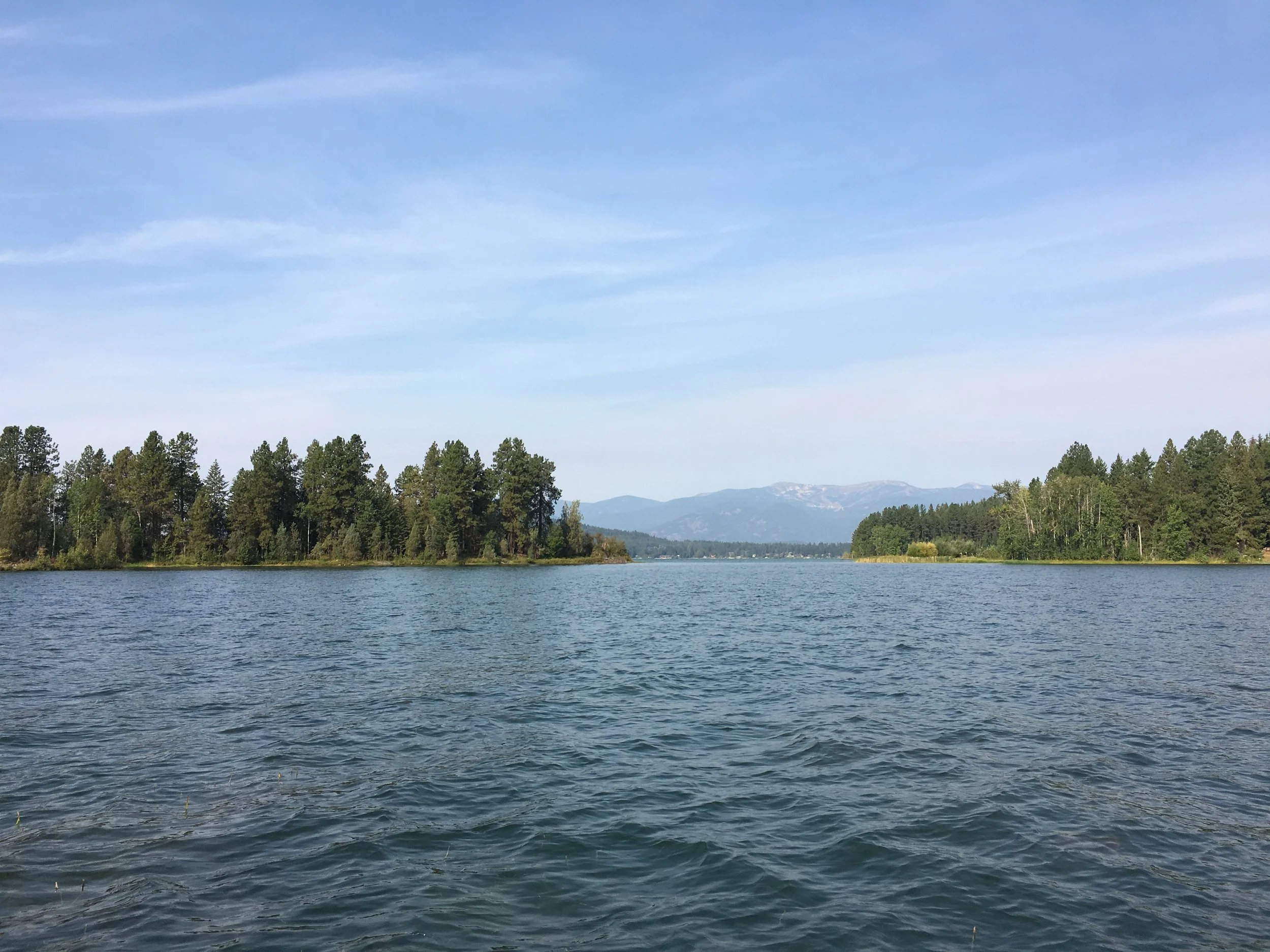
If you’ve ever looked at a map of North Idaho, you’ve seen it. That massive, ear-shaped blue blotch carved right into the panhandle. That’s Lake Pend Oreille. It’s big. Like, really big. It’s actually the largest lake in Idaho and the fifth deepest in the United States, plunging down about 1,150 feet in some spots.
You can’t just "swing by" this lake and see it all in an afternoon. It doesn't work that way. Honestly, most people just pull over at the Long Bridge in Sandpoint, take a photo, and think they’ve seen it. They haven’t. You're basically looking at the tip of an iceberg made of water.
The Massive Scale of Lake Pend Oreille
It’s hard to wrap your head around the sheer volume of water here. We’re talking 148 square miles of surface area. During the 1940s, the Navy realized the lake was so deep and quiet that it was the perfect place to test submarines. Yeah, submarines in Idaho. They built the Farragut Naval Training Station on the southern end, which at one point was the largest city in Idaho despite being a temporary military base.
Today, the Navy still uses the Acoustic Research Detachment (ARD) at Bayview. It’s kinda wild to think that while you're out there fishing for Kamloops trout, there might be a high-tech scale model of a Virginia-class submarine lurking hundreds of feet below your boat. The depth is the secret. Because it’s so deep, the water doesn't move or reflect sound the way shallower lakes do. It’s a natural laboratory.
Why the depth actually matters to you
- The water stays cold. Even in August, if you jump in away from the shoreline, it’s going to take your breath away.
- It creates a "banana belt" climate. The sheer mass of water regulates the temperature of the surrounding land, which is why Sandpoint doesn't always feel as brutally cold as the high mountain passes nearby.
- Unique fish species thrive here. We’re talking about Bull Trout and the Gerrard rainbow trout (locally called Kamloops), which can grow to sizes that look fake in photos.
The Missoula Floods: How This Beast Was Born
You can't talk about Lake Pend Oreille without talking about the apocalypse that created it. About 12,000 to 15,000 years ago, a massive ice dam—part of the Purcell Trench lobe of the Cordilleran Ice Sheet—blocked the Clark Fork River. This created Glacial Lake Missoula.
Eventually, the dam failed. Repeatedly.
Imagine a wall of water hundreds of feet high tearing through the landscape at highway speeds. It scoured out the basin of Pend Oreille, leaving behind the dramatic cliffs you see today near Lakeview and Bayview. When you see those jagged rock faces on the southern end, you’re looking at the raw scars of a prehistoric flood that redefined the geography of the entire Pacific Northwest. It’s humbling, really.
Getting Around: Sandpoint vs. Bayview vs. Hope
The lake is sort of split into different "personalities."
Sandpoint is the hub. It’s got the City Beach, the shops, and the famous Long Bridge. If you want a latte before you get on a boat, you go to Sandpoint. It’s accessible. It’s friendly. But it’s also the busiest part of the water.
Then you have Hope and East Hope on the eastern shore. This is where the locals go when they want to actually see the sunrise. The views of the Green Monarch Mountains from Hope are, in my opinion, the best in the state. Period. The shoreline drops off incredibly fast here. One minute you’re in three feet of water, the next you're over an abyss.
Bayview is the oddball. Tucked into the southwest corner, it’s famous for its floating homes. People literally live on the lake year-round in houses built on logs. It feels more like a coastal Alaskan fishing village than a town in Idaho. It’s also the gateway to Farragut State Park, which offers thousands of acres of hiking and some of the best disc golf courses in the country.
The Fishing Legend (And the Controversy)
For decades, Lake Pend Oreille was the place for world-record trout. In 1947, a guy named Wes Hamlet pulled a 37-pound Kamloops out of these waters. That record stood for a long time.
But things got weird.
In the late 90s and early 2000s, the mysis shrimp population (which was introduced by humans—bad idea) caused a boom in Lake Whitefish and Kokanee. Then the Lake Trout (Makinaw) started taking over and eating everything. The famous Kamloops and the native Bull Trout started disappearing.
The Idaho Department of Fish and Game (IDFG) had to get aggressive. They actually started paying people to catch and keep Lake Trout. It worked. The Kokanee rebounded, and the big rainbows are getting big again. It’s a delicate balance. If you're fishing here, you need to know the rules. Bull Trout are protected; catch one, and it stays in the water.
Boating Safety: Don't Be a Statistic
I’m being serious here: this lake can kill you if you're careless. Because of its size and the way the Cabinet and Selkirk Mountains funnel wind, storms can kick up in minutes. You’ll be in glass-calm water at 2:00 PM, and by 2:15 PM, you’ve got four-foot whitecaps.
If you are renting a boat in Sandpoint, keep an eye on the "rollers." If the wind starts coming out of the south, get to shore. The fetch (the distance wind travels over open water) on Pend Oreille is long enough to build up massive waves that can swamp a small craft or a jet ski easily.
Also, the water temperature is no joke. Even in July, if you fall in far from shore, hypothermia is a real risk. Wear your life jacket. It sounds like something your mom would say, but out here, it's just common sense.
Navigation tips for the uninitiated
- Watch for the "Sandpoint Drift." The current near the mouth of the Pend Oreille River can be stronger than it looks.
- The "Pillows." These are underwater rock hazards near the islands (like Hope Island). Use a depth finder or stay well clear of the shoreline in areas you don't know.
- The Clark Fork Delta. It’s beautiful for kayaking, but it’s shallow and full of logs. Don't take your $100k wakeboard boat in there unless you want a very expensive repair bill for your prop.
What Most People Get Wrong About the Name
First off, it's pronounced "Ponderay." Don't say "Pend Or-eel-ee." You'll stick out like a sore thumb.
The name comes from the French fur traders. "Pend d'Oreille" means "ear hanging" or "earring." It was the name given to the Kalispel tribe because of the large shell earrings they wore. The lake took the name of the people. It’s a bit of a linguistic fossil from the 18th-century fur trade era when the North West Company was trying to figure out how to navigate the rugged interior.
Actionable Steps for Your Visit
If you're actually planning to head up here, don't just wing it.
Start at Farragut State Park. If you want the best "bang for your buck" view, hike the Highpoint Trail. It’s a moderate climb, and the view from the top gives you the best perspective of the "Southern End" and the Navy’s acoustic research area. You can see the scale of the lake better from 1,000 feet up than you can from the beach.
Rent a boat from Hope. Most people rent in Sandpoint, which means they spend an hour just motoring across the wide, shallow northern flats. If you rent in Hope, you are immediately in the deep, dramatic water near the Green Monarchs. It’s more scenic, and you're closer to the "jumping rocks" where locals hang out.
Check the weather via the Navy’s stations. Don't just look at your phone's generic weather app. Look for localized marine forecasts. If there’s a small craft advisory, believe it.
Visit in September. July and August are chaotic. The boat launches are packed, and the "Sandpoint Squeeze" (the traffic on Highway 95) is real. September has warm water, crisp air, and zero crowds. It’s the local secret.
Lake Pend Oreille isn't just a body of water. It's an engine that drives the economy, a graveyard for prehistoric floods, and a silent playground for the world's most advanced naval technology. It deserves a bit of respect when you visit. Pack your trash out, watch the horizon for clouds, and maybe grab a huckleberry shake in Hope on your way out. You'll understand why we live here once you see the sun dip behind the Selkirks from the middle of the lake.