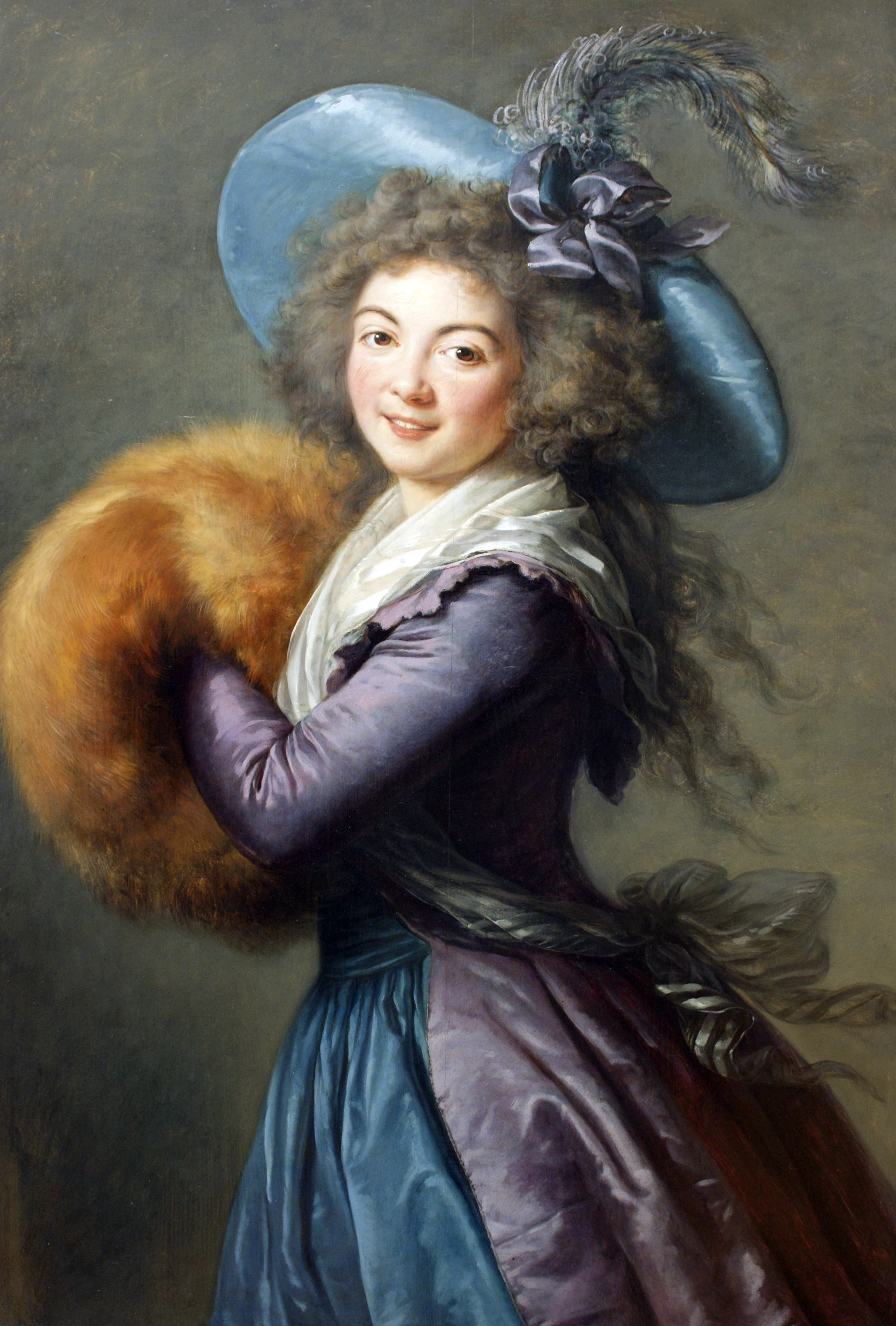
If you’ve ever scrolled through an art history feed and seen a portrait of a woman looking suspiciously "Instagram ready"—flawless skin, big eyes, and a soft, hazy glow—you’ve probably met the work of Marie-Elisabeth-Louise Vigée Le Brun. She was basically the portrait photographer of the 18th century, minus the digital filters.
She was also a survivor. Honestly, it’s a miracle she kept her head during the French Revolution, considering she was essentially the BFF of the most hated woman in France: Marie Antoinette. People love to paint her as just some royalist hanger-on who got lucky.
That’s wrong.
Vigée Le Brun was a powerhouse. She was supporting her entire family by the age of 15. She wasn't just "talented" for a girl; she was arguably the most successful portraitist in Europe at a time when women weren't even allowed to walk into most art academies without a male chaperone.
The Hustle Was Real from Day One
Elisabeth wasn’t born into the high-flying world of Versailles. Her dad, Louis Vigée, was a fan painter and a pastel artist—talented, but definitely not "rich." He was the one who saw her sketching on her schoolbooks and famously shouted, "You will be a painter, my child, if there ever was one!"
He died when she was only 12.
Suddenly, the family was broke. Her mom, Jeanne, was a hairdresser who quickly remarried a jeweler named Jacques-François Le Sèvre. Elisabeth hated him. In her memoirs, she basically describes him as a greedy miser who took all the money she earned and made her life miserable.
So, what did she do? She painted.
By her mid-teens, she was already a professional. She didn't have a license (the local guild actually shut her studio down once because she was "unauthorized"), but she was so good that the aristocrats didn't care. They wanted that "Vigée Le Brun look."
Why Marie Antoinette Chose Her
In 1778, Elisabeth got the call. The Queen needed a portrait.
Marie Antoinette was a PR nightmare even back then. She was seen as cold, frivolous, and "the Austrian woman." When Elisabeth showed up, something clicked. They were the same age. They both loved music. They even sang duets together while Elisabeth worked.
Vigée Le Brun ended up painting the Queen about 30 times.
The Scandal of the "Underwear" Portrait
Most people think "scandal" in 1783 meant something sexual. For Elisabeth and the Queen, it was a dress. She painted Marie Antoinette in a simple white muslin gown—the chemise à la reine.
The public went ballistic.
They thought the Queen was being painted in her chemise (basically her bra and slip). They felt it was disrespectful to the monarchy. But the real reason? It was a blow to the French silk industry. The Queen was wearing cheap cotton from the colonies instead of expensive Lyon silk.
Elisabeth had to pull the painting from the Salon and quickly paint a new one in a blue silk dress to calm everyone down. It was her first real taste of how dangerous her proximity to the throne actually was.
Breaking the "Teeth" Taboo
You’ve probably noticed that people in old paintings never smile with their teeth. It was considered "low class" or even a sign of madness.
Elisabeth didn’t care.
In 1787, she painted a self-portrait with her daughter, Julie. In it, she is smiling. Like, a real, open-mouthed, teeth-showing smile. The critics were horrified. One gossip sheet called it an "affectation" that was "condemned by persons of taste."
But that’s why her work still feels human today. She captured emotion, not just status. She wanted to show the "sweetness of life," a phrase she used constantly in her writings.
The Midnight Escape
When the Bastille fell in 1789, Elisabeth knew she was a target. The revolutionary pamphlets were already dragging her name through the mud, claiming she was having affairs with government ministers and spending the Queen's money.
On the night the mob marched on Versailles, she grabbed her daughter, Julie, and boarded a public coach to Italy. She left with almost nothing.
Her husband, Jean-Baptiste-Pierre Le Brun, stayed behind. He was a gambler and a bit of a scoundrel, but he was also a savvy art dealer. To save his own skin (and her property), he eventually had to divorce her and label her an "emigrée" so the government wouldn't seize everything they owned.
She spent the next 12 years in exile.
How She Conquered Europe
Most people would have given up. Instead, Vigée Le Brun turned her exile into a victory lap.
- In Italy: She was elected to the Academy in Rome.
- In Austria: She became the go-to painter for the Habsburgs.
- In Russia: She stayed for six years, painting Catherine the Great’s granddaughters and becoming a favorite of the Russian elite.
She was earning more money than ever. She wasn't just a refugee; she was a brand. By the time she finally returned to France in 1802, the world had changed, but her reputation was untouchable.
What We Get Wrong About Her Legacy
There's a tendency to dismiss Marie-Elisabeth-Louise Vigée Le Brun as a "feminine" painter because she liked soft colors and pretty sitters. People use words like "sentimental" as an insult.
But look at the technicality.
Her ability to paint the texture of a lace cuff or the translucent glow of a pearl was second to none. She bridged the gap between the frilly Rococo style of the old world and the sharp, clean lines of Neoclassicism.
She was also incredibly smart about her image. She wrote her Souvenirs (memoirs) in her 80s to make sure she was the one who told her story, not the revolutionary tabloids.
Actionable Insights for Art Lovers
If you want to really "see" a Vigée Le Brun, look for these three things next time you’re in a museum like the Met or the Louvre:
- The Hands: She was obsessed with hands. They are never stiff; they are always doing something—holding a child, a rose, or a palette.
- The Eyes: She used a specific technique to make eyes look "wet" and alive, giving them a sparkle that many of her contemporaries couldn't replicate.
- The Fabrics: Look closely at the muslin or silk. You can almost feel the weight of the cloth. She understood fashion better than almost any painter of her era.
Vigée Le Brun died in 1842 at the age of 86. She had outlived the Revolution, Napoleon, and even her own daughter. On her tombstone, it says: "Here, at last, I rest." Given that she produced over 600 paintings and 200 landscapes while running for her life across a continent, she definitely earned it.
To explore her work further, start by comparing her Self-Portrait in a Straw Hat (1782) with the Rubens painting that inspired it, Le Chapeau de Paille. You’ll see exactly how she took the Old Masters and made them feel modern.