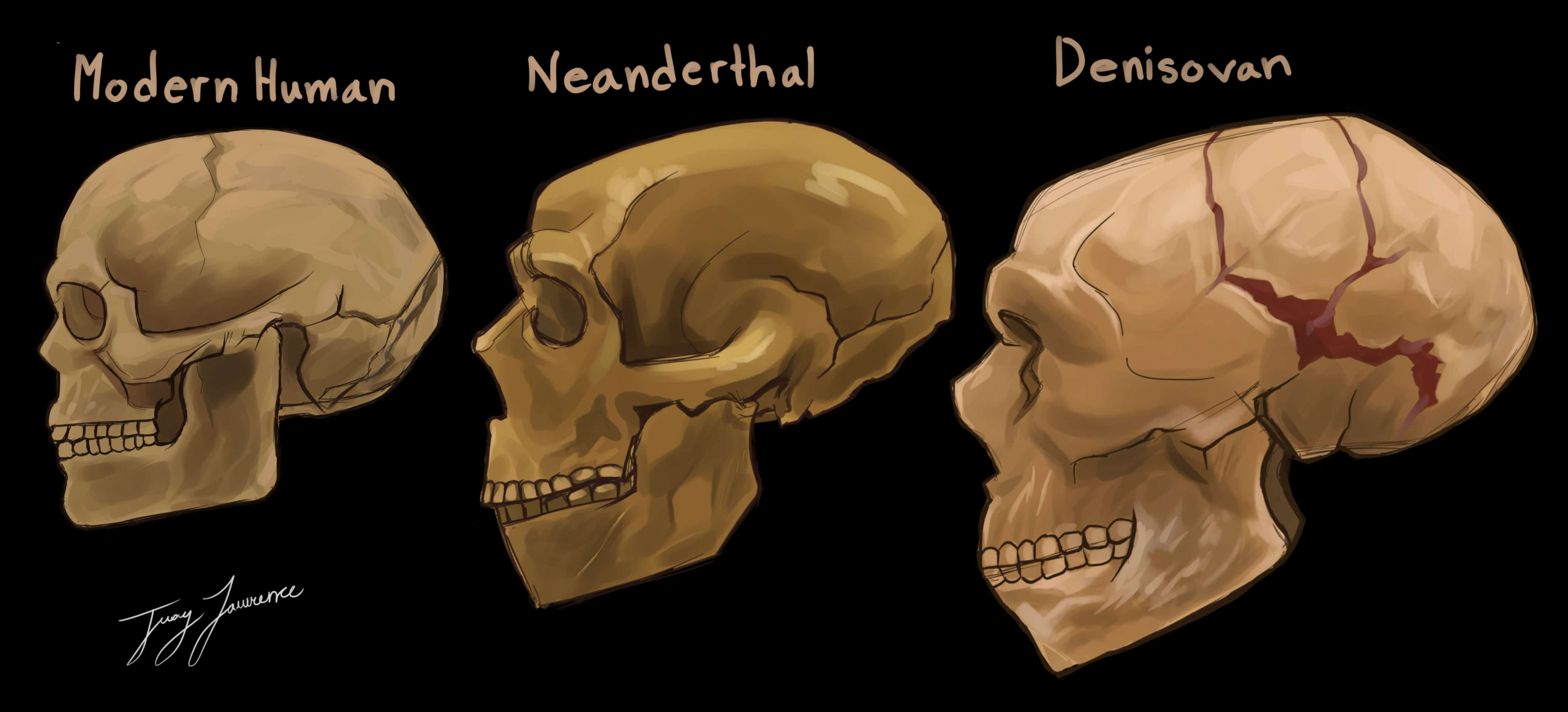
You’ve probably seen the classic museum display. It’s usually two skulls side-by-side. One looks like yours—round, high forehead, delicate. The other looks like it could take a punch from a freight train. When you start comparing a neanderthal vs human skull, the first thing that hits you isn't just the size; it’s the sheer "bulk" of our extinct cousins. Honestly, calling them "cavemen" does a massive disservice to the complex biology involved here. They weren't just "primitive" versions of us. They were a completely different evolutionary gamble.
Ever wonder why they had those massive brow ridges? Or why our chins stick out while theirs just... disappear? It’s not just about aesthetics. Every ridge, bump, and cavity in those bones tells a story about how they breathed, how they ate, and how they survived an Ice Age that would make our modern winters look like a tropical vacation.
The Massive Brow and the Vanishing Chin
If you hold a Neanderthal skull, the most striking feature is the supraorbital torus. That’s the fancy scientific name for that heavy bar of bone over the eyes. In a neanderthal vs human skull comparison, this is the "dead giveaway." Humans basically don't have this. Our foreheads are vertical, like a wall. Neanderthals had foreheads that sloped backward, retreating behind those thick bony shelves.
Scientists like Fred Smith have debated for decades why they had these ridges. Some thought it was to support heavy chewing muscles. Others thought it was structural, like a shock absorber for the face. Interestingly, recent 3D modeling suggests it might have been more about social signaling or simply a byproduct of how their braincases were shaped.
Then there is the chin. Or rather, the lack of one.
Grab your jaw right now. You feel that pointy bit at the bottom? That’s a "mental eminence." Surprisingly, Homo sapiens are the only hominids that have a true chin. When you look at a Neanderthal jawbone (the mandible), it just slopes straight back toward the throat. Why do we have one? Some researchers think it helps our jaws deal with the stress of speech, while others think it’s just a result of our faces shrinking over time while our teeth stayed relatively large.
The Braincase: Football vs. Basketball
There’s a huge misconception that Neanderthals were dim-witted because they looked "rugged." That’s just wrong. In fact, if we’re talking strictly about volume, the average Neanderthal brain was often larger than the average modern human brain.
But shape matters.
A modern human skull is globular. It’s shaped like a basketball. This high, vaulted shape allows for expanded parietal and temporal lobes. Neanderthal skulls were long and low—shaped more like a professional American football. At the very back of their skull, they had a distinct bulge called an occipital bun. If you run your hand along the back of your head, you might feel a tiny bump, but a Neanderthal had a protruding shelf of bone there.
Why the long face?
Neanderthals had what we call "midfacial prognathism." Their whole face looked like it had been pulled forward by the nose. This created a huge space inside the nasal cavity. If you look at a neanderthal vs human skull from the front, their nasal opening is massive.
Living in Pleistocene Europe was cold. Brutally cold. One theory, often discussed by biological anthropologists like Robert Franciscus, suggests these large noses acted as "radiators." They warmed and humidified the frigid air before it hit their lungs. However, more recent studies suggest it might actually have been about moving massive amounts of air to fuel their high-metabolism, muscular bodies. These people were built like CrossFit athletes on steroids; they needed oxygen, and lots of it.
The Teeth and the "Third Hand"
If you look closely at Neanderthal incisors, you’ll notice something weird. They are often incredibly worn down, sometimes right to the gum line. This isn't just from eating tough meat.
Neanderthals used their mouths as a third hand.
They would grip animal hides with their teeth to hold them steady while scraping them with stone tools. This put immense mechanical stress on the front of the skull. This behavior likely influenced the way their face was reinforced. When you compare a neanderthal vs human skull, our teeth look tiny and delicate. We invented better tools and eventually started cooking more soft foods, so our jaws "gracilized"—they got smaller and weaker because we didn't need a vise-grip in our mouth anymore.
The Myth of the "Missing Link"
People often ask if Neanderthals are our ancestors. The answer is: sort of, but mostly no. We are sister species. We shared a common ancestor—likely Homo heidelbergensis—about 600,000 to 800,000 years ago.
We lived alongside them for millennia. We know from DNA evidence (the 2010 Neanderthal Genome Project) that most people of non-African descent carry about 1% to 4% Neanderthal DNA. So, they didn't just go extinct; they were partially absorbed. But even with that interbreeding, the physical differences in the skull remain distinct. You wouldn't mistake a Neanderthal skull for a modern human one, even if that Neanderthal was wearing a suit and sitting across from you on the subway.
Why the Human Skull Won
If they had bigger brains and tougher bones, why are we here and they aren't? The skull might hold the clue.
Our globular braincase allows for a different organization of brain tissue. While they had massive visual processing centers (the back of the brain), we have more developed prefrontal and parietal regions. This is the stuff that handles social networking, complex language, and abstract thought. Basically, we might have been better at talking to each other and building large-scale tribes.
Neanderthals lived in small, isolated groups. When the climate shifted rapidly, they couldn't adapt their "culture" as fast as we could. Their skulls were built for a specific, harsh environment. Ours were built for flexibility.
Key Anatomical Markers
- Brow Ridge: Continuous and thick in Neanderthals; nearly absent in humans.
- Forehead: Sloping in Neanderthals; vertical and high in humans.
- Occipital Bun: A bony "knot" at the back of Neanderthal heads; absent in us.
- Chin: Completely absent in Neanderthals; a defining feature of Homo sapiens.
- Nasal Cavity: Large and wide in Neanderthals; narrower in humans.
- Eye Orbits: Neanderthals had larger, rounder eye sockets, suggesting they may have had better low-light vision for those long, dark northern winters.
Actionable Insights for the Curious
If you want to see these differences in person, don't just look at photos. The nuances are 3D.
- Check out the Smithsonian's 3D Collection: They have high-resolution scans of the La Ferrassie 1 Neanderthal skull. You can rotate it and compare it directly to a modern human scan.
- Look for the "Retromolar Space": If you find a photo of a Neanderthal jaw, look behind the last molar. There’s a gap there. Humans don't have that; our teeth are crammed right to the back of the jaw. This is why many of us need our wisdom teeth pulled—our skulls literally shrank too fast for our teeth to keep up.
- Visit the Neanderthal Museum: If you’re ever in Mettmann, Germany, it’s built right near the site where the first recognized Neanderthal fossils were found in 1856. Seeing the actual "Type Specimen" puts the scale into perspective.
- Feel your own anatomy: Place your fingers on your brow. Move them up. If you hit a flat wall, you're looking at the result of 200,000 years of "self-domestication" that gave us the modern human face.
The reality of the neanderthal vs human skull debate is that neither is "better." One was a specialist, perfected for the cold and the hunt. The other—us—is a generalist, built for communication and change. We are the last ones standing, but we carry their ghosts in our DNA and their history in our museums.