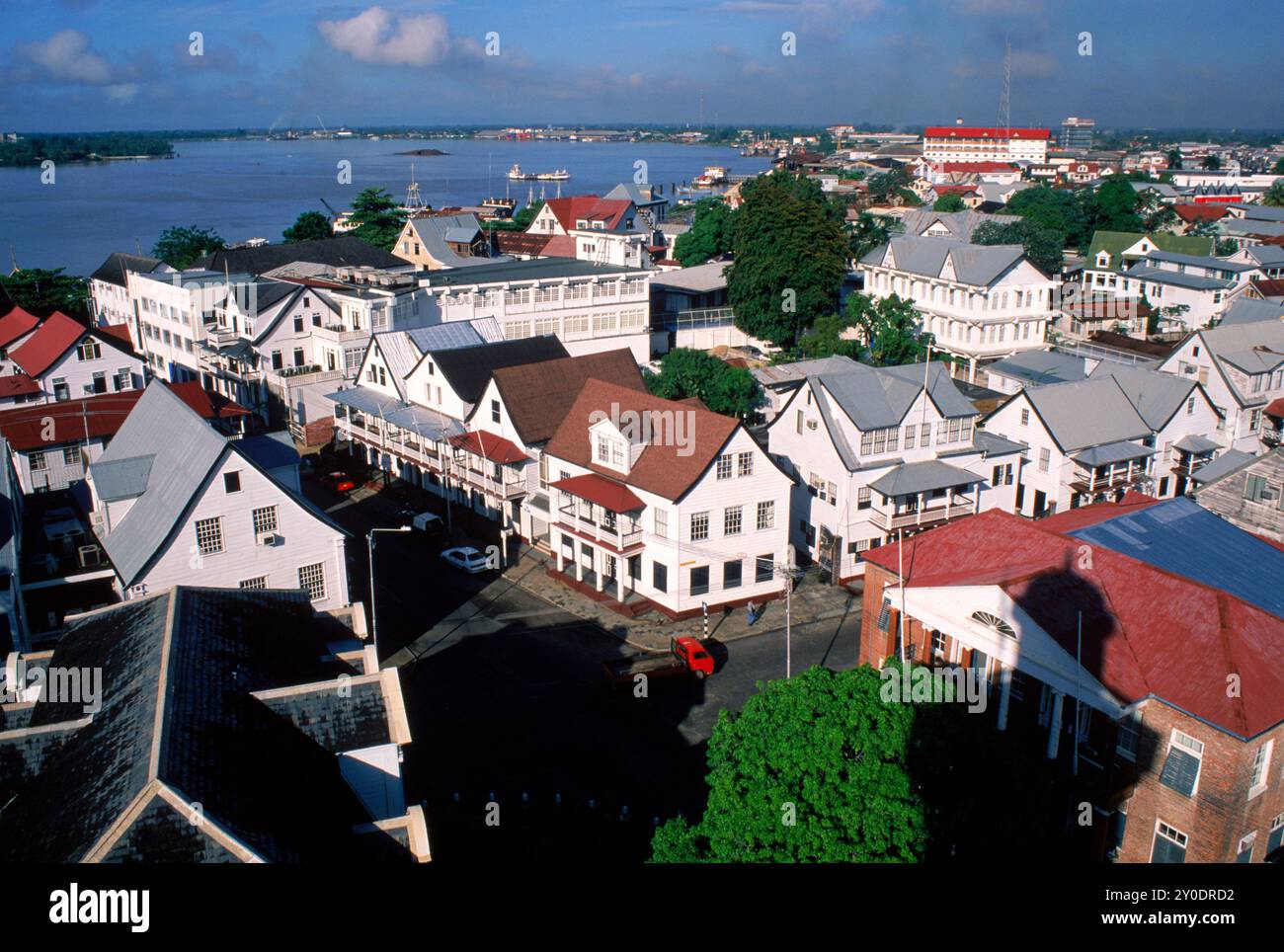
Most people can't point to it on a map. Honestly, even seasoned backpackers trekking through South America tend to skip the "Guianas" entirely, favoring the well-trodden paths of Peru or Colombia. That’s a mistake. Paramaribo Suriname is a jarring, beautiful, and utterly confusing place that feels less like Latin America and more like a fever dream where the Caribbean, Amsterdam, and Mumbai crashed into the Amazon rainforest.
It’s humid. Like, "change your shirt three times a day" humid.
The first thing you notice when you land at Zanderij is the air—thick, sweet with the smell of damp earth and woodsmoke. Then you see the architecture. Paramaribo’s historic inner city is a UNESCO World Heritage site for a reason. It’s a sprawl of black-and-white colonial wooden buildings that look like they were plucked out of a 17th-century Dutch canal district and dropped into a tropical swamp. Waterkant, the street running along the Suriname River, is the heart of it all. You’ll see locals sitting on the wall, sipping Parbo Beer, watching the massive brown river churn toward the Atlantic. It’s slow. It’s vibrant. It’s Paramaribo.
The Dutch Legacy and the "Wooden City" Realities
You can't talk about Paramaribo Suriname without talking about the wood. While the rest of the continent built with stone and brick, the Dutch settlers here realized the swampy soil couldn't handle the weight. So, they built with timber.
The Saint Peter and Paul Cathedral-Basilica is the crown jewel. It’s supposedly the largest wooden structure in the Western Hemisphere. Inside, the cedar is unpainted, giving it this warm, honey-colored glow that smells faintly of old forests. It’s magnificent. But there's a grit to it, too. Just a few blocks away from the pristine, restored government buildings, you’ll find magnificent wooden mansions that are literally melting back into the earth, reclaimed by termites and the relentless jungle rot.
It’s a city of contrasts.
Walking through the center, you’ll hit Independence Square (Onafhankelijkheidsplein). It’s an enormous green space where the Presidential Palace sits. It’s white, stately, and surprisingly accessible. On Sunday mornings, this is where the famous bird-singing competitions happen. Men bring their caged twatwa birds to see whose song is the most melodic. It’s dead serious. There are judges, silence is expected, and the prize money isn't just pocket change. It's one of those hyper-local traditions that makes you realize you aren't in a tourist trap. You’re in a living city.
A Cultural Mashup That Shouldn't Work (But Does)
Suriname’s history is heavy. The Dutch traded New York (then New Amsterdam) to the British for Suriname in 1667 because of sugar. That trade shaped the genetic makeup of Paramaribo forever. After slavery was abolished, the Dutch brought in indentured laborers from India and Java (Indonesia).
The result?
You can walk down Keizerstraat and see the Neveh Shalom Synagogue sitting right next to the Ahmadiyya Anjuman Isha’at Islam Mosque. They share a fence. They share a parking lot. This isn't some staged "peace" photo-op; it’s just how the city functions.
The food reflects this chaos in the best way possible. You haven't lived until you've had Saoto Soup—a Javanese chicken broth topped with bean sprouts, fried vermicelli, and a boiled egg—for breakfast, followed by Roti for lunch, and maybe some Pom (a Creole dish made from the pomtajer root) for dinner. It’s a culinary whiplash that somehow makes perfect sense once you’re on the ground.
- Maroon Culture: Don't forget the Maroons—descendants of Africans who escaped plantations and built independent kingdoms in the interior. They bring their crafts and languages (like Sranan Tongo) into the city markets.
- Hindustani Influence: About a quarter of the population is of Indian descent, bringing vibrant festivals like Holi/Phagwa to the streets.
- Javanese Staples: Head to the Blauwgrond district for the best saté and nasi goreng outside of Indonesia.
Logistics: Getting There and Staying Sane
Paramaribo isn't easy. Let's be real about that.
Johan Adolf Pengel International Airport is about an hour's drive from the city center. The road is a narrow strip carved through the jungle. If you arrive at night, the darkness is absolute, save for the occasional roadside shack selling bara (savory fried dough).
Transportation inside the city is dominated by privately owned, brightly painted buses. They don't have a formal schedule. You just stand on the side of the road and look hopeful. Or, better yet, use the local ride-hailing apps like 711. They're reliable and save you the headache of haggling in Dutch or Sranan Tongo.
Cash is king here. While some upscale places take cards, you'll need Surinamese Dollars (SRD) for almost everything. Be warned: the exchange rate can be volatile. Locals often keep a close eye on the "parallel market" rate versus the official bank rate. It’s a bit of a dance. If you’re coming from the US or Europe, your money will go far, but don't expect "Southeast Asia cheap." Suriname imports a lot of its goods, so prices for electronics or specialty items can be eye-watering.
Why the "Hidden Gem" Label is Actually True
We use that phrase a lot in travel writing, don't we? "Hidden gem."
But Paramaribo Suriname actually earns it because it’s so geographically isolated. To the west is Guyana, to the east is French Guiana, and to the south is a thousand miles of untouched Amazonian canopy. There are no roads connecting Suriname to Brazil. You can only get here by plane or by a ferry across the rivers that border the country.
This isolation has preserved a vibe that is remarkably authentic.
You won't find a McDonald's in Paramaribo. You won't find a Starbucks. Instead, you'll find Roopram Roti, a local chain that's so popular they actually have branches in the Netherlands to serve the diaspora.
If you want a true taste of the city’s soul, head to the Central Market. It’s a massive, two-story labyrinth on the waterfront. The bottom floor is a riot of colors: dragon fruit, massive bunches of bananas, and herbs I couldn't name if you paid me. The upper floor? That’s where things get interesting. It’s known as the "Witch’s Market" or the Maroon market. You’ll find traditional medicines, roots, barks, and concoctions meant to cure everything from a broken heart to a persistent cough. It’s intense. It’s crowded. It’s exactly what a market should be.
Moving Beyond the City Limits
While the city itself is fascinating, Paramaribo Suriname serves as the gateway to the "Deep South." And by that, I mean the interior.
About 80% of Suriname is primary rainforest. From Paramaribo, you can hop on a small Cessna or take a long-tail motorized canoe (a korjaal) up the Suriname River. Places like Danpaati or Palumeu offer a glimpse into a world that feels completely disconnected from the 21st century.
You’ll stay in lodges run by local Maroon or Indigenous communities. You’ll swim in the "cola" colored water (stained brown by tannins from fallen leaves) and listen to howler monkeys scream at dawn. It’s loud. The jungle is never quiet. It’s a cacophony of insects, birds, and wind that makes the city feel like a library by comparison.
Safety and What to Watch Out For
Is it safe? Mostly.
Paramaribo is generally safer than many other South American capitals, but it’s not Disneyland. Pickpocketing happens, especially around the market and the bus station. Don't wander into the palm gardens (Palmentuin) late at night—while beautiful by day with their towering royal palms, they aren't well-lit and can attract some sketchy characters after dark.
Also, watch out for the sun. You’re practically on the equator. If you don't wear sunscreen, you’ll be lobster-red in twenty minutes. I’m not exaggerating.
Actionable Steps for Your Trip
If you're actually planning to visit, don't just "wing it." Suriname requires a bit of prep.
Check your visa requirements. As of late, Suriname has moved toward an "entry fee" system for many nationalities (like the US, Canada, and the EU), which you can pay online before you arrive. Do not wait until you're at the gate in Miami or Amsterdam to check this.
Book a river tour early. The best interior lodges fill up weeks in advance because they have limited capacity. If you want to visit a Maroon village, look for guides who have direct ties to the community—it ensures your money actually stays in the village.
Pack the right gear. You need a high-quality raincoat (it can pour for ten minutes then be sunny again), DEET-based mosquito repellent, and a portable power bank. Power outages in the city are rare but not unheard of, and once you head into the jungle, electricity is often limited to a few hours of generator use at night.
Learn the basic lingo. While Dutch is the official language, almost everyone speaks English and Sranan Tongo. A simple "Fawaka?" (How are you?) goes a long way with the locals.
Paramaribo Suriname isn't for everyone. It's for the traveler who likes it a little messy. It’s for the person who wants to see how three continents merged into a tiny corner of South America. It’s a city that demands you slow down, sweat a little, and eat things you can’t pronounce. And honestly? That’s the best way to travel.
Start by booking a flight into PBM (Zanderij) and give yourself at least four days in the city before heading into the bush. Walk the Waterkant at sunset, grab a spicy bakabana with peanut sauce, and just watch the river. You’ll get it then.
Your Checklist for Paramaribo:
- Apply for your E-Tourist Card/Entry Fee online at least 72 hours before travel.
- Pack a universal adapter; they use both Type C and Type F (European style) outlets.
- Bring a physical map or download Google Maps for offline use; cell service can be spotty in the historic district.
- Carry small denominations of USD or Euro for emergency exchange, but use SRD for daily transactions.
- Visit the Joden Savannah site—the oldest Jewish settlement in the Americas—on a day trip from the city.
The humidity might wilt your collar, but the sheer cultural density of Paramaribo Suriname will stay with you long after you've dried off.