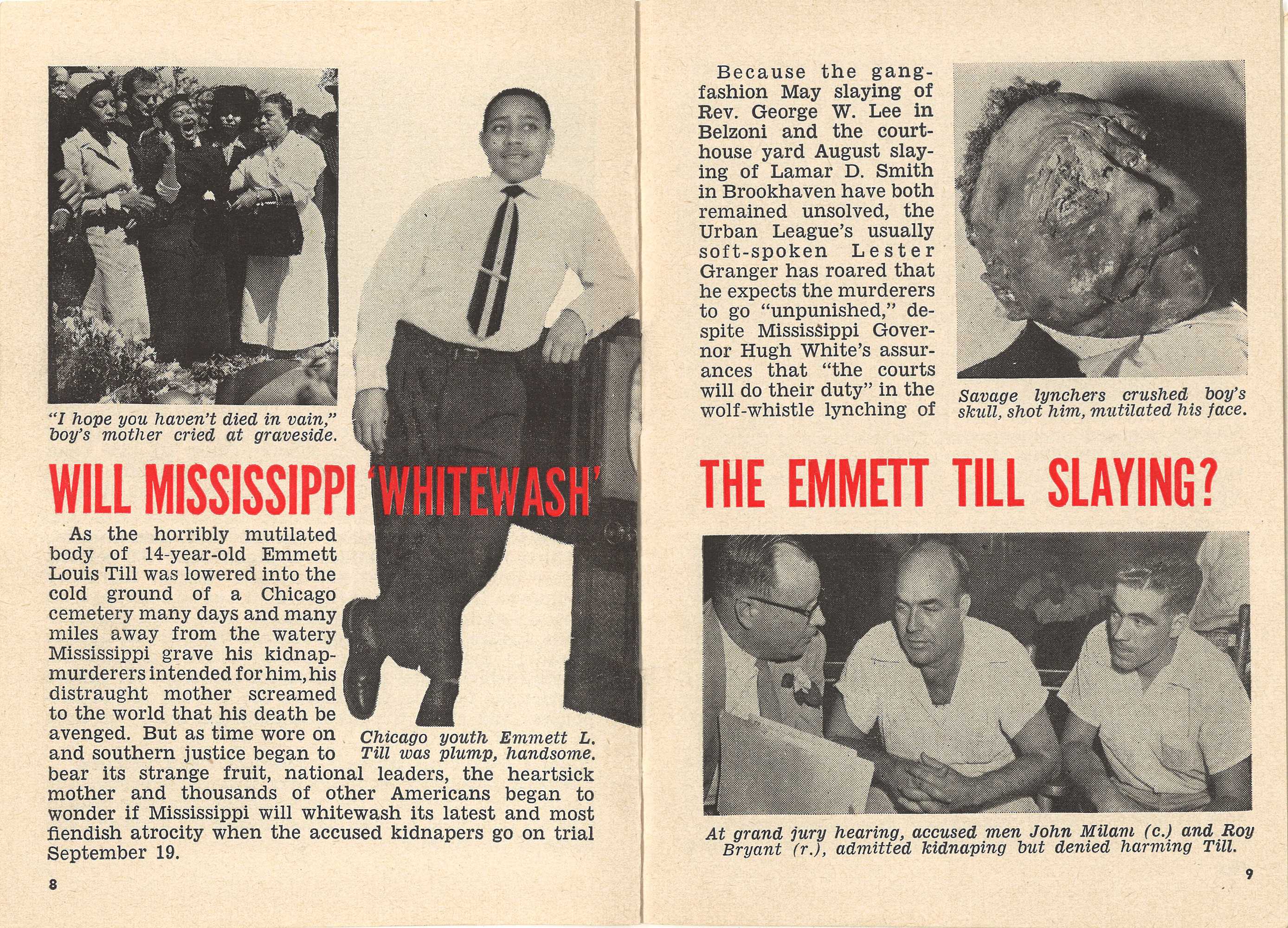
When Mamie Till-Mobley stood over the bloated, unrecognizable remains of her 14-year-old son in 1955, she didn't just see a tragedy. She saw a message. Most people know the name Emmett Till, but it’s the pictures of Emmett Till that truly forced America to stop lying to itself.
Honestly, it’s hard to look at them. That’s kind of the point.
The story usually starts with a whistle in Money, Mississippi. It ends with a lynching so brutal that the local sheriff tried to bury the body immediately to hide the evidence. But Mamie wouldn’t have it. She demanded her son be sent back to Chicago. She insisted on an open-casket funeral.
"Let the people see what I’ve seen," she said. It was a radical, gut-wrenching decision that basically birthed the modern Civil Rights Movement.
The Most Famous Portrait vs. The Reality
There’s a specific photo of Emmett that you’ve probably seen in history books. He’s wearing a straw hat, smiling slightly, looking like any other kid from the South Side of Chicago. He looks radiant. It’s a studio portrait that captures his innocence.
Then there are the other photos.
The ones taken by David Jackson and published in Jet magazine.
These images showed the world a face that had been beaten into a mask of broken bone and swollen flesh. One eye was missing. His head had been shot. A 75-pound cotton gin fan had been tied to his neck with barbed wire before he was tossed into the Tallahatchie River.
When Jet published those pictures of Emmett Till on September 15, 1955, they didn't just report news. They created a visual vocabulary for Black pain and resistance. The magazine sold out instantly. They had to reprint it—the first time that had ever happened in the publication's history.
Why the Jet Magazine Photos Were Different
Back in the 50s, white-owned media didn't show this kind of thing. If a Black man was lynched, it was often a local "secret" or, worse, celebrated with postcards sold to white spectators.
By allowing Jackson to photograph her son’s corpse, Mamie Till-Mobley flipped the script.
She turned a private funeral into a public trial of American "democracy." Over 50,000 people filed past that casket at Roberts Temple Church of God in Christ. Some people fainted. Others just stared in disbelief. But they all saw it.
The "Emmett Till Generation"
Sociologists like Joyce Ladner have talked about the "Emmett Till Generation." These were Black kids who saw those photos in Jet and realized, "That could be me."
It didn't make them hide. It made them angry.
Rosa Parks famously said she thought of Emmett Till when she refused to give up her seat on that bus in Montgomery, just 100 days after his murder. The images acted as a catalyst that moved people from the sidelines into the streets.
The Enduring Controversy of the Images
Even today, these photos stir up a lot of debate. In 2017, a white artist named Dana Schutz painted a work called Open Casket for the Whitney Biennial. It sparked huge protests.
Many Black artists and activists, like Parker Bright, argued that Black death shouldn't be a "spectacle" for white consumption or profit. They felt it was an act of "cultural appropriation" of trauma.
It’s a complicated conversation. On one hand, the photos are vital historical evidence. On the other, there is a legitimate fear that constantly circulating images of Black people being killed desensitizes us to the violence.
What Most People Get Wrong About the Photos
One common misconception is that these photos were "leaked." They weren't. Every single frame was curated and permitted by Mamie. She knew exactly what she was doing. She was a master of the "visual record."
Another thing? People forget that there were photos of the trial, too. Ernest Withers, another legendary Black photographer, captured the tension in that Sumner, Mississippi, courtroom. He took pictures of Mose Wright, Emmett's great-uncle, courageously pointing his finger at the killers in a room full of armed white men.
That was unheard of in 1955.
The Killers' Confession
Remember, Roy Bryant and J.W. Milam were acquitted by an all-white, all-male jury after only about an hour of deliberation. One juror even said it would have taken less time if they hadn't stopped to drink soda.
Because of "double jeopardy," they couldn't be tried again. So, they sold their story to Look magazine for $4,000 and bragged about the murder. They literally admitted to it in print because they knew they were untouchable.
Seeing the Legacy Today
If you want to understand the full weight of this, you sort of have to look at the original casket. It’s now at the National Museum of African American History and Culture in D.C.
The family actually discovered the original casket was being stored in a shed at the cemetery after Emmett was exhumed for a 2005 investigation. Lonnie Bunch, the museum's founding director, helped preserve it.
Standing in front of it is a heavy experience. It’s a reminder that these aren't just "historical artifacts." They represent a 14-year-old boy who never came home from summer vacation.
Actionable Insights for Engaging with This History
If you are researching or teaching about the pictures of Emmett Till, keep these things in mind:
- Context is everything. Don't just look at the disfigured photo; look at the portrait of him in the hat first. Remember the human before the tragedy.
- Respect the mother's intent. Mamie Till-Mobley wanted the world to "bear witness." When you view these images, do so with the gravity of a witness, not a tourist.
- Support preservation. Organizations like the Emmett Till Interpretive Center work to keep these stories alive in Mississippi, where markers are still frequently vandalized.
- Connect the dots. Look at how modern movements use video and photography. From the Rodney King video to the filming of George Floyd, the lineage of using "the image" as a weapon for justice starts right here in 1955.
History isn't just about what happened; it's about what we're willing to see. Mamie Till-Mobley made sure we couldn't look away.
To learn more about the preservation of these sites, you can visit the official Emmett Till Memory Project which maps out the locations of the lynching and trial to ensure the physical history is never erased.