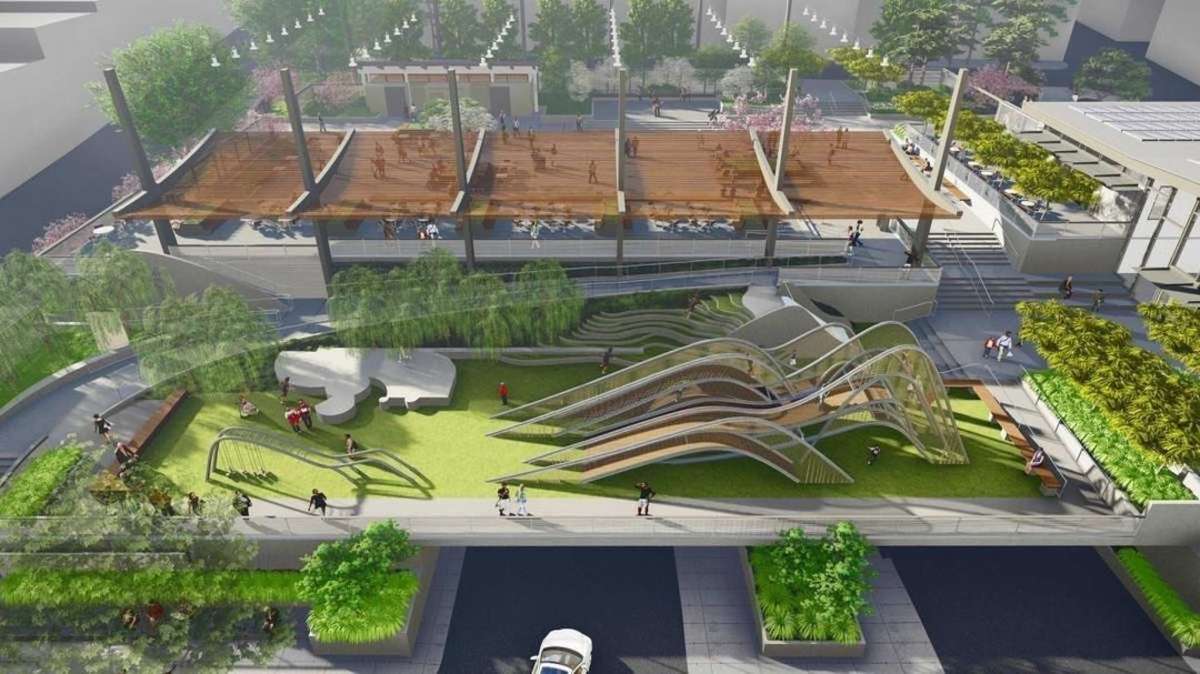
If you walk into Portsmouth Square Park San Francisco expecting a lush, rolling green meadow with quiet benches and chirping birds, you’re going to be pretty confused. Honestly, it looks like a giant concrete lid. That’s because, in many ways, it is—it sits right on top of a parking garage. But don't let the gray stone fool you. This isn't just some random urban plaza. It is the "Living Room" of Chinatown. It’s loud. It’s crowded. It’s smells like incense and diesel and steamed buns.
It’s perfect.
Most tourists just breeze past the square on their way to buy a cheap souvenir Golden Gate Bridge or a bag of fortune cookies. That’s a mistake. If you want to actually understand how San Francisco became San Francisco, you have to stand in this square. This is where the American flag was first raised in the city in 1846. It’s where the first public school in California opened its doors. It’s where Sam Brannan ran through the streets shouting "Gold! Gold from the American River!" which basically kickstarted the madness of 1849.
The Chaos and the Community
Walk up the stairs from Kearny Street today and the history feels distant, replaced by the immediate clatter of mahjong tiles. You’ll see groups of elderly men huddled over stone tables, their faces pinched in deep concentration. It’s intense. People bet—sometimes for money, sometimes just for pride—and the spectators are just as vocal as the players.
This isn't a "park" in the way suburbanites think of them. It’s a vital piece of infrastructure for a neighborhood that is one of the most densely populated areas in the Western Hemisphere. For many residents living in nearby SROs (Single Room Occupancy hotels), these few acres of concrete are the only backyard they have.
The space is cramped. On any given Saturday, you've got kids playing on the structure at the North end, Falun Gong practitioners doing slow-motion exercises near the elevators, and tourists trying to figure out where the "Robert Louis Stevenson" memorial is. Stevenson used to sit here back in the late 1800s, watching the ships come into the bay and dreaming up plot points for Treasure Island. There’s a bronze ship on a granite plinth dedicated to him, but most of the time, it’s just a convenient spot for someone to lean their grocery bag.
Why the Design is... Like That
You might notice the park feels a bit tiered and awkward. In the 1960s, the city decided that the best use of this historic site was to dig a massive hole and put a four-story parking garage underneath it. The park we see now is the 1970s-era "roof" of that garage. It was a controversial move then, and it remains a point of contention for urban planners today.
Basically, the design disconnected the park from the street level. To get into the heart of the action, you have to commit to climbing stairs or finding the somewhat temperamental elevator. This elevation creates a strange sort of "island" effect. Once you’re up there, the traffic on Kearny disappears behind the concrete walls, and you’re fully immersed in the world of Chinatown.
The Goddess of Democracy and the Weight of History
Near the Western edge of the park stands a statue that feels a bit out of place if you don't know the context. It’s a bronze replica of the "Goddess of Democracy," the iconic figure built by students during the 1989 Tiananmen Square protests in Beijing. The original was destroyed by tanks; this one stands as a defiant reminder of the political pulse of this community.
Portsmouth Square Park San Francisco has always been political. This is where the community gathers to protest, to celebrate Lunar New Year, and to demand better housing rights. When the 1906 earthquake leveled the city, this square became a tent city for the displaced. When the neighborhood was threatened by "urban renewal" projects that would have bulldozed blocks of historic buildings, the organizers met here.
Practical Realities for Visitors
Look, I’ll be real with you: the bathrooms here are notoriously rough. If you need a pit stop, you’re better off heading to a nearby cafe or the Chinatown branch of the San Francisco Public Library right across the street.
Also, the pigeons. They are everywhere. And they are bold.
If you’re coming for the photos, go to the upper bridge that crosses over Kearny Street. It connects the park to the Hilton hotel, but it offers a killer view of the Transamerica Pyramid looming over the traditional Chinese architecture. It’s that classic "old meets new" shot that everyone wants, but it actually feels earned here.
Things You Shouldn't Miss
- The Mahjong Tables: Even if you don't know how to play, just watch the hand speed. It’s incredible. Just don't get in the way or try to take close-up photos of people's faces without asking—it's their space, not a human zoo.
- The Stevenson Memorial: Located on the eastern side. It’s a quiet nod to the city’s literary past.
- The Tot Lot: If you have kids, this is one of the few places in Chinatown where they can actually run. It was renovated recently and is surprisingly decent.
- The Morning Tai Chi: If you can get there by 7:00 AM or 8:00 AM, the atmosphere is totally different. The aggression of the afternoon gambling is replaced by a synchronized, silent flow of movement.
How to Actually Experience the Square
Don't just walk through it. Buy a couple of pork buns from Good Mong Kok Bakery on Stockton Street—be prepared to wait in line—and then walk the two blocks over to the square. Find a spot on a concrete ledge, eat your buns, and just watch.
You’ll see the way the grandmothers (the "Amas") keep a watchful eye on everything. You'll hear the Cantonese dialect bouncing off the walls. You'll feel the vibration of the city.
The park is currently undergoing a series of long-term renovation plans. The city's Recreation and Parks Department has been working on a "Portsmouth Square Improvement Project" to make the space more accessible and modern. They’re looking at better lighting, more greenery (actual dirt!), and fixing those elevators. But these things move slow. For now, it remains its gritty, authentic self.
Actionable Ways to Use This Information
- Visit on a Weekday Afternoon: This is when the social life of the park is at its peak. Between 1:00 PM and 4:00 PM, the "Living Room" is full.
- Combine with the Cable Car: Take the California Line to the top of the hill and walk down through Chinatown to the square. It saves your knees.
- Check the Event Calendar: If it’s near the Lunar New Year or the Autumn Moon Festival, Portsmouth Square becomes the stage for massive community performances and lion dances.
- Support Local: After your visit, walk one block over to the Chinese Historical Society of America. It provides the deep-dive context that the park’s plaques only hint at.
- Respect the Space: Remember that for many, this isn't a tourist attraction; it's a sanctuary. Keep your voice at a moderate level and give the gamers their space.
Portsmouth Square is the soul of the neighborhood. It isn't pretty in a traditional sense, but it is deeply, unapologetically alive. If you want to see the real San Francisco—the one that survived fires, quakes, and decades of struggle—you’ll find it here, sitting on a concrete bench, playing a game of cards.