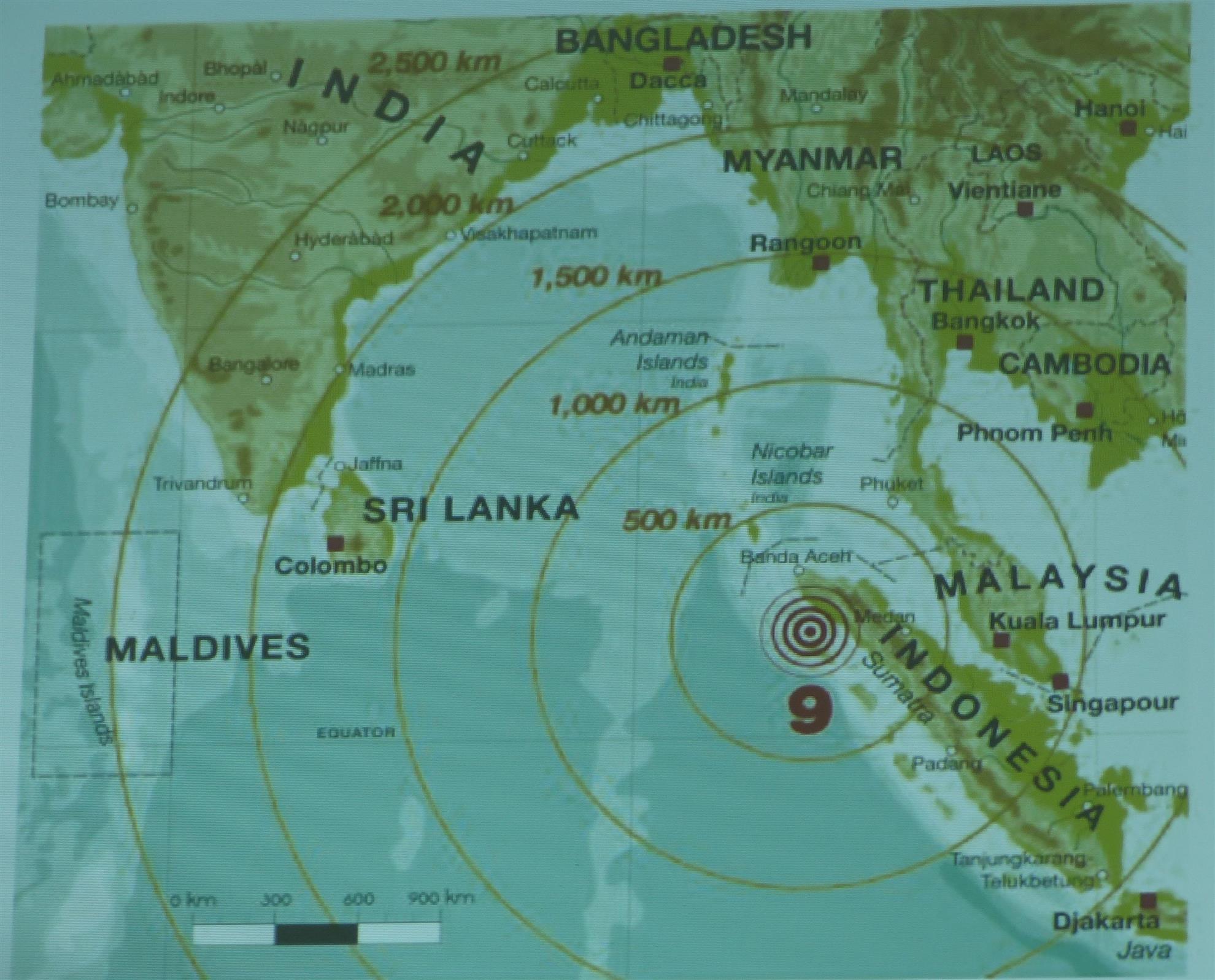
December 26, 2004. It started as a Sunday like any other for millions of people living along the coastlines of the Indian Ocean. Tourists were eating breakfast at beachfront resorts in Phuket. Fishers in Sri Lanka were mending nets. In Aceh, Indonesia, the day was just beginning to warm up. Then, the ground began to shake. It didn’t just shake; it groaned.
The 2004 earthquake and tsunami wasn't just a "natural disaster." It was a planetary event.
Most people don't realize that the earthquake itself lasted nearly ten minutes. That is an eternity when the earth is moving under your feet. Scientists later measured the magnitude at 9.1 to 9.3, making it one of the most powerful seismic events ever recorded by modern instruments. It was so violent that the entire planet vibrated by about 10 millimeters. Basically, the Earth wobbled.
The Science of Why it Was So Deadly
The epicenter was off the west coast of northern Sumatra. Here’s the thing: this wasn't a standard "shake and break" quake. It was a megathrust event. The Indo-Australian Plate was being forced under the Burma Plate. When the tension finally snapped, a 1,500-kilometer section of the fault line ruptured. Imagine a piece of the ocean floor the size of California being shoved upward by several meters in an instant.
That displaced a massive volume of water.
In the deep ocean, you wouldn't even have felt it. A tsunami in deep water is often only a few inches high, traveling at the speed of a jet plane—about 500 miles per hour. But as that energy reaches shallow water, it slows down and builds up. It’s called "shoaling." The back of the wave catches up to the front, and suddenly, you have a wall of water. In some parts of Aceh, the water reached heights of 100 feet. That is the height of a ten-story building.
The ocean didn't just come in as a single "surfable" wave. It was more like a rising, relentless tide that refused to stop. It was a churning slurry of debris, cars, trees, and buildings.
Why Nobody Saw it Coming
One of the most tragic aspects of the 2004 earthquake and tsunami was the total lack of warning.
In 2004, there were no tsunami sensors in the Indian Ocean. There were plenty in the Pacific, because Japan and Hawaii have dealt with this for centuries. But the Indian Ocean? It was considered a "quiet" zone for tsunamis. People on the beaches in Thailand saw the water recede—a phenomenon called "drawback"—and they didn't run. They walked out onto the newly exposed sand to pick up fish and shells.
They didn't know that the water receding is the ocean drawing its breath before it screams.
By the time the roar of the incoming wave was audible, it was often too late to reach high ground. In places like Sri Lanka and India, the wave arrived hours after the initial quake. If there had been a functional buoy system and a way to text-alert the population, tens of thousands of lives could have been saved. Honestly, the lack of infrastructure was just as much a killer as the water itself.
The Human Toll and the Numbers
The statistics are staggering, but they often feel cold. 227,898 people died. That’s the official estimate, though many believe the real number is higher because so many bodies were swept out to sea or buried in mass graves without being identified.
- Indonesia: The hardest hit. Over 160,000 dead.
- Sri Lanka: Roughly 35,000 victims.
- India: Approximately 16,000, specifically in Tamil Nadu and the Andaman and Nicobar Islands.
- Thailand: Over 8,000 deaths, including many international tourists.
It wasn't just Asia. The energy was so immense that it traveled all the way to South Africa, where it still had enough power to kill people 5,000 miles away from the epicenter. It’s hard to wrap your head around that kind of scale.
Lessons Learned (and Some We Forget)
The world changed after the 2004 earthquake and tsunami. We finally built the Indian Ocean Tsunami Warning System. It’s a complex network of seafloor sensors and communication hubs.
But technology is only half the battle. You have to have "last-mile" education. If a siren goes off, do people know where the high ground is? In 2004, on Simeulue Island in Indonesia, very few people died despite being closest to the epicenter. Why? Because of local folklore. Their ancestors had passed down stories about the Smong—the giant wave. When the ground shook, the elders shouted "Smong!" and everyone ran for the hills immediately.
They didn't need a satellite buoy. They had oral history.
Misconceptions People Still Have
A lot of people think tsunamis are just big waves you can dive under. You can't.
A tsunami is a column of water moving with the weight of the entire ocean behind it. If you're caught in it, you aren't just swimming; you're being tossed in a washing machine full of jagged concrete and rebar. Another misconception is that there is only one wave. Usually, the second or third wave is the largest. In 2004, many people returned to the shore after the first wave passed to help others, only to be caught by a much larger second surge.
What You Should Know Moving Forward
If you live in or travel to a coastal area, especially near a subduction zone (like the US West Coast, Japan, or Southeast Asia), you need a plan.
First, know the signs. If the ground shakes for more than 20 seconds and it's hard to stand, get to high ground. Don't wait for an official siren. Natural warnings are often faster than digital ones. Second, if you see the ocean "disappear" or recede unnaturally far, move inland immediately. Do not stop to take a video.
The 2004 earthquake and tsunami proved that we are incredibly vulnerable, but it also showed a level of global cooperation we rarely see. Billions of dollars in aid poured in from every corner of the globe.
Actionable Steps for Coastal Safety:
- Check Tsunami Maps: Most coastal cities now have inundation maps online. Find out if your hotel or home is in a "red zone."
- The 20-20-20 Rule: If the earthquake lasts 20 seconds, you have roughly 20 minutes to get 20 meters high (or inland). It’s a rough guide, but it saves lives.
- Emergency Go-Bag: Keep a small bag with water, a whistle, and a flashlight near your bed if you're in a high-risk area.
- Follow Official Sources: Follow the Pacific Tsunami Warning Center (PTWC) or your local meteorological agency on social media for real-time data.
The reality is that another "Big One" will happen eventually. It’s just how the Earth works. Geologic time is different from human time, but the 2004 event served as a brutal, necessary wake-up call for a world that had grown complacent about the power of the sea.