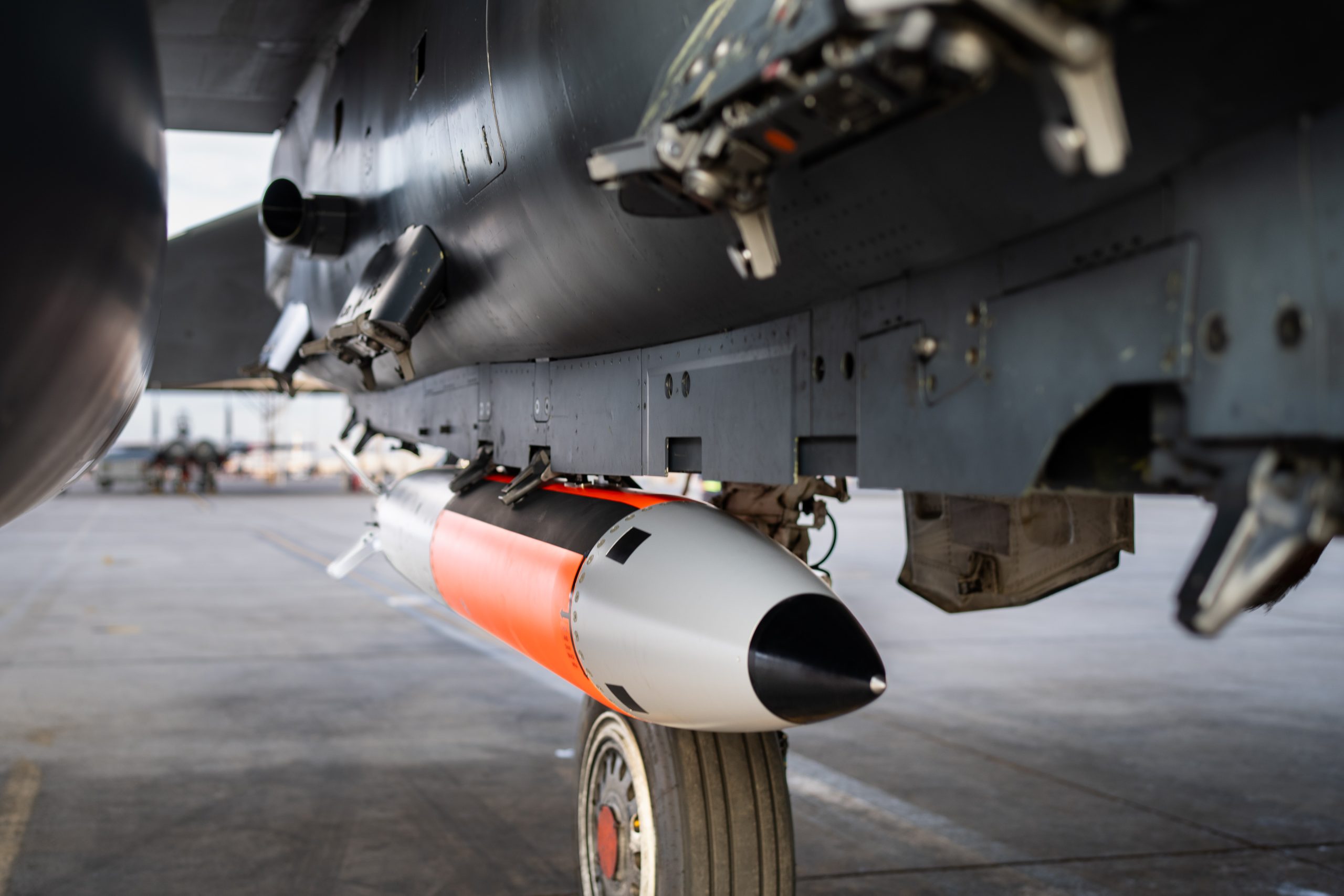
Nuclear weapons aren't exactly "new." We’ve had them since the 1940s. But the B61 12 gravity bomb is something else entirely, and honestly, it’s kind of changing the way the Pentagon thinks about deterrence. It isn’t just another bigger boom. In fact, it’s actually a smaller boom in many cases.
The US military is currently phasing out older versions of the B61—variants like the -3, -4, and -7—to make room for this new "dash 12." Think of it as a massive hardware and software update for the most important weapon in the American stockpile. It’s been in the works for over a decade. It cost billions. And depending on who you ask, it’s either a necessary modernization or a dangerous escalation.
What makes the B61 12 gravity bomb different?
Most people hear "gravity bomb" and think of World War II. They imagine a plane flying directly over a target and dropping a "dumb" hunk of metal that falls wherever the wind takes it. That’s not what’s happening here.
The B61 12 gravity bomb is the first of its kind to feature a Boeing-made tail kit. This is a big deal. Instead of falling blindly, the bomb uses an internal navigation system to steer itself toward a target. This doesn't make it a "missile"—it has no engine—but it makes it terrifyingly accurate.
Accuracy matters in the nuclear world for a reason that sounds counterintuitive: it lets you use a smaller explosion.
If you can guarantee the bomb hits within 30 meters of a bunker, you don't need a massive, city-leveling megaton warhead to destroy it. You can use a lower "yield." The B61 12 has what’s called "dial-a-yield" capability. An operator can set the explosion to be as small as 0.3 kilotons or as large as 50 kilotons. For perspective, the bomb dropped on Hiroshima was about 15 kilotons.
So, you’ve got a weapon that can be a surgical strike or a regional catastrophe.
The digital backbone
Wait. Why are we still using gravity bombs at all? Wouldn't a cruise missile be better?
Basically, flexibility. The B61 12 is designed to be carried by almost everything in the fleet. We're talking about the B-2 Spirit, the upcoming B-21 Raider, the F-15E Strike Eagle, and even the F-35A Lightning II. Because it's a "Life Extension Program" (LEP), the Department of Energy’s National Nuclear Security Administration (NNSA) is basically taking the nuclear "pit" from older bombs and putting them into brand-new, high-tech shells.
It’s recycling, but for the apocalypse.
Hans Kristensen, the director of the Nuclear Information Project at the Federation of American Scientists, has spent years tracking this development. He’s noted that this accuracy makes the weapon more "usable." That’s a word that makes arms control experts lose sleep. If a bomb is accurate and has a low yield, does that make a general more likely to suggest using it in a conventional conflict? It’s a messy debate.
The stealth factor and the F-35
If you want to understand why the B61 12 gravity bomb matters right now, look at the F-35.
In early 2024, the F-35A was officially certified to carry the B61 12. This is the first time a fifth-generation stealth fighter has been cleared to carry a nuke. This changes the math for any adversary. A stealth jet can, theoretically, slip past radar nets and deliver a precision nuclear strike before the other side even knows they’re under attack.
It’s a massive shift.
During testing at Sandia National Laboratories and Tonopah Test Range, the B61 12 demonstrated its ability to be released from a jet flying at supersonic speeds. It’s not just falling; it’s flying.
Why the tail kit is the secret sauce
The tail kit isn't just about steering. It’s about stability. Older B61s used a parachute to slow down so the plane could escape the blast radius. Parachutes are unpredictable. They drift. The B61 12 gets rid of the parachute. Instead, it uses spin-rocket motors to stabilize itself as it falls.
It looks like a dart.
This allows the aircraft to stay at a higher altitude or release the weapon from a distance, rather than doing a "loft" maneuver where the pilot has to toss the bomb and pull a hard U-turn.
The cost of "refurbishing" the end of the world
Let's talk money. This project is expensive. Like, "multiple aircraft carriers" expensive.
The B61 12 Life Extension Program is estimated to cost roughly $10 billion for about 480 bombs. That’s more than $20 million per bomb. And remember, these aren't even "new" warheads. We are reusing the explosive cores. Most of that money goes into the electronics, the structural integrity of the casing, and the rigorous testing required to ensure that a 30-year-old piece of plutonium will still go bang if it's supposed to—and won't if it isn't.
Safety and Security
NNSA keeps these things under lock and key, obviously. But the B61 12 includes updated "Permissive Action Links" (PAL). These are the coded switches that prevent unauthorized detonation. The -12 variant has the most advanced security features ever put in a gravity bomb. Even if someone stole one, they couldn't make it explode without the right authorization codes from the President.
It’s basically a high-security vault that falls from the sky.
The European connection
This isn't just a US story. The B61 12 is a central part of NATO’s "nuclear sharing" agreement.
Right now, there are older B61 bombs sitting in vaults in places like Germany, Italy, Belgium, the Netherlands, and Turkey. Under NATO agreements, if a major war broke out, the US could hand these bombs over to Belgian or German pilots to drop from their own planes.
The arrival of the B61 12 in Europe is a huge geopolitical signal. Russia sees it as a threat because of that F-35 compatibility. If you're sitting in the Kremlin, a stealth fighter with a precision nuke is a much bigger headache than a slow B-52 bomber that you can see coming from 500 miles away.
Common misconceptions
People get a few things wrong about the B61 12 gravity bomb.
First, it’s not a "bunker buster" in the way the B61-11 is. The dash 11 has a hardened steel casing for slamming deep into the earth. While the dash 12 is accurate, it’s primarily designed for surface or near-surface bursts. However, because it’s so accurate, it can effectively destroy many underground targets by hitting the "door" or the exact point of weakness.
Second, it’s not "new" technology in terms of the physics. The nuclear physics involved are decades old. The "new" part is the guidance and the integration with digital cockpits.
Third, some think it replaces all other nukes. It doesn't. We still have ICBMs in silos in Montana and North Dakota, and we still have Submarine-Launched Ballistic Missiles (SLBMs). The B61 12 is the "tactical" arm of the triad—the part that provides options other than "destroy the entire planet."
Why this matters for the future of warfare
We are entering a "tri-polar" nuclear world. It's not just the US and Russia anymore; China is rapidly expanding its silos.
In this environment, the B61 12 gravity bomb is the US's way of saying, "We have a flexible response." It’s meant to deter smaller-scale nuclear use. If a country thinks they can use a tiny nuke to win a local war, the B61 12 is there to show that the US can respond in kind without necessarily starting World War III.
It’s a grim insurance policy.
The NNSA successfully completed the "First Production Unit" in late 2021, and full-scale production is currently ramping up. Within the next couple of years, the older variants will be mostly gone, replaced by this sleek, silver, guided dart.
Actionable insights for following defense tech
If you're interested in how the B61 12 impacts global security, you should keep an eye on these specific developments over the next year:
- F-35 Deployment in Europe: Watch for news about the 48th Fighter Wing at RAF Lakenheath in the UK or Ghedi Air Base in Italy. When F-35s start showing up there in numbers, the B61 12 isn't far behind.
- The B-21 Raider Flight Tests: This is the next-gen stealth bomber. Its primary mission involves carrying the B61 12. As the B-21 enters service, the gravity bomb becomes even more relevant.
- Congressional Budget Requests: Look at the NNSA's yearly budget. Any "cost overruns" usually signal technical hurdles in the refurbishment process.
- NATO Nuclear Sharing Debates: Keep an eye on domestic politics in Germany. There is often a lot of friction regarding the presence of US nukes on German soil. If Germany ever pulls out of the sharing agreement, the B61 12 loses its primary "home" in Europe.
The B61 12 gravity bomb isn't just a relic of the Cold War. It’s a bridge to a very different, and very complicated, future of high-tech deterrence. It’s a weapon defined by its constraints—smaller, more accurate, and more "usable." Whether that makes the world safer or more dangerous is a question that doesn't have a simple answer. But for now, the US military is all in on the idea that being able to hit a target precisely is the best way to make sure you never have to pull the trigger.