History books usually give you a single day, but the reality was much messier. When people ask about the Battle of Fort Sumter date, the quick answer is April 12, 1861. But that’s just the moment the fuse hit the powder. To really understand why those specific thirty-four hours changed everything, you have to look at the tense, awkward, and frankly desperate weeks leading up to the first shot. It wasn't just a calendar entry; it was a slow-motion train wreck that everyone saw coming but nobody could stop.
The Countdown to Chaos
South Carolina had already seceded in December 1860. By the time 1861 rolled around, the federal troops under Major Robert Anderson were basically living on a ticking time bomb. They had moved from the easily accessible Fort Moultrie to the unfinished, island-based Fort Sumter in the middle of the night. It was a bold move. It was also a logistical nightmare.
Anderson was stuck. He was low on food, low on fuel, and surrounded by Confederate batteries that were growing stronger every single day. President Abraham Lincoln, who had just been inaugurated in March, was in a corner. If he evacuated, he looked weak. If he reinforced the fort with soldiers, he looked like the aggressor. So, he took a middle path: he decided to send "provisions" only. No guns, no extra troops—just bread and bacon. He even told the Governor of South Carolina, Francis Pickens, exactly what he was doing.
It was a brilliant political move, but it forced the hand of the Confederate government in Montgomery, Alabama. Jefferson Davis couldn't let the fort be resupplied indefinitely. On April 10, 1861, Confederate Brigadier General P.G.T. Beauregard—who, in a strange twist of fate, had actually been Anderson's student at West Point—received orders to demand the fort's surrender.
April 12, 1861: The Earth Shook at 4:30 AM
Negotiations failed. Anderson, ever the gentleman, told the Confederate messengers that he would be starved out in a few days anyway if they didn't batter the fort to pieces. But the Confederates couldn't wait.
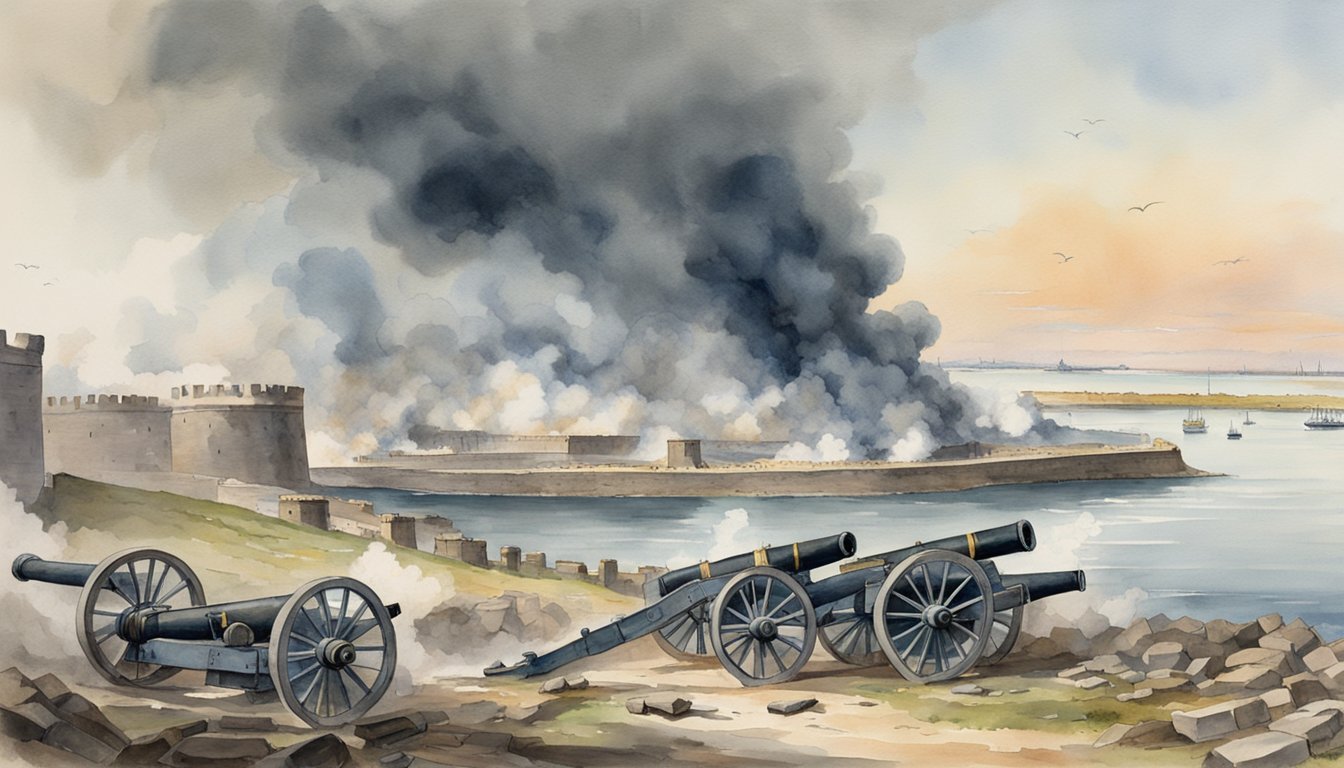
At exactly 4:30 AM on April 12, 1861, a signal shell arched over Charleston Harbor and exploded directly over Fort Sumter. That was the official start. For the next thirty-four hours, the harbor was a ring of fire. It’s hard to imagine the noise. Heavy iron shells screaming through the air, the smell of sulfur everywhere, and the realization among the soldiers that there was no going back.
Interestingly, the first shot wasn't fired by a famous general. It was likely Edmund Ruffin, a 67-year-old Virginian and die-hard secessionist who had traveled to Charleston just to see the war start. He wanted to be the one to pull the lanyard.
The Union response didn't start until about 7:00 AM. Captain Abner Doubleday—the man often (and incorrectly) credited with inventing baseball—fired the first return shot for the North. The Union troops were severely outmatched. They didn't have enough fuses for their own shells, so they were mostly firing solid iron balls that didn't explode. They were basically throwing rocks at a fortress while the Confederates were raining fire down on them.
Why the Date Matters Beyond the History Books
Most people forget that the Battle of Fort Sumter date marks a shift in how Americans viewed themselves. Before April 12, many people in the North thought the whole "secession thing" would just blow over. They figured it was political posturing. After the shells started flying, that illusion vanished.
The fire inside the fort became the biggest problem. Red-hot "shot" (cannonballs heated in furnaces) fired by the Confederates set the wooden barracks on fire. Anderson's men were fighting the flames and the Confederates at the same time. They were wrapping wet cloths over their faces just to breathe. It was miserable. By the morning of April 13, the main flagpole was shot down. A brave officer named Peter Hart managed to nail it back up, but the situation was hopeless.
The Surrender and the Strange Lack of Casualties
Here is the kicker: throughout the entire thirty-four-hour bombardment, nobody died.
Think about that. Thousands of shells were exchanged, buildings were leveled, fires were raging, yet not a single soldier on either side was killed during the actual battle. It feels almost scripted. It wasn't until the surrender ceremony on April 14 that tragedy struck. During a planned 100-gun salute to the U.S. flag, a pile of cartridges accidentally exploded. Private Daniel Hough was killed instantly, becoming the first casualty of the Civil War. A second soldier, Edward Galloway, died of his wounds later.
It’s a grim irony. The bloodiest war in American history started with a massive battle where no one died in combat, only to have the first death caused by a ceremonial salute.
Myths and Misconceptions
People often think Fort Sumter was a massive, invincible fortress. It wasn't. It was unfinished. Many of the guns weren't even mounted. Anderson had to keep his men away from the upper "barbette" tier because they were too exposed to Confederate sharpshooters and shellfire. They spent most of the battle huddled in the lower casemates.
Another big one? The idea that the North was ready. They weren't. Lincoln's relief fleet was actually waiting just outside the harbor during the battle, but they couldn't get in because of a gale and the fact that the Confederates had sunk hulks in the channel. They watched the fort burn from the sea, unable to help.
Impact on the Modern Landscape
If you visit Charleston today, the Battle of Fort Sumter date is everywhere. It’s a point of pilgrimage. But for the average person, why should you care about a date from 1861?
Because it’s the ultimate example of what happens when communication fails and ideology takes over. The weeks leading up to April 12 were filled with frantic telegrams and "secret" meetings that everyone knew about. It was a failure of the political process. When you look at the timeline, you see a series of "points of no return." Once the first shot was fired, the time for talking was over.
How to Explore This History Yourself
If you're looking to dive deeper into the events of April 1861, don't just stick to the basic Wikipedia entry. There are better ways to get the "boots on the ground" feel of what happened.
- Read the Official Records: The "War of the Rebellion: Official Records of the Union and Confederate Armies" contains the actual telegrams sent between Beauregard and Anderson. They are surprisingly polite, which makes the whole thing feel even more surreal.
- Visit the Fort: You have to take a boat from Liberty Square or Patriots Point. Seeing the harbor from the water gives you a real sense of how isolated Anderson really was.
- Check the Diaries: Look for Mary Chesnut’s Civil War diary. She was in Charleston on April 12 and described the scene from the rooftops. She talked about how people were cheering and drinking coffee while watching the bombardment like it was a fireworks show. They had no idea what was coming next.
The Battle of Fort Sumter date isn't just a trivia answer. It's the moment the United States stopped being a collection of arguing states and became a nation at war with itself. It's a reminder of how quickly "unthinkable" events can become reality when the right (or wrong) pressure is applied.
Practical Steps for History Buffs
To truly grasp the significance of April 12, 1861, your next steps should involve looking at the immediate aftermath rather than just the battle itself.
- Research the "Call to Arms": Look at Lincoln’s proclamation on April 15, 1861, where he called for 75,000 volunteers. This was the direct result of the Sumter date and what actually caused the "Upper South" (like Virginia and Tennessee) to finally secede.
- Examine the Technology: Study the difference between "rifled" and "smoothbore" cannons used at the time. Fort Sumter proved that masonry forts were becoming obsolete against the newer, more accurate rifled guns.
- Trace the Timeline: Map out the 34-hour window from the first shot to the surrender. Seeing how the wind shifted the smoke and fire explains why Anderson finally had to give up the fort.
The date might be a fixed point in time, but the story is still very much alive in how we understand American identity today.