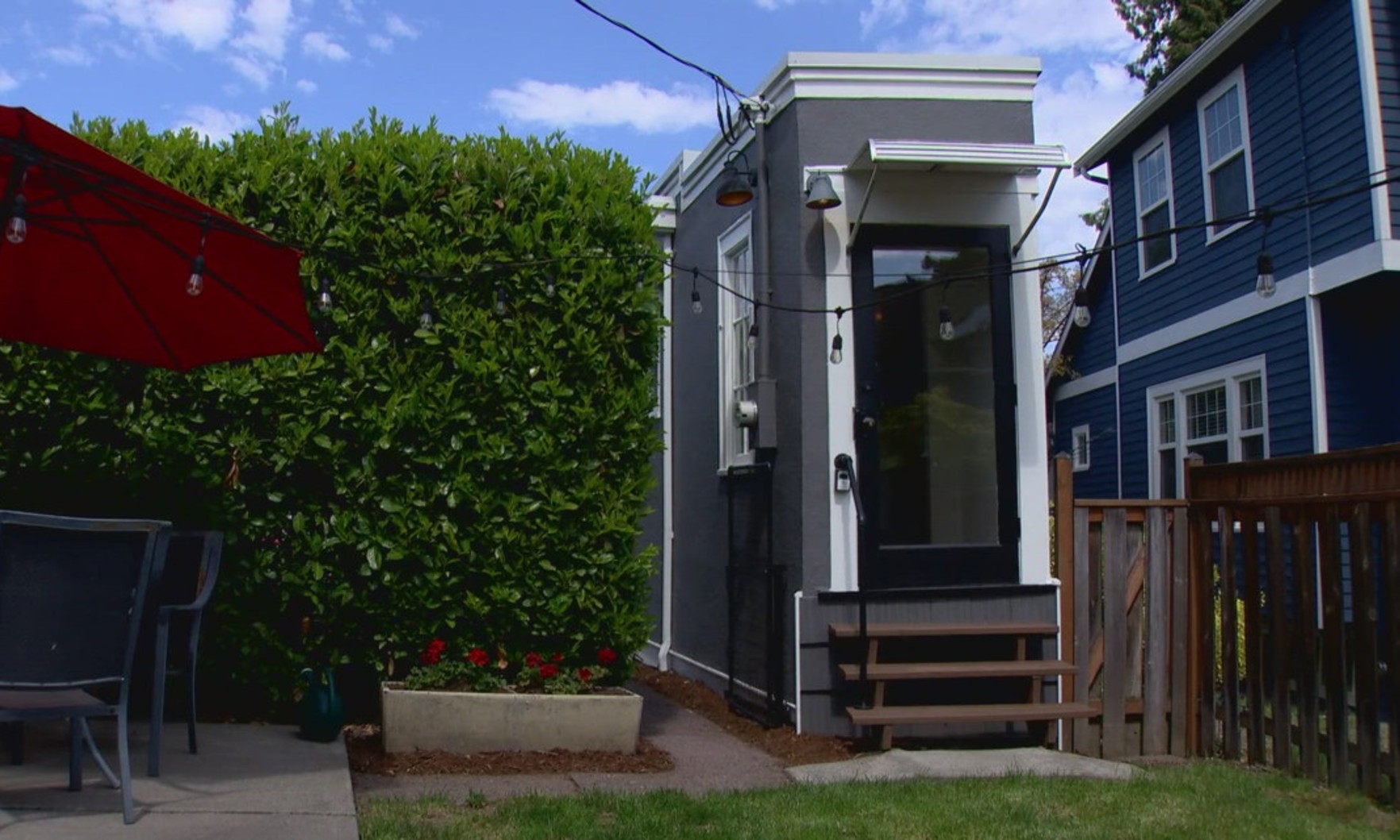
It is impossibly thin. If you walk down Hull Street in Boston’s historic North End, you might actually miss it if you blink. People call it the Boston Spite House, but its official address is 44 Hull Street. This isn’t just some quirky architectural mistake or a tiny home experiment from a hipster influencer. It is a monument to a massive family feud. Imagine being so angry at your brother that you build a house specifically to ruin his view and block his sunlight. That is exactly what happened here.
Walking past it feels weird. You look at it and think, "Nobody could actually live in that." But they do. They have for over a century. It is roughly ten feet wide at its widest point and tapers down to about nine feet in the back. It’s the kind of place where you can probably touch both walls if you have long enough arms.
The Petty History of the Boston Spite House
The story goes back to the Civil War era. Most local historians, including those who frequent the Old North Church nearby, point to a pair of brothers. When their father died, he left them a plot of land. One brother went off to fight in the war. The other stayed behind. While the soldier was away, the brother who stayed home decided to build a massive house on the majority of the lot.
He didn't leave much.
When the soldier returned, he found only a tiny sliver of land left for him. He was, understandably, livid. Most people would have sued or just moved on. Not this guy. He decided to use that remaining "useless" strip of land to build a house that would serve as a permanent middle finger to his sibling. By building 44 Hull Street, he effectively blocked all the sunlight from his brother's rear windows and ruined his view of the harbor.
It worked.
The house is about four stories tall. It’s skinny, awkward, and legendary. It wasn't built for comfort; it was built for revenge. This is why the Boston Spite House is often cited in property law discussions and architectural tours—it represents the intersection of limited urban space and unlimited human pettiness.
What It’s Actually Like Inside
You might wonder how a human functions in a space this narrow. It’s not like a normal house. There are no grand hallways. In fact, there are basically no hallways at all. The house is roughly 1,166 square feet, which sounds decent until you realize that square footage is spread across four vertical levels.
The rooms are narrow. Very narrow.
Instead of doors between rooms, you often find that the staircase itself acts as the divider. You move from the kitchen to the living area by climbing. Everything is custom. You can’t just go to a big-box furniture store and buy a sectional sofa for a house that is barely wider than a king-sized mattress.
Interestingly, the house sold in 2021 for a staggering $1.25 million. People are willing to pay a premium for a piece of history, even if that history involves shimmying sideways past your dining table. The back of the house is actually narrower than the front. It creates this strange, wedge-like perspective that makes the building feel like it’s leaning away from the "big" house next door.
Why Spite Houses Are a Real Phenomenon
Boston isn't the only place with a spite house, though ours is arguably the most famous. These structures popped up across the East Coast during the 18th and 19th centuries before modern zoning laws made them illegal. In those days, if you owned the land, you could pretty much build whatever you wanted, even if it intentionally harmed your neighbor's property value.
- The Hollensbury Spite House in Alexandria, Virginia, is another famous example. It was built just to keep horse-drawn wagons out of a private alley.
- The Pink House in Newburyport was allegedly built by a woman who, after a bitter divorce, demanded a replica of her family home. Her ex-husband built it, but he put it in the middle of a salt marsh where the water was undrinkable.
The Boston Spite House stands out because it is right in the middle of a bustling neighborhood. It isn't isolated. It’s tucked between traditional brick buildings, making its thin profile look even more ridiculous. When you stand in front of it, you realize how much effort it took to make this happen. Every brick laid was a deliberate choice to aggravate a family member.
Architectural Challenges of Living Small
Living here requires a specific mindset. You have to be a minimalist. There is no room for clutter. Most of the storage is built into the walls or tucked under the stairs.
The light is actually better than you’d think on the upper floors because the house is so thin that windows on both sides allow light to pass all the way through. But on the ground floor? It’s dark. It feels like a bunker. That was the whole point, though. The builder didn't care about his own light as much as he cared about taking it away from someone else.
Honestly, the "skinny house" (as locals often call it) is a masterclass in maximizing utility. It has a full kitchen, bathrooms, and bedrooms. It even has a small roof deck. From that deck, you get a view of the USS Constitution and the harbor—the very view the soldier brother fought to reclaim in his own spiteful way.
Visiting 44 Hull Street Today
If you’re planning to see the Boston Spite House, you need to be respectful. This is a private residence. It is not a museum. People live there, eat dinner there, and probably get annoyed by the hundreds of tourists taking selfies in front of their door every day.
It is located directly across from the Copp's Hill Burying Ground. This is convenient for a history walk. You can visit the graves of the Mather family (famous for the Salem Witch Trials) and then turn around to see the pinnacle of 19th-century sibling rivalry.
- Start at the Old North Church. It’s just a two-minute walk away.
- Walk up Hull Street. Keep your eyes peeled on the left side (if you're walking away from the church).
- Look for the red door. The house is painted in a classic Boston brick red, but the narrowness is the giveaway.
Don't try to knock on the door. Don't peer through the windows. Just appreciate the sheer audacity of the architecture from the sidewalk.
The Legal Legacy of Spite Houses
Today, you couldn't build this. Modern "Right to Light" laws and strict zoning regulations prevent people from building structures solely to annoy their neighbors. In most jurisdictions, a "spite fence" or "spite building" is legally defined as something that provides no benefit to the owner and is constructed with malicious intent.
If the soldier brother tried this today, his brother would just call the city planning office. The project would be shut down before the first brick was laid. This makes the Boston Spite House a protected relic of a time when the law was much more "Wild West" regarding property rights.
It’s also a reminder of how Boston was built. The North End is a maze. The streets are narrow because they follow the original cow paths of the 1600s. Space has always been at a premium here. Building a house on a "sliver" of land wasn't just mean; it was a logistical nightmare that required serious masonry skills.
How to Appreciate the Architecture
When you look at the house, notice the windows. They are disproportionately large for the width of the building. This was a necessity. Without those windows, the interior would feel like a coffin.
The house is roughly four times as tall as it is wide. That ratio is wild. Most houses are wider than they are tall, or at least balanced. This one looks like a brick book standing on its end.
If you're into photography, the best angle is from the corner of the burying ground across the street. This allows you to capture the depth—or lack thereof—of the building. You can see how it pinches in toward the back, almost like it’s trying to hide behind the neighbor's wall.
Actionable Tips for Your North End Visit
To get the most out of seeing the Boston Spite House, you should pair it with a broader exploration of the North End’s history. This neighborhood is the oldest in the city.
- Go early. The North End gets incredibly crowded by noon. If you want a photo without twenty other people in it, get there by 8:00 AM.
- Check the graveyard. Copp’s Hill Burying Ground offers a great elevated view of the house and the surrounding area.
- Grab a cannoli afterward. You are a five-minute walk from Mike’s Pastry and Modern Pastry. Everyone argues about which is better. (Hint: Modern usually has the shorter line and better cream).
- Wear comfortable shoes. The sidewalks in this part of town are uneven brick and cobblestone. Your ankles will thank you.
The Boston Spite House remains one of the most interesting stops in the city because it’s human. It’s not a grand monument to a president or a war hero. It’s a monument to a guy who got cheated and decided to do something about it. It’s a story everyone understands. We’ve all felt that spark of petty frustration. Most of us just don't have the masonry skills to turn that frustration into a million-dollar piece of real estate.
If you are heading to Boston, put Hull Street on your list. It takes five minutes to see, but the story will stay with you much longer than a visit to a standard museum. It is the ultimate example of how history isn't just made of big events; it's made of small, narrow, brick-and-mortar grudges.