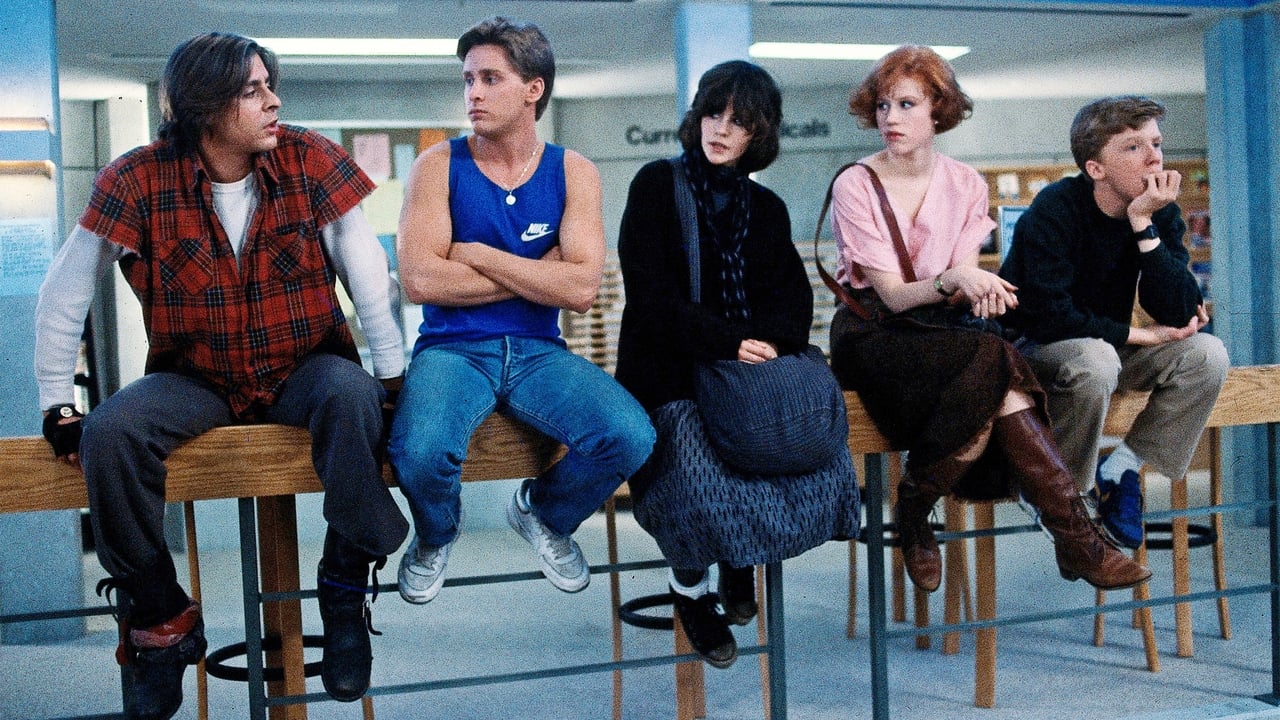
Five kids. One Saturday. A library that felt like a cage. When John Hughes released his magnum opus in 1985, nobody—not even the studio—really knew if audiences would care about a brain, an athlete, a basket case, a princess, and a criminal just sitting around talking. But they did. More than forty years later, the cast of The Breakfast Club remains the definitive blueprint for the "Brat Pack" era, though the lives they led after that fictional detention ended couldn't have been more different.
People think these actors were best friends forever. They weren't. Honestly, the chemistry you see on screen was a mix of intense rehearsals and the fact that most of them were actually quite young and terrified of fading into obscurity.
Judd Nelson and the Method of Being a Menace
Judd Nelson almost got fired. It’s a bit of Hollywood lore that’s actually true. To play John Bender, the quintessential "criminal," Nelson stayed in character off-camera. He was mean to Molly Ringwald. He stayed prickly. John Hughes, who was notoriously protective of Ringwald, was ready to kick Nelson off the set until the other cast members stepped in to save his job.
Nelson’s career after Shermer High is a weird, jagged line. He hit it big again with St. Elmo’s Fire immediately after, but he never quite transitioned into the leading man status that people expected. You’ve probably seen him in voice-over work—he was Hot Rod in the original Transformers movie—or in smaller, grittier TV roles like Empire. He didn't want to be the heartthrob. He wanted to be a character actor, and in a way, he got exactly what he asked for, even if it meant moving away from the A-list spotlight.
Molly Ringwald: The Muse Who Walked Away
Molly Ringwald was 16 when she played Claire Standish. Think about that. She was a literal child carrying the emotional weight of a generation. Hughes basically built a cinematic universe around her, from Sixteen Candles to Pretty in Pink. But by the late 80s, Ringwald did something most young stars would find insane: she moved to France.
She wanted to be a person, not a poster on a teenager's wall.
Returning to the US years later, her career shifted toward television and writing. Most younger viewers know her now as Mary Andrews on Riverdale, playing the mother of a new generation of dramatic teens. It’s a full-circle moment that feels poetic. Ringwald has been very vocal lately about the "problematic" elements of Hughes’ films, particularly the scene where Bender hides under her skirt. It’s a nuanced take—she loves the films that made her, but she isn’t afraid to point out that 1985 was a very different, and sometimes uglier, time for women in film.
Anthony Michael Hall: From Nerd to Heavy
If you look at Anthony Michael Hall in 1985 and then look at him in The Dark Knight or Halloween Kills, it’s hard to believe it’s the same guy. He was the "Brain," Brian Johnson. He was the scrawny kid who couldn't handle the pressure of an F grade.
Hall intentionally broke his typecasting. He turned down roles in Ferris Bueller’s Day Off because he didn't want to be the nerd anymore. He joined Saturday Night Live at 17, becoming the youngest cast member in history—a stint that was widely considered a disaster because he was just too young for the grueling pace of live sketch comedy.
He disappeared for a bit. Struggled with some personal demons. Then, he came back as a leading man in The Dead Zone on USA Network. He’s one of the few members of the cast of The Breakfast Club who successfully transitioned into a "tough guy" or "authoritative figure" archetype. He’s bulky, he’s deep-voiced, and he’s miles away from the kid who had a flare gun in his locker.
Emilio Estevez: The Man Who Preferred the Director’s Chair
Andrew Clark, "The Athlete," was played by Emilio Estevez. At the time, Emilio was arguably the biggest star of the group. He was the son of Martin Sheen and the brother of Charlie Sheen, but he kept his own name to forge his own path.
While he had massive hits like The Mighty Ducks and Young Guns, Estevez’s heart was always behind the camera. He started writing and directing early on. His film Bobby, about the assassination of Robert F. Kennedy, showed a level of maturity and political interest that was a far cry from the varsity wrestling singlet. He’s mostly stepped back from the Hollywood machine lately, focusing on smaller, more personal projects like The Way. He seems content. He didn't need the constant validation of the paparazzi.
Ally Sheedy: The "Basket Case" Who Found Her Voice
Allison Reynolds, the "basket case" who ate Pixy Stix and Cap'n Crunch sandwiches, was the soul of the movie. Ally Sheedy played her with a twitchy, haunting brilliance.
Post-detention, Sheedy had a rougher road than some of her costars. The industry didn't quite know what to do with her. She had a major resurgence in the late 90s with the independent film High Art, where she played a drug-addicted photographer. It won her a lot of critical acclaim and reminded people that she was a powerhouse actor, not just a girl who shook dandruff onto a drawing.
She’s been teaching lately. She’s an adjunct professor at City College of New York, helping the next generation of actors find their footing. It’s a remarkably grounded life for someone who was once at the center of the Hollywood universe.
Why the Chemistry Actually Worked
The reason the cast of The Breakfast Club feels like a real group of students is because Hughes made them hang out in the Chicago suburbs for weeks before filming. They went to high schools. They watched how kids sat and talked.
There was a real sense of isolation.
The film was shot almost entirely in sequence. That’s rare. Usually, movies are shot out of order for budget reasons. But Hughes wanted the actors to actually feel the progression of the day. The exhaustion you see in the final scenes? That’s real. By the time they were filming the "confessional" circle on the floor, the actors were genuinely tired of each other and the room. That friction created the magic.
What happened to the supporting players?
It wasn't just the five kids. Paul Gleason, who played Vice Principal Richard Vernon, became the ultimate cinematic "jerk" authority figure for the rest of his career. He leaned into it. He loved it. He passed away in 2006, but his "don't mess with the bull" speech remains one of the most quoted moments in 80s cinema.
Then there’s John Kapelos, the janitor Carl. He was the secret MVP. He represented the future—the guy who sees everything but doesn't care about the social hierarchies of high school. Kapelos has had a massive career as a character actor, appearing in hundreds of TV shows and movies. He’s the guy you recognize in everything but can't quite place.
Actionable Insights for Fans and Collectors
If you’re looking to dive deeper into the history of the cast of The Breakfast Club or want to own a piece of this cinematic history, here are the most effective ways to do it without falling for the "nostalgia bait" traps:
- Skip the standard Blu-ray: If you want the real story, track down the Criterion Collection release. It contains over 50 minutes of never-before-seen deleted scenes that actually change how you view the characters, especially the relationship between Carl the janitor and Principal Vernon.
- Read the memoirs: To get the unvarnished truth about the set, read Molly Ringwald's Getting the Pretty Back or Ally Sheedy's various interviews regarding the "Brat Pack" label. They offer a much more cynical (and realistic) view of the 80s than the marketing materials suggest.
- Follow the modern projects: Don't just re-watch the old stuff. Check out Anthony Michael Hall in Halloween Kills or Ally Sheedy in Single Drunk Female. Seeing how their acting styles evolved provides a much deeper appreciation for the work they did as teenagers.
- Visit the filming locations: Most of the movie was filmed at the old Maine North High School in Des Plaines, Illinois. While it's now a police station/government building, the exterior is still iconic. Just don't expect to find the library—it was a massive set built in the school's gymnasium.
The reality of the cast of The Breakfast Club is that they were five very different people who were captured at a specific moment in time when their anxieties matched the anxieties of an entire generation. They didn't all stay famous, and they didn't all stay friends. But for a few weeks in a Chicago gym, they managed to tell a truth that still rings true: when you grow up, your heart dies. Luckily for these five, their work on screen ensured that a piece of their youth would stay alive forever.