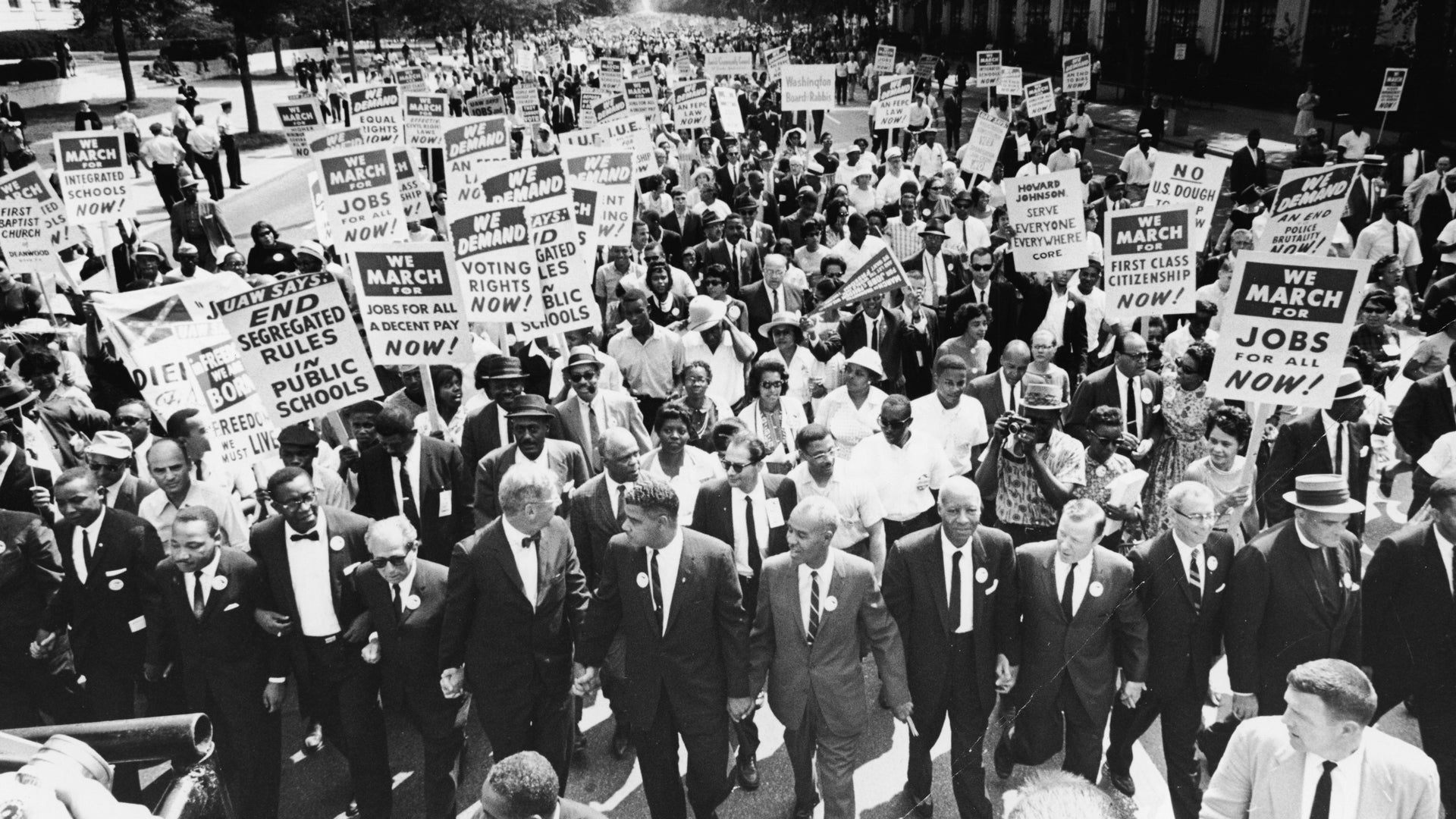
History isn't a straight line. People often talk about the civil rights movement in 1960s like it was this neat, organized parade that started with a dream and ended with a law. It wasn't. It was messy, terrifying, and honestly, a lot more radical than your high school textbook probably let on. If you look at the raw data and the primary accounts from folks like Ella Baker or Bayard Rustin, you realize the decade wasn't just about "equality" in a vague sense—it was a high-stakes chess match against a system that was perfectly comfortable using dogs and fire hoses on children.
We remember the big speeches. But the reality? It was a decade of gritty, local organizing. It was about grandmothers in Mississippi risking their houses to host SNCC volunteers and students sitting at lunch counters while people poured hot coffee down their backs.
The 1960 Greensboro Sit-ins: More Than Just Lunch
You've heard of the Greensboro Four. Ezell Blair Jr., Franklin McCain, Joseph McNeil, and David Richmond. On February 1, 1960, they sat down at a Woolworth’s lunch counter in North Carolina.
But here’s what's usually missed: they weren't the first to try this. Not by a long shot. There had been sit-ins in Wichita and Oklahoma City years prior. So why did Greensboro spark a wildfire? Timing. The 1960s brought a specific kind of cultural exhaustion with the slow pace of legal change. "With all deliberate speed"—the phrase from the Brown v. Board decision—had turned out to mean "hardly moving at all."
By the end of that week, hundreds of students joined them. By the end of the month, sit-ins were happening in seven states. This wasn't a top-down directive from the NAACP. In fact, some of the older generation of leaders were terrified these "kids" were going to ruin the legal strategy. It was raw, organic, and incredibly dangerous. These students were basically saying that if the law wouldn't protect their dignity, they’d put their bodies in the way until the system broke.
Freedom Riders and the Burning Bus in Anniston
1961 was the year things got violent. Really violent. The Congress of Racial Equality (CORE) decided to test whether the Supreme Court's ruling against segregation in interstate travel was actually being enforced.
It wasn't.
When the Freedom Riders pulled into Anniston, Alabama, a mob attacked the bus. They slashed the tires. When the bus tried to limp away, they followed it. They threw a firebomb through the window and held the doors shut. Think about that for a second. They tried to burn people alive for sitting on a bus together.
The images of that charred bus frame did something that speeches couldn't. They forced the Kennedy administration's hand. JFK wanted to focus on the Cold War and Khrushchev; he didn't want to deal with "the race issue" on the front page of every international newspaper. But the civil rights movement in 1960s was brilliant at one specific thing: creating a crisis that could no longer be ignored.
The Birmingham Pivot
If you want to understand how the movement actually worked, you have to look at Birmingham in 1963. Project C. The "C" stood for confrontation.
Martin Luther King Jr. and the Southern Christian Leadership Conference (SCLC) almost failed here. The campaign was flagging. People were scared to get arrested because they couldn't afford bail. That's when James Bevel suggested something controversial: use the children.
On May 2, 1963, over a thousand students skipped school to march. This is the moment where Bull Connor, the Commissioner of Public Safety, unleashed the dogs and the high-pressure hoses. If you've seen those photos—the ones where the water pressure is literally peeling bark off trees and knocking kids down—that’s Birmingham.
It was a PR nightmare for the United States. It forced the business community in Birmingham to negotiate because the city was becoming a ghost town. It also led directly to King writing "Letter from Birmingham Jail," which, honestly, is a much more "fed up" document than people realize. He wasn't just talking to segregationists; he was calling out the "white moderate" who preferred order to justice.
The 1964 Civil Rights Act: A Beginning, Not an End
LBJ signed the Civil Rights Act of 1964. It was massive. It outlawed discrimination in public places and integrated schools. But if you talk to activists from that era, they'll tell you the mood wasn't just celebratory—it was wary.
The law was a piece of paper. Enforcement was another story. In the Deep South, the 1964 Act didn't magically make it safe to vote. That's why Freedom Summer happened. Hundreds of college students, mostly white and from the North, headed to Mississippi to register Black voters.
This led to the disappearance and murder of James Chaney, Andrew Goodman, and Michael Schwerner. The fact that the FBI only got involved because two of the victims were white remains a bitter point of reflection for many who were there. It highlighted a grim reality: the media and the government cared more about white blood than Black lives.
The Voting Rights Act of 1965 and the Bridge
Selma. 1965. John Lewis.
The march from Selma to Montgomery was about one thing: the right to vote without being murdered for it. On "Bloody Sunday," state troopers attacked marchers on the Edmund Pettus Bridge.
The footage aired on television, interrupting a movie about Nazi war crimes. The irony wasn't lost on the American public. Within months, the Voting Rights Act of 1965 was passed. It did away with literacy tests and poll taxes—the "legal" tricks used to keep Black people from the ballot box.
The Shift to Black Power and the North
By 1966, the civil rights movement in 1960s was changing. The focus shifted from the Jim Crow South to the de facto segregation of the North—redlining, job discrimination, and police brutality.
This is where you see the rise of the Black Panther Party in Oakland and the "Black Power" slogan popularized by Stokely Carmichael. The movement became less about "integration" into a burning house and more about self-determination and economic power.
When Dr. King moved into a dilapidated apartment in Chicago to protest housing conditions, he found that Northern racism was just as virulent as Southern racism, just less "polite." He was hit by a rock during a march in Marquette Park and said he’d never seen mobs as hateful as the ones in Chicago.
What Most People Get Wrong About 1968
We tend to end the story with King’s assassination in Memphis. It’s a tragic, cinematic ending. But 1968 wasn't the end. It was an explosion.
The Fair Housing Act was passed days after his death, mostly because the government was terrified of the riots (or rebellions, depending on who you ask) breaking out in over 100 cities. The movement didn't "die" with King; it fractured and evolved. It moved into the feminist movement, the anti-war movement, and the fight for LGBTQ+ rights (Stonewall happened in 1969, after all).
Why the 1960s Still Matters Today
If you look at the voting maps today, or the wealth gap, or the way districts are drawn, you see the fingerprints of the 1960s everywhere. The civil rights movement in 1960s wasn't a historical "event" that finished; it was a shift in the American tectonic plates that is still settling.
The activists of that era didn't have iPhones or social media. They had mimeograph machines and phone trees. They had a level of discipline that is almost hard to fathom today. They didn't just "post" about things; they organized until the status quo became more expensive than the change they were asking for.
Actionable Insights for Today
If you're looking to actually engage with this history or apply its lessons, here's the move:
- Read the Primary Sources: Don't just watch a documentary. Read The Autobiography of Malcolm X and King’s Where Do We Go from Here: Chaos or Community? The nuances in their late-stage thinking will surprise you.
- Support Modern Voting Rights: The 1965 Voting Rights Act was gutted by the Supreme Court in 2013 (Shelby County v. Holder). Understanding the 60s means understanding why that matters right now.
- Look at Local History: Every city has a 1960s civil rights story. Find out who led the protests in your town. It wasn't just the famous names; it was local teachers, preachers, and students.
- Acknowledge the Economic Component: The 1963 March on Washington was officially the "March on Washington for Jobs and Freedom." We often forget the "Jobs" part. The fight was always about the pocketbook as much as the ballot.
The decade was a masterclass in how to move a mountain. It shows that progress isn't inevitable—it’s forced. And usually, it's forced by people who are tired of waiting for "the right time."