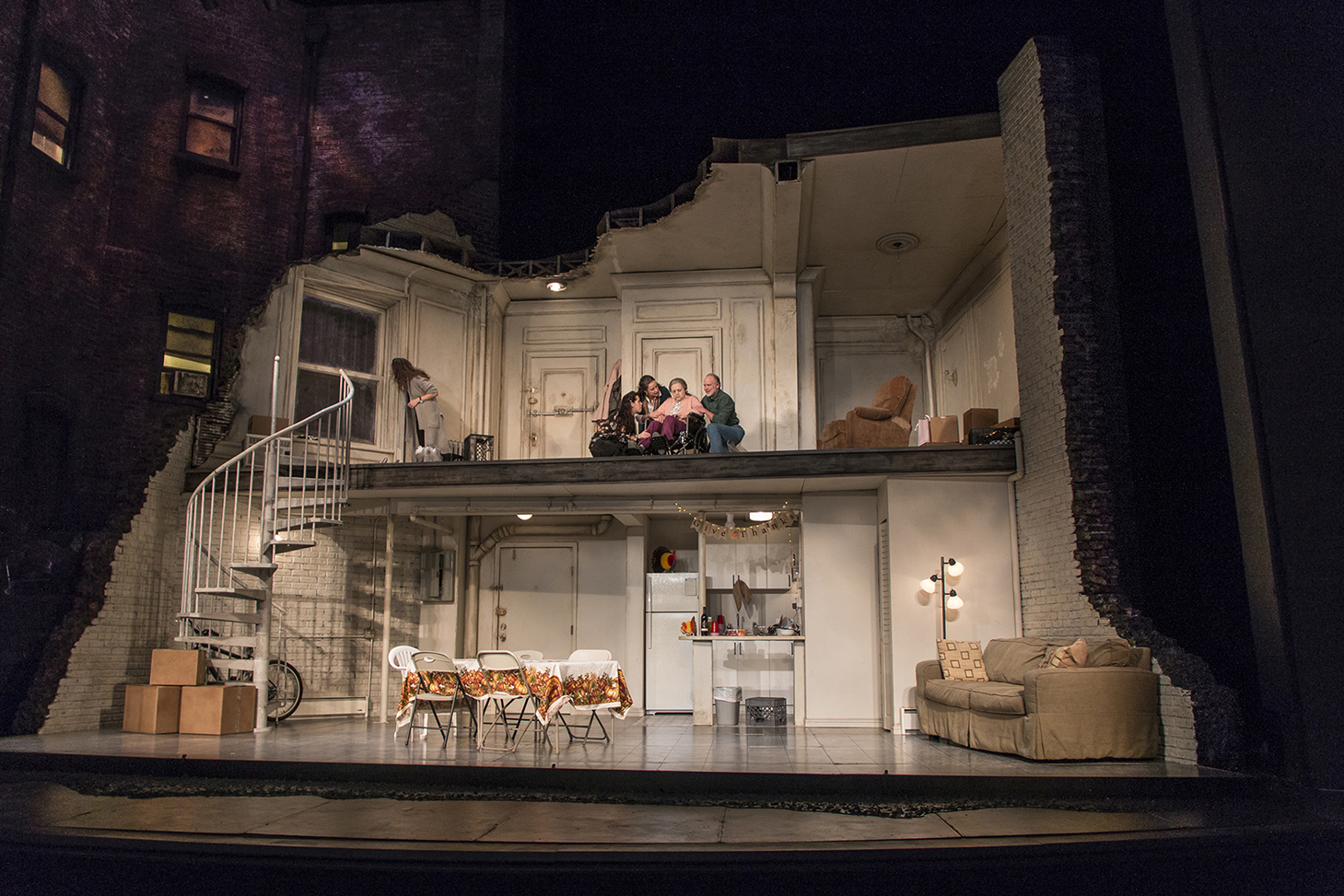
If you’ve ever sat at a Thanksgiving table and felt a sudden, inexplicable chill that had nothing to do with the drafty windows, you already understand The Humans. It’s a play that doesn't rely on flashy monsters or cheap jump scares. Instead, Stephen Karam crafts a type of horror that is far more invasive: the slow-burning realization that your family is falling apart, your body is failing, and the American Dream is basically a ghost story we tell ourselves to stay sane.
It’s heavy. Honestly, it’s a lot.
But there’s a reason this play cleaned up at the 2016 Tony Awards and continues to be staged in regional theaters across the country. It captures a specific frequency of modern anxiety that most writers are too afraid to touch. Karam isn't interested in the "perfect" family drama where everything gets resolved over pumpkin pie. He wants to show you the leaks in the ceiling.
What is The Humans actually about?
At first glance, the setup is almost cliché. The Blake family—three generations of Irish-Catholics—gathers for Thanksgiving dinner in a run-down duplex in Chinatown, Manhattan. Brigid, the youngest daughter, has just moved in with her boyfriend, Richard. Her parents, Erik and Deirdre, have driven in from Pennsylvania with "Momo," the grandmother whose dementia has reached a heartbreaking crescendo. Aimee, the older sister, is there too, dealing with a devastating breakup and a chronic illness that’s ruining her career.
Nothing happens. Then everything happens.
The play is technically a one-act, running about 90 minutes without an intermission. This is a deliberate choice. Karam creates a pressure cooker environment where the audience can't escape the mounting tension. The "horror" elements aren't supernatural, even though the basement apartment is creepy as hell. There are thumps from overhead neighbors. The lights flicker and die at the worst possible moments. These environmental stressors mirror the internal collapse of the characters. It’s a literal and metaphorical "downward" movement—the play starts on the upper floor of the duplex and ends in the darkness of the windowless basement.
The genius of Stephen Karam’s dialogue
Most plays sound like, well, plays. Characters take turns speaking in perfectly formed paragraphs. People don't do that in real life. We interrupt. We trail off. We say "uh-huh" while checking our phones.
Karam is a master of the "overlapping" script. If you look at the physical book of The Humans, the dialogue is often written in two columns. This means characters are speaking simultaneously. It creates this wall of sound that perfectly mimics a real family gathering. You’ve got Deirdre complaining about her boss while Erik is trying to fix a window and Brigid is arguing about the wine. It’s chaotic. It’s noisy. It’s exactly how families communicate when they’re trying to avoid talking about the things that actually matter.
This "hyper-realism" is what makes the play so effective. When a character finally drops a truth bomb—like Erik’s confession about his job or Deirdre’s insecurity about her social standing—it hits like a physical blow because the air was previously filled with so much meaningless chatter.
The ghosts in the architecture
The apartment itself is a character. It’s a "pre-war" duplex, which sounds fancy until you realize it’s a damp, noisy, windowless box. In the 2016 Broadway production directed by Joe Mantello, the set was a massive, two-story structure that allowed the audience to see what was happening in one room while a different conversation occurred in another.
This creates a sense of voyeurism. You see Aimee crying on the toilet while her parents are laughing upstairs. You see the "Momo" character wandering aimlessly while the young couple discusses their financial future. This layering reinforces the theme that we never truly know the people we love, even when we’re trapped in a small space with them.
The "scary" parts of the play come from the building’s quirks.
- The sudden, booming thuds from the neighbor upstairs (who is never seen).
- The red light of the trash compactor glowing like an eye.
- The way the shadows stretch as the evening turns into night.
It’s a psychological thriller disguised as a family dramedy. Karam has explicitly mentioned in interviews that he wanted to write a "scary play" that didn't have a ghost. He succeeded. The "ghosts" are the things we fear: poverty, sickness, and being alone.
Why the ending of The Humans is so controversial
If you’re looking for a neat bow, go watch a sitcom. The Humans ends on a note that leaves many audience members feeling deeply unsettled. As the family leaves, Erik is left alone in the darkening basement. The noises from the building intensify. The lights fail completely.
Some critics argue the ending leans too hard into horror tropes. Others see it as a profound statement on the isolation of the human soul. Erik, a man who has spent his life trying to provide a "middle-class" existence for his daughters, is literally left in a hole in the ground.
It’s a bleak image.
But it’s also honest. The play reflects a post-9/11, post-2008 recession anxiety where the safety nets are gone. Erik and Deirdre worked hard, stayed loyal to their jobs, and went to church, yet they are still facing a terrifyingly uncertain future. The play suggests that the "terrors" of the world aren't coming for us from the outside; they are already in the room with us.
The transition from stage to screen
In 2021, Karam adapted and directed a film version of the play. It’s a fascinating experiment in translation. On stage, you have the wide-angle view of the entire house. On film, Karam uses tight, claustrophobic shots. He focuses on the rot: the peeling wallpaper, the grease on the stove, the stains on the ceiling.
The film stars Richard Jenkins, Amy Schumer, Beanie Feldstein, and Steven Yeun. It’s a powerhouse cast. While some fans of the play felt the film was too dark, it leans even harder into the "arthouse horror" aesthetic. It’s not a "movie" in the traditional sense; it’s a sensory experience of discomfort.
If you’re a student of acting, the film is a masterclass in subtlety. You can see the micro-expressions of disappointment on Deirdre’s (played by Jayne Houdyshell, who won a Tony for the role on Broadway) face when her daughters roll their eyes at her. That stuff is harder to see from the back row of a theater.
Key themes that make the play universal
What makes this play work in 2026 just as well as it did in 2016? It’s the focus on "existential dread" that everyone feels but no one knows how to name.
- Economic Anxiety: This isn't a play about "poor" people, but it’s about people who are one medical bill away from ruin. That is the reality for most of the audience. The Blakes are struggling to keep up appearances, and the effort is exhausting them.
- The Failure of Religion: The parents are devout Catholics, but their faith doesn't provide the comfort it used to. It’s more of a habit than a sanctuary.
- Physical Decay: From Momo’s dementia to Aimee’s ulcerative colitis, the play is obsessed with the betrayal of the body. We like to think we are in control, but our biology says otherwise.
- Communication Gaps: Despite talking constantly, the family members are often speaking different languages. The generational gap between the "boomer" parents and "millennial" children is handled with incredible nuance—neither side is entirely right or entirely wrong.
How to approach The Humans as a reader or viewer
If you’re going to watch a production or read the script, don't look for the "plot." There isn't a traditional inciting incident that leads to a climax and resolution. Instead, look for the shifts in power. Watch how Brigid tries to assert her independence through her "organic" cooking, and how Deirdre subtly undermines her. Watch how Richard tries to fit into a family dynamic that is inherently closed off to outsiders. The play is found in the pauses.
It’s also surprisingly funny. You have to laugh, or you’ll cry. The humor is dry, self-deprecating, and very "East Coast." If you don't find the Momos of the world—the grandmother who sporadically screams nonsense—a little bit funny, you’ve never dealt with the absurdity of elder care.
Actionable insights for theater lovers
If you are a director, actor, or just a fan of the craft, there are several ways to engage more deeply with this work.
For Actors:
- Study the "overlapping" sections. The key isn't to wait for your turn to speak, but to listen for the "trigger" word that makes your character jump in. It’s about rhythm, not lines.
- Focus on the "physical life" of the character. How does Erik hold his back? How does Aimee hide her pain? The play is intensely physical.
For Directors:
- The sound design is 50% of the show. If the "thumps" from upstairs don't sound real, the tension evaporates. Invest in a high-quality sound system and a designer who understands the psychology of noise.
- Don't over-direct the "horror." If you try to make it a ghost story, you lose the humanity. Let the environment be creepy, but keep the acting grounded in reality.
For Casual Viewers:
- Watch the film first if you struggle with reading scripts, then find a recording of the Broadway cast if possible. The differences in tone are a great lesson in how much a director influences the "feel" of a story.
- Pay attention to your own family’s next gathering. You’ll start to hear the "Karam dialogue" everywhere. It’s a bit haunting once you notice it.
The Humans remains a vital piece of American literature because it refuses to lie to us. It tells us that things might not be okay. Our parents will get old. We will lose our jobs. The lights will go out. But for 90 minutes, we’re all in that basement together, eating cold turkey and trying to find a reason to keep going. That’s about as human as it gets.
Next Steps for Deeper Understanding
- Read the script: Obtain a copy of the TCG (Theatre Communications Group) edition. Pay close attention to the stage directions; Karam’s descriptions of the soundscape are as important as the dialogue.
- Compare versions: Watch the 2021 film directed by Karam and then find clips of the Broadway production. Note how the use of space (the set) changes the emotional impact of the "secret" reveals.
- Explore "New Realism": Research other plays in this vein, such as Annie Baker’s The Flick or Branden Jacobs-Jenkins’ Appropriate, to see how contemporary playwrights are reinventing the family drama through the lens of modern anxiety and "hyper-real" staging.