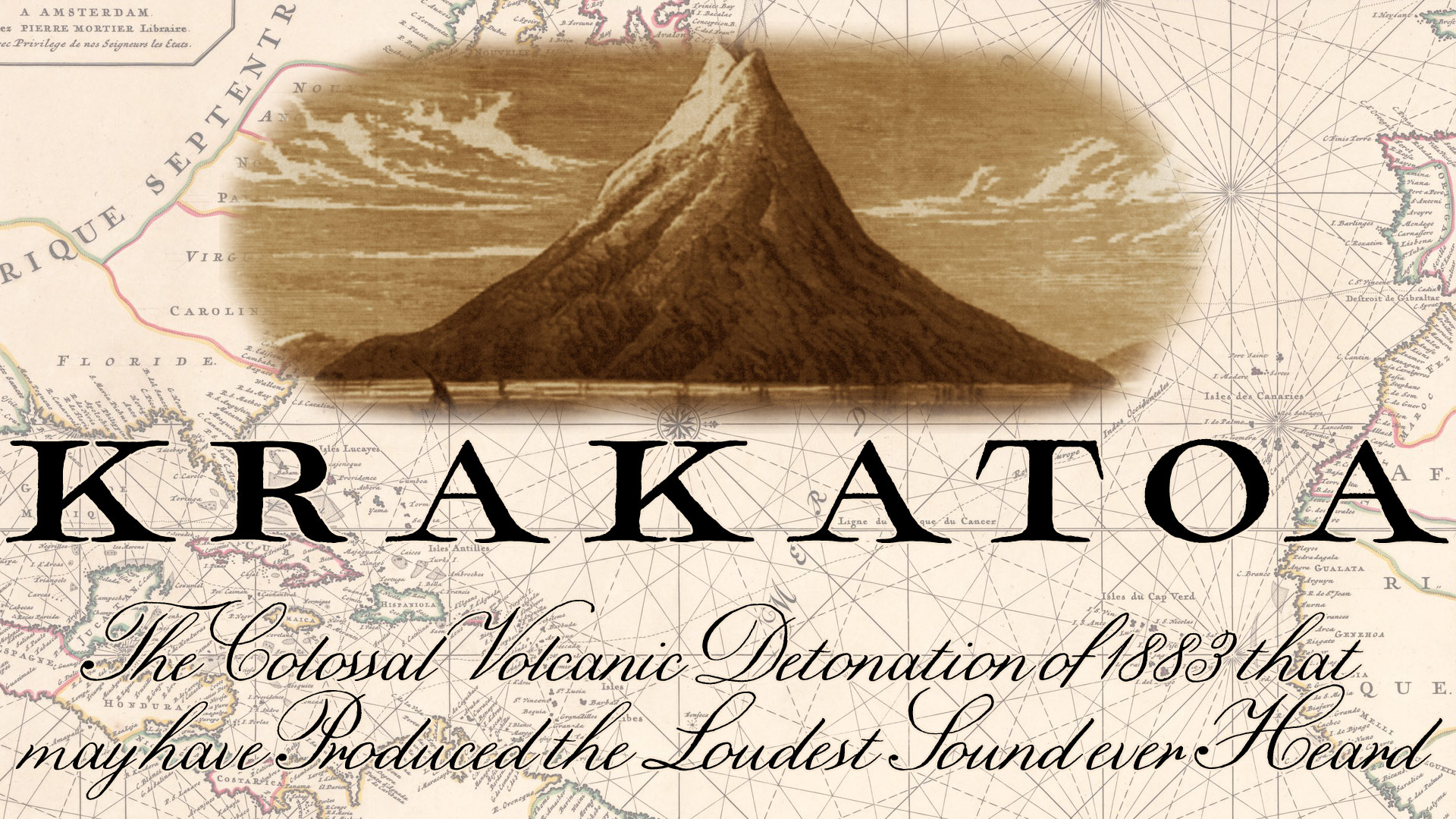
On August 27, 1883, the world essentially broke its own ears. Imagine standing in Manhattan and hearing a gunshot that went off in Dublin. That isn't a metaphor. It’s a mathematical reality of how loud the Krakatoa eruption actually was. When the island of Krakatoa, situated in the Sunda Strait between Java and Sumatra, finally gave way, it didn't just explode. It produced a pressure wave so violent that it ruptured the eardrums of sailors 40 miles away. People often ask about the "volume" of historical events, but Krakatoa is the gold standard for acoustic violence.
It was 10:02 a.m. local time.
The final cataclysmic blast released an estimated 200 megatons of TNT. To put that in perspective, that’s roughly 13,000 times the yield of the "Little Boy" bomb dropped on Hiroshima. This wasn't just a loud noise you’d hear at a concert or standing next to a jet engine. This was a physical wall of air moving so fast and with such force that it stopped being "sound" in the way we understand it and became a literal shockwave of death.
The 3,000-Mile Shout
Most people think of sound as something that fades out after a few blocks or miles. Krakatoa laughed at those physics. The sound was heard distinctly by people on Rodriguez Island in the Indian Ocean. That is nearly 3,000 miles away. Let that sink in for a second. If you were sitting in Boston, you would have heard a dull roar coming from San Francisco.
The reports from that day are chilling. At the British consulate in Mauritius, officials recorded what they thought was heavy distant gunfire. In Alice Springs, Australia, residents were startled by what sounded like two distinct shots from a rifle. They weren't shots. They were the echoes of an island being pulverized thousands of miles across the sea. Because sound travels at roughly 767 miles per hour, those people in Australia heard the "bang" about four hours after the island actually vanished.
Ruptured Eardrums and Pressure Spikes
If you were unfortunate enough to be within a 100-mile radius, the experience wasn't "loud"—it was traumatic. The captain of the British ship Norham Castle wrote in his log that the explosions were so violent that over half of his crew’s eardrums were literally shattered. He genuinely believed the Day of Judgment had arrived. He wasn't being dramatic. When the air pressure spikes that fast, your body simply cannot equalize.
Technically speaking, at a distance of 100 miles, the sound was still reaching 172 decibels. For context, a rock concert is around 120 dB. A chainsaw is 110 dB. The threshold for permanent, instant hearing loss is around 140 dB. At 172 dB, the sound is no longer just a noise; it’s a physical force that can cause internal hemorrhaging.
The Barometers Didn't Lie
How do we actually know how loud the Krakatoa eruption was if we didn't have modern digital recorders in 1883? We have the barometers.
Across the globe, in gasworks and weather stations, barometric pressure gauges began to go haywire. These instruments were designed to track slow changes in weather, but on August 27, they recorded a spike so sharp it looked like a vertical line. The pressure wave from Krakatoa was so massive that it circled the entire globe. Not once. Not twice. It circled the Earth seven times.
For several days, every barometer on the planet pulsed every 34 hours as the wave passed by again and again, getting slightly weaker each time. This is what physicists call an infrasonic wave. You couldn't "hear" the later passes with your ears, but the atmosphere was literally ringing like a giant bell.
Why was it so much louder than other volcanoes?
Basically, it comes down to the plumbing. Krakatoa is a subduction zone volcano. As the magma chamber emptied during the initial smaller eruptions, the ceiling of the volcano collapsed. This allowed billions of gallons of cold seawater to rush into the white-hot magma chamber.
You’ve probably seen what happens when you drop a drop of water into a deep fryer. Now imagine that on a scale of cubic miles. The resulting "phreatomagmatic" explosion was a steam-powered bomb of unfathomable proportions. The water didn't just boil; it flashed into steam instantly, expanding its volume by 1,600 times in a fraction of a second. That is the "engine" that drove the loudest sound in recorded history.
Comparing Krakatoa to Modern Events
We love to compare things to the biggest stuff we know. The 1980 eruption of Mount St. Helens was a tragedy and a massive geological event, but compared to Krakatoa, it was a firecracker. St. Helens was heard maybe 200 miles away. Krakatoa was 15 times that.
Even the 2022 Hunga Tonga-Hunga Ha'apai eruption, which was the loudest thing we've recorded with modern satellite and digital sensors, didn't quite match the sheer atmospheric punch of 1883. Tonga was loud—don't get me wrong—and its pressure wave also circled the globe, but the sheer volume of material displaced at Krakatoa remains the heavyweight champion of acoustic events.
What This Means for Today
Honestly, if an eruption of Krakatoa’s magnitude happened today in a densely populated area, the "sound" would be the least of our worries, yet it would be a major cause of immediate casualties. We now have millions of people living in coastal "red zones" where the acoustic impact alone would shatter windows for hundreds of miles, leading to massive secondary injuries before the tsunami even hit.
The 1883 event changed how we look at the atmosphere. It was the first time scientists realized that the air around us acts as a single, fluid medium capable of carrying energy across vast distances. It birthed the study of infrasound.
Practical Steps for Geologic Awareness
If you’re fascinated by the raw power of these events, there are ways to track them in real-time. We live in an era where you don't have to wait for a telegram from 3,000 miles away to know something happened.
- Follow the USGS Volcano Hazards Program: They provide real-time data on volcanic activity globally. If a "big one" happens, this is where the raw data hits first.
- Monitor Infrasound Networks: Organizations like the CTBTO (Comprehensive Nuclear-Test-Ban Treaty Organization) maintain a global network of infrasound sensors that pick up everything from meteor entries to volcanic blasts.
- Check Local Topography: If you live near a subduction zone (like the Pacific Northwest or parts of Southeast Asia), understand your local tsunami evacuation routes. The sound is your warning; the water is the danger.
- Study the Krakatoa Sequence: Read Simon Winchester's book Krakatoa: The Day the World Exploded. It’s widely considered the definitive account of the social and scientific impact of the event.
The eruption of Krakatoa wasn't just a natural disaster. It was the moment humanity realized exactly how small our voices are compared to the Earth’s. We are living on a pressurized vessel, and 1883 was the day the safety valve blew.