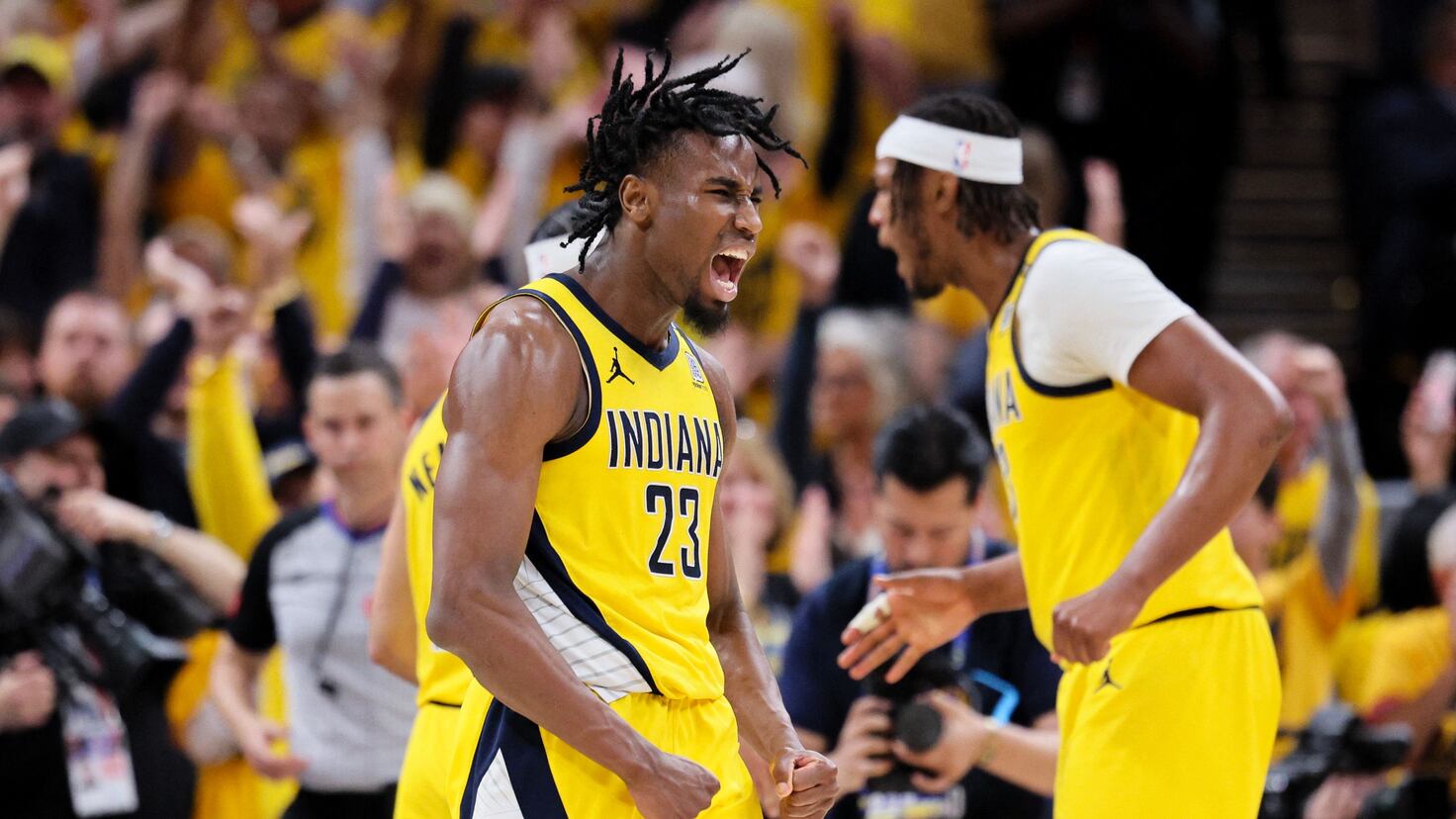
If you walk into Gainbridge Fieldhouse today, you'll see the banners. They’re hanging high, stitched with gold and blue, marking the years 1970, 1972, and 1973. But for a younger generation of fans—the ones who grew up on Reggie Miller’s clutch threes or Tyrese Haliburton’s no-look passes—there is a nagging, uncomfortable asterisk. The Indiana Pacers haven't won an NBA title. Not once.
Wait. So why are those banners there?
The truth is, the last time the Pacers won a championship wasn't in the NBA at all. It was in the American Basketball Association (ABA), a league that was louder, funkier, and frankly, more experimental than the buttoned-up NBA of the 1970s. Indiana wasn't just a participant in the ABA; they were the absolute, undisputed kings of it. They were the Boston Celtics of the "Red, White, and Blue" ball era. When people ask about the last time this franchise reached the mountain top, they’re looking back over fifty years to a time when Slick Leonard was pacing the sidelines and George McGinnis was tearing rims off backboards. It was a different world. It was a different league.
The 1973 Finals: The End of a Dynasty
The 1972-73 season was a grind. Honestly, the Pacers weren't even the favorites for most of that year. They finished second in the Western Division behind a powerhouse Utah Stars team. But Indiana had something that other teams couldn't replicate: a psychological edge. They had already won titles in '70 and '72. They knew how to win when the air got thin in the fourth quarter.
In the 1973 ABA Finals, the Pacers faced off against the Kentucky Colonels. This wasn't just a basketball game; it was a regional war. The Colonels had Dan Issel and Artis Gilmore—a seven-foot-two tower of power who made life miserable for anyone entering the paint. The series went the distance. Seven games. It all came down to May 12, 1973, at Freedom Hall in Louisville.
George McGinnis was a force of nature that night. He dropped 27 points. Freddie Lewis added 27 of his own. The Pacers walked into a hostile environment and walked out with an 88-81 victory. That was it. That was the third trophy in four years. If you’re counting the days, we are talking about more than 19,000 sunrises since the city of Indianapolis hosted a professional basketball championship parade.
Why the NBA Transition Changed Everything
When the ABA-NBA merger finally happened in 1976, the Pacers were one of the four teams brought into the "big leagues" alongside the Nuggets, Nets, and Spurs. But they didn't enter as equals. They entered as survivors.
The NBA essentially shook the Pacers down for every dime they had. The "entry fee" was $3.2 million—a massive sum in the mid-70s. To put that in perspective, the Pacers had to sell off their best player, the legendary Terry Knight, and even trade away draft picks just to keep the lights on. They were financially gutted. This is the part people usually miss when they complain about the Pacers' lack of NBA hardware. The team spent the first decade in the NBA just trying not to go bankrupt.
Success in the ABA was built on flair and fast-paced offense. The NBA was a more physical, slower-paced slog back then. The Pacers transitioned from being the big fish in a small pond to a starving fish in a very cold ocean. They didn't make the playoffs for years. The momentum of those three championships evaporated under the weight of "expansion" debt.
The Reggie Miller Era: So Close You Could Taste It
You can't talk about the last time the Pacers won a championship without talking about the 1990s, because that’s the closest they’ve come to repeating the 1973 magic. If 1973 was the peak, 2000 was the agonizing "almost."
Reggie Miller. Rik Smits. Mark Jackson. The 2000 Pacers were a machine. They finally broke through the Eastern Conference ceiling by beating the Knicks, setting up a Finals date with the Los Angeles Lakers. The problem? The Lakers had Shaquille O'Neal in his absolute prime and a young Kobe Bryant.
Indiana fought. They took the Lakers to six games. Jalen Rose was spectacular. Reggie was hitting shots from the parking lot. But Shaq was an unsolvable math problem, averaging 38 points and 16 rebounds for the series. The Pacers lost Game 6 by only six points. If a couple of bounces go differently—if Kobe doesn't take over Game 4 after Shaq fouled out—maybe the "last championship" conversation would be about the year 2000 instead of 1973.
What the 1973 Team Had That Modern Teams Lack
Looking back at that 1973 squad, there was a specific chemistry that Slick Leonard cultivated. He wasn't just a coach; he was a master motivator who understood the Indiana psyche. The state loves "pure" basketball, but that ABA team played with a chip on their shoulder that felt like a localized storm.
- George McGinnis: He was LeBron before LeBron. A local kid from Indy who stayed home to play for IU and then the Pacers. His physical dominance in 1973 was the primary reason they survived the Kentucky series.
- Mel Daniels: The heart. He was the rebounding king who provided the toughness.
- Roger Brown: "The Rajah." Many basketball historians consider him the greatest one-on-one player to ever live. He was the guy you gave the ball to when the play broke down.
Modern NBA teams are built on "spacing" and "analytics." The '73 Pacers were built on grit and the three-pointer—which was actually an ABA invention that the NBA mocked for years before eventually adopting it. In a way, the last Pacers championship team was playing "modern" basketball forty years before the rest of the world caught up.
Misconceptions About the ABA Titles
A lot of casual fans dismiss the ABA titles. They say the competition was weak. That’s objectively false. By the mid-70s, the ABA was winning the majority of the inter-league exhibition games against the NBA. They had Julius Erving. They had Rick Barry. They had the stars.
The last time the Pacers won a championship, they were beating teams that were arguably more talented than the NBA's middle tier. Dismissing the 1973 title because it wasn't under the "NBA" brand is like saying a gold medal at the Olympics doesn't count because it wasn't a World Championship. It was the highest level of basketball available to those players at that time.
Can the Drought End?
The current landscape for the Pacers feels more optimistic than it has in a decade. With Tyrese Haliburton, the team has a superstar who mirrors the unselfish, high-IQ play of the early 70s legends. They play fast. They lead the league in assists often. It's a style that Slick Leonard would have loved.
But the road to a trophy in 2026 is vastly different than it was in 1973. The sheer wealth of the big-market teams creates a vertical climb for "small-market" Indiana. However, the blueprint remains the same: find a transcendent star (McGinnis then, Haliburton now), surround them with specialized shooters, and maintain a home-court advantage that makes visiting teams want to quit.
Actionable Insights for Fans and Historians
If you want to truly appreciate the history of Indiana basketball, don't just look at the NBA standings.
- Watch the "Undefeated" Documentary: It covers the ABA era in depth and shows just how much the Pacers meant to the city when the NBA wouldn't even give Indianapolis a look.
- Visit the Banners: Go to a game. Look at the 1973 banner. It represents a team that went 15-3 in the playoffs. That is total dominance.
- Study George McGinnis: If you only know Reggie Miller, you only know half the story. McGinnis's 1972-73 season is one of the greatest individual years in the history of the sport, regardless of the league.
- Support Local Basketball: The Pacers' identity is tied to the "Hoosier" mythos. The championship drought is a bummer, sure, but the culture that built those 1970s teams is still alive in the high school gyms across the state.
The 1973 championship wasn't a fluke. It was the culmination of a dynasty that redefined how professional basketball was played. While the wait for an NBA title continues, the legacy of that final ABA trophy remains the gold standard for every player who puts on the Indiana jersey. They aren't just chasing a win; they are chasing the ghost of 1973.