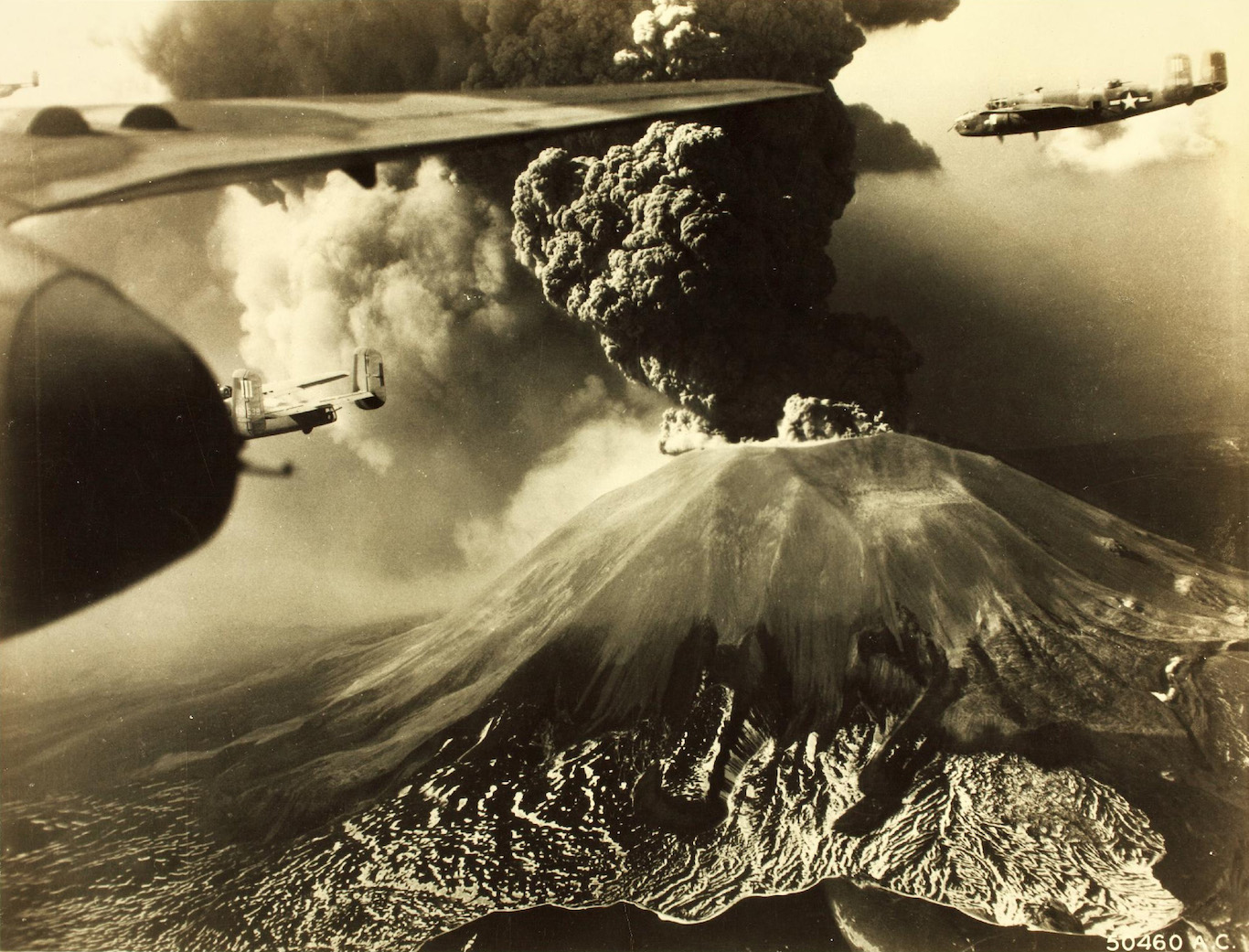
March 1944 was already a disaster. Italy was a mess of mud, landmines, and the grinding gears of the Allied advance against Nazi Germany. Then the ground started shaking. You’d think a world war would be enough for one decade, but nature had other plans for the residents of San Sebastiano and the airmen of the 340th Bombardment Group. The Mount Vesuvius eruption 1944 wasn't just some minor geological hiccup; it was the last time this monster actually blew its top, and it happened right in the middle of a literal war zone.
Imagine being a B-25 Mitchell pilot. You've survived flak over Monte Cassino. You've dodged Luftwaffe fighters. Then, you wake up to find your entire airfield covered in hot acidic ash and your multi-million dollar planes melting into expensive scrap metal.
It was surreal.
The volcano had been rumbling for years, actually. It wasn't a sudden surprise to the locals who lived in its shadow, but the intensity of the March 18th breakout caught the military command completely off guard. Most people today think of 79 AD when they hear the name Vesuvius. They think of stone people and bread loaves frozen in time. But the 1944 event is arguably more fascinating because we have color film of it. We have diary entries from soldiers who were terrified of a mountain while they were supposed to be fighting a human enemy.
What Really Happened During the Mount Vesuvius Eruption 1944
The eruption began in earnest on the afternoon of March 18. It started with lava. Slow, viscous, unstoppable rivers of molten rock began creeping down the western slope toward the towns of San Sebastiano and Massa di Somma.
If you've ever seen lava in person, you know it’s not always a fast-moving river like in the movies. Sometimes it’s a wall of slag that looks like a moving pile of burning charcoal. It crunches. It sounds like breaking glass on a massive scale. As the lava hit the stone houses of the Italian villages, the structures didn't just burn; they were crushed under the weight.
Local villagers didn't panic as much as you'd expect. They were used to hardship by then. They tried to save what they could. People were seen carrying heavy wooden furniture, mattresses, and even religious statues just a few yards ahead of the advancing heat. It was a slow-motion catastrophe.
The Death of the 340th Bombardment Group
While the villagers were losing their homes, the United States Army Air Forces were losing their hardware. The 340th Bomb Group was stationed at Pompeii Airfield, just a few miles from the base of the volcano.
It sounds like a bad joke. Stationing a bomber group at the base of the world's most famous volcano? But military logic in 1944 was about proximity to the front lines, not geological surveys.
By March 20th, the "tephra"—the technical term for the rock fragments and ash ejected by the volcano—started falling in earnest. It wasn't just dust. It was heavy, jagged stones called lapilli. They rained down on the exposed B-25 bombers. The weight was immense. The ash was so hot it scorched the fabric control surfaces of the planes and etched the plexiglass windscreens until they were opaque.
Roughly 80 to 90 aircraft were damaged or destroyed. That’s an entire bombardment group wiped out without a single German shot being fired. Sergeant Melvyn Hopper, a member of the group, later recalled that the "crunching" sound of the ash on the wings was something he’d never forget. It was a logistical nightmare for the Allies, who were trying to maintain air superiority during a crucial phase of the Italian campaign.
The Science of the "Final" Eruption
Geologists like Giuseppe Imbò, who was the director of the Vesuvius Observatory at the time, stayed at his post throughout the entire event. Talk about dedication. He was literally on the mountain while it was exploding, taking notes and trying to warn the Allied military police about the impending danger.
The Mount Vesuvius eruption 1944 marked the end of a long eruptive cycle that had begun back in 1913. Vesuvius is a stratovolcano. It’s temperamental. Since 1944, the conduit—the "throat" of the volcano—has been plugged. This is why scientists get nervous today. A plugged volcano builds pressure.
- Type of Eruption: It transitioned from effusive (lava flows) to explosive (ash plumes).
- The Plume: The ash cloud reached heights of over 15,000 feet.
- The Casualties: Roughly 26 to 28 people died, mostly from roof collapses caused by the weight of the ash.
- The Displacement: Nearly 12,000 people were evacuated by the Allied Military Government.
Kinda crazy to think that while the British and Americans were managing a war, they also had to become emergency disaster responders for a volcanic crisis. They used heavy trucks to move civilians and distributed C-rations to starving Italian families whose crops had just been buried under two feet of gray grit.
Why This Eruption Still Matters in 2026
We are currently in the longest period of repose Vesuvius has had in centuries. That’s not a good thing. The 1944 event is the baseline for what a "moderate" eruption looks like. It serves as the blueprint for the Italian government’s current evacuation plans.
If you visit the area today, you’ll see the "Red Zone." This is the area that would need to be evacuated immediately if the mountain wakes up. More than 600,000 people live there now. In 1944, the population was a fraction of that, and the chaos was still significant. Imagine trying to move half a million people through the narrow, crowded streets of modern Naples while ash is falling.
Basically, 1944 was a warning shot.
The 1944 eruption also provided a unique case study in how volcanic ash interacts with machinery. Modern aviation still uses the data gathered from the damaged B-25s to understand how silicate particles melt inside jet engines. When that Icelandic volcano (Eyjafjallajökull) shut down European airspace in 2010, the shadow of the 1944 Vesuvius event was looming over the decision-making process.
Misconceptions About the 1944 Event
A lot of people think Vesuvius is "dead." It isn't. It's just sleeping.
Another big myth is that the 1944 eruption was as big as the one that buried Pompeii. It wasn't even close. The 79 AD eruption was a Plinian event—massive, catastrophic, and world-altering. The 1944 version was a "Strambolian to Sub-Plinian" event. It was big enough to ruin your year, but not big enough to bury an entire civilization for 1,700 years.
Honestly, the most impressive part of the story is the human element. You had Lewis Gunner crews in the British Army using their shovels to clear ash off their tents so they wouldn't be crushed in their sleep. You had American newsreels filming the lava as if it were a celebrity. It was the first "televised" (or at least widely filmed) volcanic disaster in history.
How to Explore the 1944 Legacy Today
If you’re traveling to Italy, don't just go to Pompeii and Herculaneum. Those are incredible, sure. But if you want to see the 1944 history, you have to look a bit closer.
- The Vesuvius Observatory: The old building (the one Giuseppe Imbò stayed in) is now a museum. It’s perched on the side of the volcano and houses the original seismic instruments used during the war.
- San Sebastiano al Vesuvio: Visit the town that was nearly wiped out. You can still see the path the lava took. The town was rebuilt, but the layout is a direct result of the 1944 destruction.
- The Crater Hike: When you hike to the "Gran Cono" (the great cone) today, you are looking at the result of the 1944 collapse. The crater's current shape was largely finalized during those few weeks in March.
The Mount Vesuvius eruption 1944 is a reminder that nature doesn't care about our politics or our wars. It does its own thing on its own timeline.
Actionable Insights for History and Science Buffs
- Check the Records: If you're a genealogy fan or military historian, look up the "340th Bomb Group" archives. They have digitized photos of the planes covered in ash that are hauntingly beautiful.
- Monitor the Vesuvius Observatory (INGV): They provide real-time data. It’s fascinating to see the mountain "breathing" through modern sensors.
- Read the Primary Sources: Look for the book Vesuvius by Alwyn Scarth. It’s one of the few that gives a truly detailed, non-sensationalized account of the 1944 flow dynamics.
- Visit the "Lava Fields": Around the town of Ercolano, you can still find patches of 1944 lava that haven't been fully reclaimed by vegetation. The rock is sharp, dark, and heavy.
Don't wait for the next big one to learn about this. The history is sitting there on the slopes, hidden under eighty years of Mediterranean scrub and modern villas. Vesuvius is the most dangerous volcano in the world precisely because so many people have forgotten what it’s capable of. The 1944 eruption is the only modern evidence we have of its power—study it.