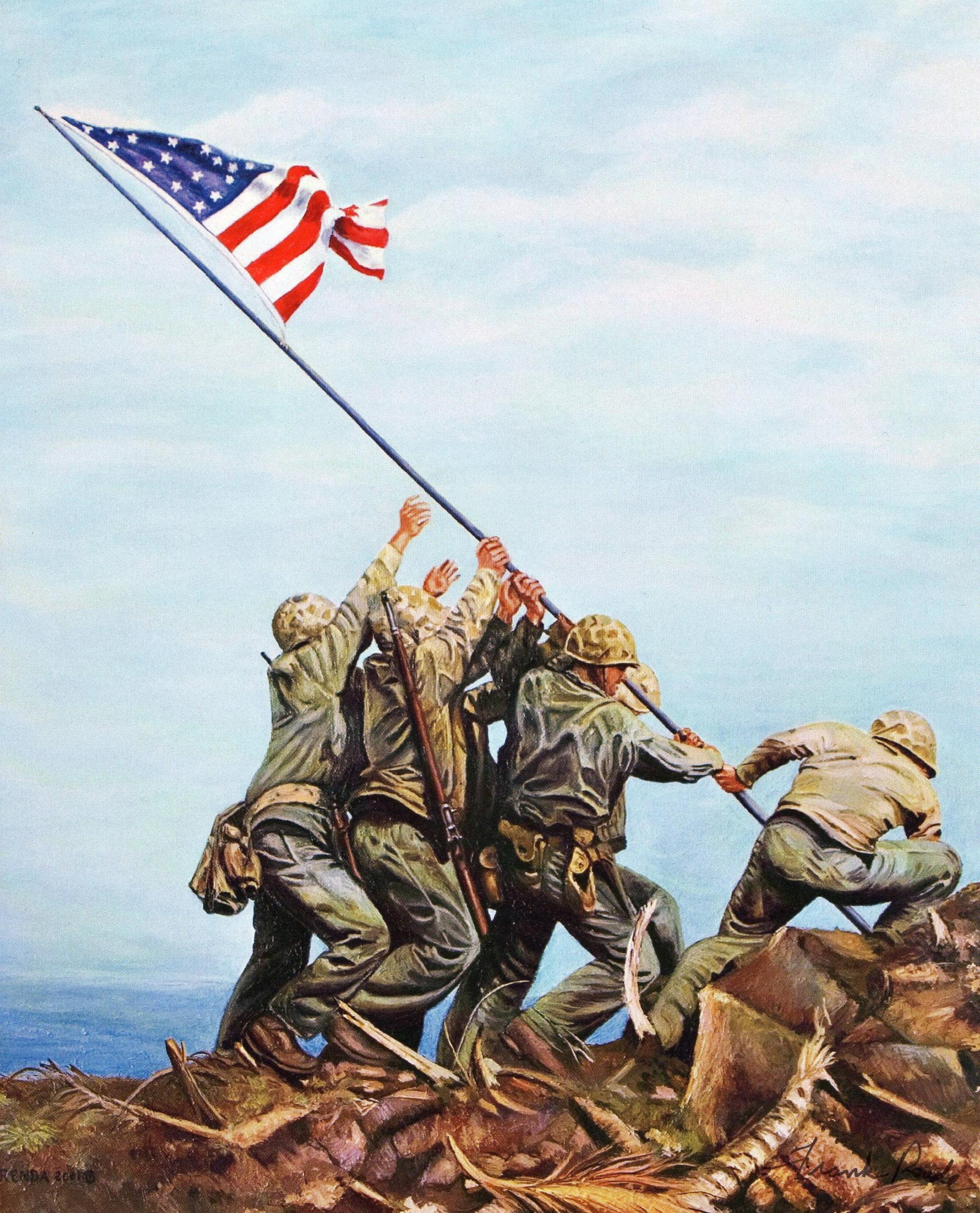
It is the most reproduced image in the history of photography. You’ve seen it on postage stamps, in bronze at the Marine Corps War Memorial, and probably in every history textbook you ever cracked open. Joe Rosenthal’s picture of Iwo Jima flag raising is basically the visual shorthand for American grit. But here is the thing—most people think they are looking at the moment the battle was won. They aren’t. In reality, when that shutter clicked on February 23, 1945, the nightmare on that sulfur-stinking island was just getting started.
The photo is perfect. The diagonal line of the pole, the straining muscles, the wind whipping the stars and stripes. It looks staged. It looks like a painting. For decades, skeptics swore Rosenthal must have directed the Marines like a Hollywood film crew. He didn't. It was a fluke of timing, a heavy camera, and a second flag.
If you want to understand why this image still carries so much weight in 2026, you have to look past the bronze statues. You have to look at the blood, the mistaken identities, and the fact that three of the men in that frame never made it off the island alive.
The First Flag vs. The Second Flag
Most folks don't realize there were actually two flag raisings that day. The first one happened earlier in the morning. Around 10:30 AM, Lieutenant Schrier and a small group of Marines hiked up Mount Suribachi and hoisted a small colors. It was a huge deal. Marines on the beach cheered. Ships in the harbor honked their whistles. It was a rare moment of joy in a meat grinder of a battle.
But Secretary of the Navy James Forrestal was hitting the beach right around then. He saw that first flag and decided he wanted it as a souvenir. Colonel Chandler Johnson, the battalion commander, wasn't having it. He thought that flag belonged to his boys. He reportedly said, "To hell with that," and ordered his men to get a second, much larger flag up there so they could keep the original.
That’s where the picture of Iwo Jima flag raising comes in. Joe Rosenthal, an Associated Press photographer who was so nearsighted he’d been rejected by the military, was trekking up the mountain. He almost missed the whole thing. He arrived just as the second group of Marines—Harlon Block, Harold Keller, Ira Hayes, Harold Schultz, Franklin Sousley, and Michael Strank—were ready to swap the flags.
Rosenthal didn’t even look through the viewfinder. He piled up some stones to stand on, sensed the movement, and snapped a single frame. He had no idea he’d just captured the soul of the war.
The Men Behind the Shadows
For a long time, we didn't even know who we were looking at. This is the messy part of history. Because the photo was taken from behind and the men were covered in dirt and gear, identification was a disaster.
Take the case of John Bradley. For over seventy years, the world believed Bradley, a Navy corpsman, was a central figure in the photo. His son even wrote the bestseller Flags of Our Fathers. But in 2016, the Marine Corps had to admit they got it wrong. After a bunch of amateur historians (Paul Foley, Eric Krelle, and Stephen L. Denton) combed through other photos from that day, they proved it was actually Harold Schultz in the frame. Schultz was a quiet guy who went to his grave never telling his family he was in the most famous photo in the world.
Then there was the Harlon Block and Henry Hansen mix-up. Harlon's mother knew. She saw the photo in the paper and told everyone, "That’s my boy." No one believed her. It took Ira Hayes hitchhiking across the country to tell Harlon’s family the truth because the official records were wrong.
These weren't just "heroes." They were kids. Michael Strank was the "old man" of the group, and he was only 25. He was a natural leader, the kind of guy who wouldn't let his men take risks he wouldn't take. He was killed by "friendly" fire from an American destroyer just days after the photo was taken. Harlon Block died hours later from a mortar shell. Franklin Sousley was shot by a sniper.
Why the Picture of Iwo Jima Flag Raising Almost Didn't Matter
The battle didn't end when the flag went up. That’s the biggest misconception. Mount Suribachi was just the southern tip of the island. The Japanese forces, led by General Tadamichi Kuribayashi, weren't on the mountain; they were inside it. They had miles of tunnels and hidden bunkers.
After the picture of Iwo Jima flag raising was taken, the Marines had to fight for 31 more days. It was a slow, agonizing crawl through volcanic ash. By the time the island was declared "secure," nearly 7,000 Americans were dead. On the Japanese side, of the roughly 21,000 defenders, only about 1,000 survived to be taken prisoner.
The photo reached the U.S. while the fighting was still raging. It was an instant sensation. President Roosevelt realized the war was running out of money, so he ordered the "survivors" in the photo back to the States for a massive Seventh War Bond tour.
Imagine being Rene Gagnon, Ira Hayes, or Harold Schultz (though Schultz wasn't identified then). You just watched your best friends get blown apart. You’re covered in the dust of their remains. Suddenly, you’re on a plane to D.C., being treated like a celebrity, and told to sell bonds to a public that thinks the war is basically over because of a picture you're in.
Ira Hayes struggled with this for the rest of his life. He hated the "hero" label. He called himself a "Pima Indian" who just did his job. He’d get drunk and tell people that his friends who stayed on the island were the real heroes. He died in a ditch at 32, a victim of the weight of a photograph he never asked to be in.
Technical Brilliance or Total Luck?
Photographically speaking, Rosenthal’s shot is a miracle. He used a Speed Graphic camera, which is basically a giant, heavy box. You don't "spray and pray" with a Speed Graphic. You get one shot.
The lighting was perfect because the clouds broke just as they lifted the pole. The shutter speed was fast enough (1/400th of a second) to freeze the flag's ripple. But the real magic is the composition. The way the bodies overlap creates a sense of collective effort. You can't see their faces, which makes them universal. They could be anyone. They could be your brother or your neighbor.
When the film was flown to Guam and developed, the AP photo editor, John Bodkin, saw it and immediately knew. He radiophotoed it to San Francisco. Within 17 hours of the event, it was on the wires. That kind of speed was unheard of in 1945.
Common Myths Debunked
- Myth: The photo was staged. Truth: It was a spontaneous shot of the second flag being raised. A film by Sergeant Bill Genaust proves the movement was fluid and unposed.
- Myth: The flag raising meant the battle was over. Truth: It happened on day four of a 36-day battle.
- Myth: All the men in the photo became rich. Truth: Most returned to grueling manual labor or struggled with what we now call PTSD.
The Enduring Legacy
We still talk about the picture of Iwo Jima flag raising because it represents the peak of the "Good War" narrative, even if the reality was much grittier. It’s an image of cooperation. In an era where everything feels fractured, there is something deeply moving about six people leaning into a single task.
The power of the image isn't in its perfection, but in its cost. When you look at it, you aren't just looking at a flag. You are looking at Michael Strank, who would be dead six days later. You are looking at Franklin Sousley, who would be dead in three weeks.
If you want to truly honor what that photo represents, don't just look at the flag. Look at the dirt on their uniforms.
Actionable Steps for History Enthusiasts
To get a real grasp on this moment beyond the surface level, here is what you should actually do:
- Read the 2016 and 2019 Marine Corps Investigation Reports: These are public documents that detail exactly how the men were misidentified and how modern forensic photo analysis finally set the record straight.
- Watch the Bill Genaust Film: Search for the color 16mm footage shot alongside Rosenthal. Seeing the motion makes the "staged" conspiracy theories evaporate instantly.
- Visit the National Museum of the Marine Corps: They house the actual second flag (the one in the photo). Seeing the wind-torn edges of the real fabric changes your perspective on the scale of the event.
- Study the Pacific Theater Logistics: To understand why Iwo Jima mattered, look into the B-29 emergency landing stats. Over 2,200 American bombers landed on that island later in the war, saving roughly 24,000 airmen. That is the "why" behind the photo.