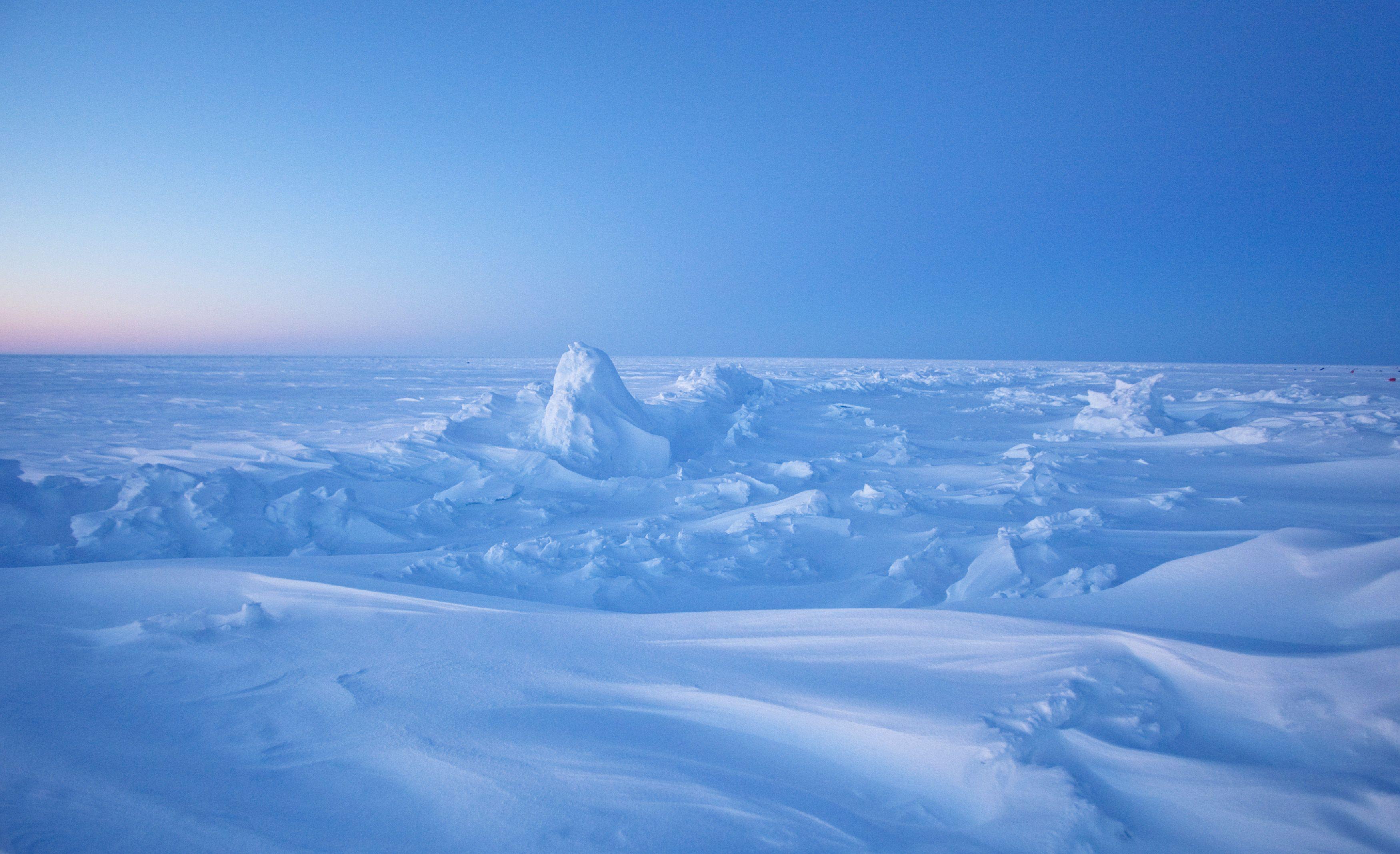
So, you want to stand on top of the world. You’re probably picturing a giant candy-cane striped pole stuck in the snow, maybe a workshop nearby, and definitely a solid sheet of ice under your boots.
But honestly? The real North Pole is a total mess.
It’s not even a place in the way we usually think about places. There is no land there. None. If you stood at the precise coordinates of 90° North right now, you’d be standing on a shifting slab of sea ice—maybe six to ten feet thick—floating over an abyss of ocean that’s more than 13,000 feet deep. If you dropped your car keys, they aren't hitting dirt; they're sinking two and a half miles into the Arctic Basin.
It’s a weird, moving target. Because the ice is constantly drifting due to winds and ocean currents, if you plant a flag at the geographic North Pole, it’ll be miles away from the "real" spot within a few hours. It’s a ghost.
The Geographic vs. Magnetic North Pole (The Big Mix-up)
Most people get this part confused, and it’s kinda important if you don’t want to end up lost in the Siberian tundra.
The real North Pole—the geographic one—is the fixed point where the Earth’s axis of rotation meets the surface. It stays put. But your compass doesn't care about the axis. It cares about the magnetic field.
The Magnetic North Pole is a wanderer. It’s currently hauling tail from Northern Canada toward Russia at a rate of about 34 miles per year. Scientists at the British Geological Survey and the National Centers for Environmental Information actually have to update the World Magnetic Model every few years just so your iPhone’s GPS doesn't start acting crazy.
Then there’s the North Pole of Inaccessibility. That’s the point in the Arctic Ocean farthest from any landmass. It’s incredibly hard to reach. If you’re looking for isolation, that’s your spot, but don’t expect a gift shop.
What It’s Actually Like on the Ice
It is brutally quiet.
Except for the groaning.
The ice isn't a silent floor; it’s alive. It cracks with sounds like gunshot reports and moans as the pressure ridges build up. When two massive sheets of ice collide, they buckle upward, creating "rubble fields" that make trekking across the real North Pole a nightmare. You aren't just skiing across a flat rink. You’re climbing over jagged ice walls and navigating "leads"—which is just a fancy word for terrifying cracks of open, black water that open up without warning.
Temperatures? In the winter, you’re looking at -40°F regularly. At that point, it doesn't matter if you use Fahrenheit or Celsius; they meet at -40, and both mean "pain."
In the summer, it actually gets "warm" enough for the snow to melt on the surface, creating these surreal, turquoise melt ponds. It’s beautiful, but it’s also a sign of how fragile the whole system is.
Who Lives There?
Polar bears? Occasionally. But they usually stick closer to the coastlines where the seals are. If a bear ends up at the real North Pole, it’s usually because it’s lost or having a very bad month.
There are no trees. No shrubs. No birds except for the occasional Arctic Tern or a stray Fulmar. It’s a desert made of frozen salt water.
The High-Stakes Politics of a Place Nobody Owns
This is where things get spicy. Under international law, no country owns the real North Pole.
Right now, the five countries surrounding the Arctic Ocean—Canada, Denmark (via Greenland), Norway, Russia, and the United States—are limited to an Exclusive Economic Zone (EEZ) of 200 nautical miles from their coasts.
But there’s a loophole.
The UN Convention on the Law of the Sea (UNCLOS) says that if a country can prove its continental shelf extends further under the water, they can claim the seafloor. Russia famously sent a sub to the bottom of the North Pole in 2007 to plant a titanium flag. It was a huge flex. Canada and Denmark have also filed claims, arguing that the Lomonosov Ridge—an underwater mountain range—is an extension of their own land.
Why do they care about a frozen wasteland?
- Oil and Gas: Estimates suggest about 22% of the world's undiscovered technical oil and gas reserves are under the Arctic floor.
- Shipping Routes: As the ice melts, the "Northern Sea Route" becomes a shortcut between Europe and Asia, potentially saving weeks of travel.
- Minerals: Rare earth metals are down there, and everybody wants them for batteries and tech.
Getting There Without Dying
If you actually want to see the real North Pole, you have two main options, and both are expensive enough to make your eyes water.
- The Russian Icebreaker: This is the "luxury" route. You board a nuclear-powered icebreaker like the 50 Let Pobedy (50 Years of Victory). It crushes through several feet of ice like it’s nothing. You get to the pole, drink some champagne on the ice, take a photo, and go back to your heated cabin. Cost? Usually upwards of $30,000.
- Barneo Ice Camp: Every April, Russian engineers used to drop paratroopers and bulldozers onto a floating ice floe near the pole to build a temporary runway. From there, you could fly a short hop to 90° North. However, geopolitics and thinning ice have made Barneo incredibly unreliable lately.
Some people still try to ski there "unsupported." That means pulling a 200-pound sled (a pulk) over ice ridges for 50 days. It is arguably the hardest physical feat on the planet. Most people who try it end up getting evacuated because the ice is drifting south faster than they can ski north—meaning they can ski for 10 hours and end up further away from the pole than when they started.
The "Real" North Pole is Disappearing
We have to talk about the ice. It’s not looking good.
According to NASA and the National Snow and Ice Data Center (NSIDC), Arctic sea ice has been declining at a rate of about 12% per decade since the late 70s. We are heading toward "ice-free summers."
That doesn't mean the water disappears; it means the real North Pole will just be open ocean during the month of September. This changes the planet’s albedo—the ability to reflect sunlight. White ice reflects heat; dark water absorbs it. It’s a feedback loop that’s making the Arctic warm four times faster than the rest of the world.
Actionable Steps for the Arctic-Obsessed
If you’re actually planning to engage with the Arctic or visit, don't just wing it.
Verify your tour operator’s credentials. If you’re booking a trip, ensure they are members of IAATO (International Association of Antarctica Tour Operators) or AECO (Association of Arctic Expedition Cruise Operators). Even though IAATO is southern-focused, many reputable Arctic guides follow similar strict environmental protocols.
Track the ice yourself. Don't take a journalist's word for it. You can check the NSIDC Arctic Sea Ice News & Analysis for daily satellite updates. It’s fascinating to watch the "freeze-up" in October.
Understand the gear. If you’re going anywhere near the High Arctic, "winter gear" from a mall won't cut it. You need vapor barrier liners (VBL) for your feet to prevent sweat from freezing into your boots, and layering systems designed by brands like Northern Playground or Shackleton that focus on moisture management in extreme cold.
Respect the sovereignty. Remember that the Arctic isn't just a playground; it’s the ancestral home of the Inuit and other Indigenous peoples. While the real North Pole is uninhabited, your journey through Svalbard, Greenland, or Nunavut involves passing through communities with deep histories and specific laws regarding land use and wildlife.
The North Pole isn't a destination you check off a list. It’s a fleeting coordinate on a restless ocean. It’s a place that reminds us that humans don't actually run the show—the ice does. And right now, the ice is telling us a story we should probably start listening to more closely.