Midnight. Rain. A soggy farewell to the British Empire.
If you look back at the footage from July 1, 1997, you’ll see Chris Patten, the last British Governor, looking genuinely devastated as the Union Jack came down for the final time. It wasn't just a ceremony. It was the end of an era that started with opium and ended with a global financial powerhouse being handed over to a communist giant. People often talk about the return of Hong Kong to China as if it were a simple real estate transaction between nations, but it was way messier than that.
Honestly, the whole thing was an experiment. Nobody had ever tried "One Country, Two Systems" before.
The treaty that started it all (and the one that ended it)
You can't understand the return of Hong Kong to China without looking at the 99-year lease. Most people think Britain owned all of Hong Kong forever, but that's not quite right. While Hong Kong Island and Kowloon were technically ceded "in perpetuity" after the Opium Wars, the New Territories—which make up the vast majority of the land—were only leased for 99 years in 1898.
By the 1980s, the clock was ticking. Margaret Thatcher went to Beijing in 1982 to talk to Deng Xiaoping. She was riding high after the Falklands War, but Deng wasn't intimidated. He basically told her that China could walk in and take the city by the afternoon if they wanted to. The British realized they couldn't run the city without the New Territories—the water, the food, and the space just weren't there.
So, they signed the Sino-British Joint Declaration in 1984.
This document is the "why" behind everything. It promised that Hong Kong’s lifestyle, its capitalist system, and its common law would stay the same for 50 years. That’s where the 2047 deadline comes from. It's a date that’s been hanging over the city like a low-hanging cloud for decades.
Why the 50-year promise felt so long back then
In 1997, 2047 felt like a lifetime away.
Think about the context of the late nineties. The Soviet Union had collapsed. People thought the whole world was moving toward Western-style democracy. There was this huge assumption that by the time 2047 rolled around, China would look more like Hong Kong, rather than Hong Kong looking more like mainland China.
It was a gamble.
The actual day of the return of Hong Kong to China
The weather was miserable. It poured. Some people in the crowds saw the rain as a bad omen; others saw it as a cleansing of colonial history. Prince Charles was there, looking stiff in his naval uniform. Jiang Zemin was there, representing the rising power of the People's Republic.
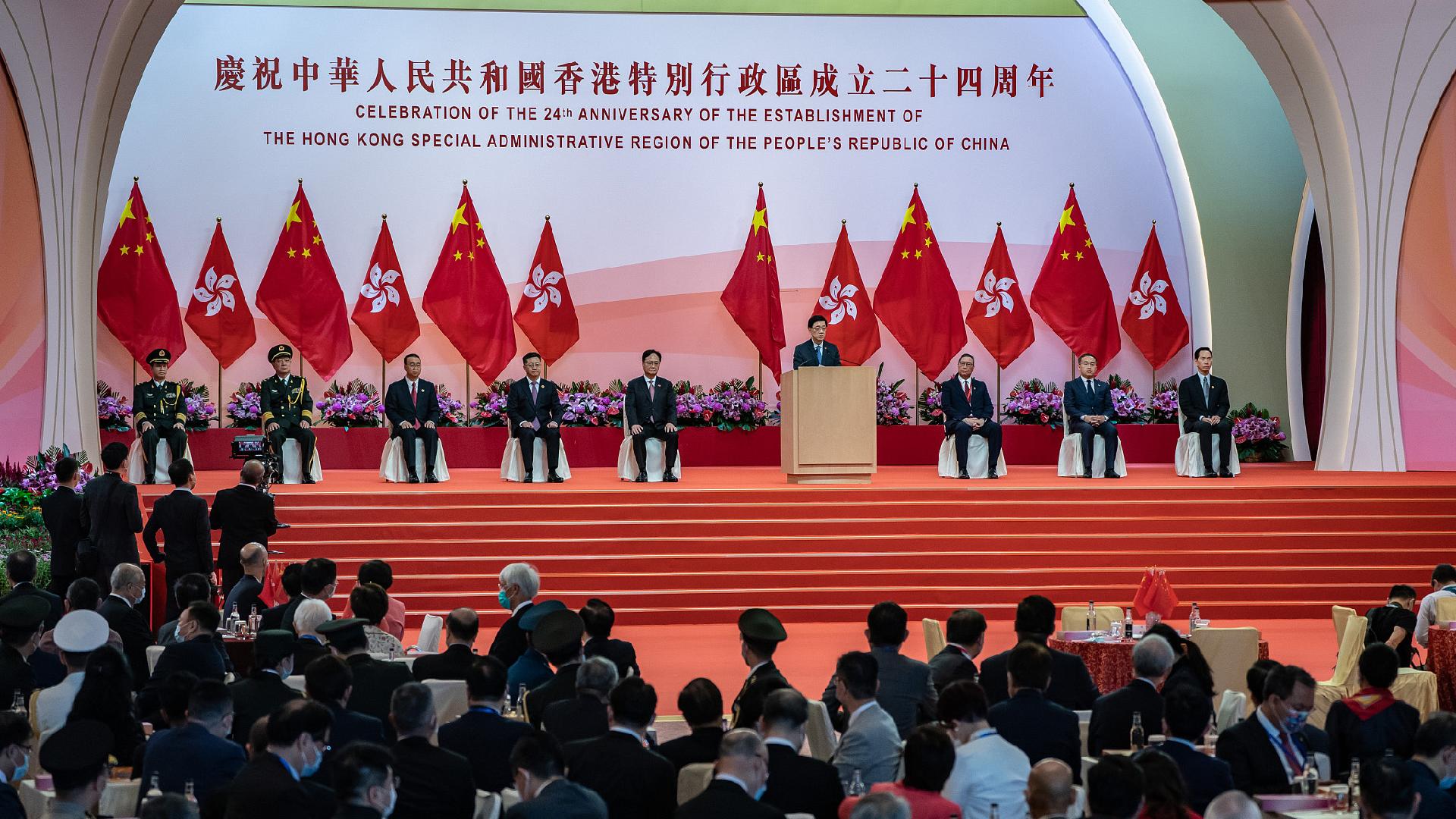
When the clock struck twelve, the British National Anthem stopped, and the "March of the Volunteers" began.
It was a massive logistical feat. Overnight, badges on police uniforms changed. The "Royal" was dropped from the names of yacht clubs and horse racing tracks. Stamps featured the Bauhinia flower instead of the Queen's silhouette. But for the average person getting dim sum the next morning, life looked surprisingly similar. The stock market opened. The HK dollar remained pegged to the US dollar. The borders stayed up.
But beneath the surface, the anxiety was real.
The Great Migration
Before the handover, tens of thousands of Hong Kongers fled. They didn't trust the promise. They moved to Vancouver (which earned the nickname "Hongcouver"), Toronto, and Sydney. They wanted an insurance policy. If things went south after the return of Hong Kong to China, they wanted a foreign passport in their back pocket.
You’ve probably met someone in London or Perth who grew up in Mid-Levels or Mong Kok. That diaspora is a direct result of the 1997 uncertainty. Interestingly, many of them actually moved back in the early 2000s when they saw that the tanks didn't roll in and the economy was booming. For a while, it looked like the experiment was actually working.
Economic shifts and the "China Factor"
Financially, the return of Hong Kong to China changed the city's role. It went from being a British colonial outpost to being the "Golden Goose" for China's modernization.
In 1997, Hong Kong’s GDP was about 18% of China's entire economy. Think about that. One tiny city-state was nearly a fifth of the size of the most populous nation on earth. Today? It's less than 3%. It's not that Hong Kong got poorer—it's that mainland cities like Shenzhen, Shanghai, and Guangzhou exploded in growth.
- The IPO Hub: Hong Kong became the place where Chinese companies like Tencent and Alibaba went to get global cash.
- The RMB Bridge: It’s still the biggest offshore center for the Chinese Yuan.
- The Wealth Gap: As mainland money poured in, property prices went through the roof. It became the most unaffordable housing market in the world, which created a lot of the social tension we see today.
What changed? The turning points
The "Two Systems" part of the deal started feeling a bit strained around 2003. That was the first time a massive protest—half a million people—hit the streets. They were protesting Article 23, a proposed national security law. The government backed down. That was a huge moment. It showed that Hong Kongers weren't just interested in making money; they cared about their distinct legal identity.
Then came the Umbrella Movement in 2014 and the massive protests in 2019.
These events accelerated the integration process. Beijing’s perspective shifted. They saw the unrest as a threat to national sovereignty. Consequently, the National Security Law (NSL) was introduced in 2020. This was a "hard" turning point. It basically ended the ambiguity of the return of Hong Kong to China.
The legal landscape changed. Many civil society groups disbanded. The electoral system was overhauled to ensure only "patriots" could run for office. To some, this was a necessary step for stability. To others, it was the premature end of the "One Country, Two Systems" promise.
A tale of two perceptions
If you talk to a government official in Beijing, they'll tell you the handover was a triumph. They see it as the final erasing of a "century of humiliation." They believe the city is now more secure and better integrated into the Greater Bay Area—a massive economic hub including Macau and Guangdong.
But if you talk to a pro-democracy activist or a lawyer who trained in the British system, they’ll tell you the city has lost its soul. They point to the loss of press freedom and the changes in the classroom curriculum.
The truth is, both things are happening at the same time. The city is becoming more "Chinese" and less "International" in its political culture, even as it remains a vital financial node for global capital.
The 2047 question: What's next?
We are now more than halfway through the 50-year guarantee.
In 1997, everyone was obsessed with what would happen on July 1, 2047. Would the border disappear? Would they drive on the right side of the road? Would the Hong Kong Dollar vanish?
Recent developments suggest that the integration is happening way ahead of schedule. We don't need to wait for 2047 to see what a post-handover Hong Kong looks like. We're living in it. The city is being tethered more tightly to the mainland via high-speed rail, massive bridges, and legal alignment.
Actionable insights: Navigating the new Hong Kong
If you're looking at Hong Kong today—whether for business, travel, or just to understand the news—you have to look past the old 1997 tropes.
- Understand the Legal Reality: If you’re doing business there, the "Two Systems" still applies to contract law and commercial disputes. The courts are still distinct from the mainland for business, but the National Security Law is the new "red line" for anything political or social.
- Follow the Money, Not the Politics: While the political headlines are often grim, the financial integration is deeper than ever. Watch the "Wealth Management Connect" schemes. That’s where the future of the city's economy lies.
- Cultural Literacy is Key: Hong Kong is no longer a place where you can ignore mainland Chinese sensibilities. Knowing Mandarin (Putonghua) is becoming just as important as knowing Cantonese or English in professional circles.
- Watch the Greater Bay Area (GBA): Don't look at Hong Kong as an island. Look at it as part of a 86-million-person megalopolis. The borders are softening, and the economic opportunities are shifting toward this regional integration.
The return of Hong Kong to China wasn't a single day in 1997. It’s a continuous, sometimes painful, and always complex process of a city trying to find its place between two very different worlds. It remains one of the most fascinating geopolitical experiments in human history.
To stay informed, monitor the annual reports from the Hong Kong Monetary Authority (HKMA) and the judicial rulings under the Basic Law. These provide the most objective data on how the city’s unique status is evolving in real-time. Knowing the difference between the "Common Law" heritage and the "National Security" overlay is the only way to truly grasp where the city stands today.