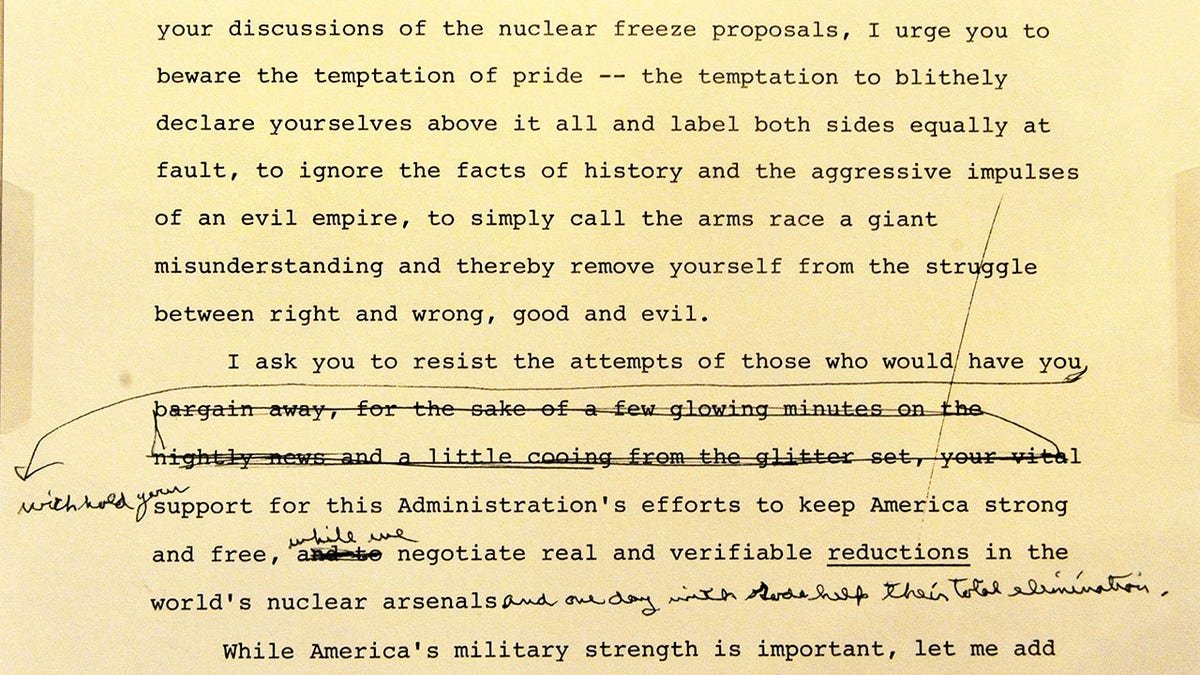
March 8, 1983. Orlando, Florida. It was hot, humid, and the air inside the Sheraton Twin Towers Hotel was thick with the scent of hairspray and old-school conviction. Ronald Reagan stepped up to the podium to address the National Association of Evangelicals. Most people today think the Ronald Reagan evil empire speech was just a high-octane taunt aimed at Moscow.
They’re wrong.
That speech wasn't actually about Russia for the first twenty minutes. Honestly, it was a sermon on American morality. Reagan spent the bulk of his time talking about school prayer, abortion, and the "modern-day secularism" he felt was eating away at the United States. He was playing to the room. But then, he pivoted. He dropped a rhetorical bomb that would rattle the Kremlin and terrify the American left for a decade. He called the Soviet Union an "evil empire."
Two words. That’s all it took to change the temperature of the Cold War.
Why the Ronald Reagan Evil Empire Speech Still Matters
Some historians say this was the moment the Cold War shifted from a chess match to a crusade. Before 1983, the vibe was all about détente—basically a fancy way of saying "let’s just agree to not blow each other up and ignore how much we hate each other." Reagan hated that. He thought it was weak. He believed that by treating the USSR as a morally equivalent "superpower," America was lying to itself.
He didn't just want to contain communism. He wanted to beat it. In the speech, he urged the audience to "beware the temptation of pride—the temptation of blithely declaring yourselves above it all and label both sides equally at fault." He was calling out the "Nuclear Freeze" movement. These were people who wanted both sides to just stop making nukes. To Reagan, that was like asking a police officer and a bank robber to both put down their guns at the same time. He wasn't having it.
The Speechwriter Behind the Fire
Anthony R. Dolan. That’s the guy who actually penned the phrase. He was a young, feisty speechwriter who’d been trying to get that "evil empire" line into a Reagan speech for a while.
He’d tried to sneak it into a talk Reagan gave to the British House of Commons a year earlier. The State Department guys? They freaked out. They scrubbed it. They thought it was too aggressive. They thought it would start World War III. But for the Orlando gig, the "grown-ups" in the administration weren't paying as much attention. They figured a religious convention in Florida was a small-potatoes event.
Big mistake. Or big win, depending on who you ask.
The "Evil" Parts Nobody Talks About
We remember the "Empire" bit. But what about the rest? Reagan used the word "evil" eight times. He called the Soviet Union "the focus of evil in the modern world."
He was leaning heavily into C.S. Lewis. Seriously. He referenced the "screwtape" mentality of the church. He was telling these evangelicals that the struggle against communism wasn't just a political border dispute; it was a spiritual war.
- Moral Equivalence: Reagan rejected the idea that the US and USSR were just two bullies in a playground.
- The Unborn: He linked the "sanctity of life" to the struggle against totalitarianism.
- Totalitarian Darkness: He described the Soviet system as an "experiment" that had failed because it tried to replace God with the State.
The reaction was instant. The Soviet news agency TASS called Reagan "lunatic." Liberal pundits in the US called him a "warmonger." Anthony Lewis of The New York Times called the speech "primitive" and "sectarian." They thought Reagan was being a cowboy.
Did It Actually Work?
Here’s the nuance. Did calling them "evil" make the Soviet Union collapse? Not by itself. The Soviet economy was already a mess. They were spending too much on their military and couldn't grow enough grain to feed their people.
But it changed the psychology of the conflict. Natan Sharansky, a famous Soviet dissident who was in a gulag at the time, later said that when the news of the speech trickled into the prisons, it was like a bolt of electricity. For the people trapped inside the system, hearing the leader of the free world call it what it was—evil—gave them hope. It stripped away the USSR's mask of legitimacy.
The Pivot to Peace
What’s really weird—and what people often forget—is that just a few years later, Reagan was strolling through Red Square with Mikhail Gorbachev.
In 1988, a reporter asked Reagan if he still thought the Soviet Union was an "evil empire." Reagan basically said, "No, that was another time, another era." He was a pragmatist. He used the "evil empire" rhetoric to build leverage, to signal that he wouldn't be bullied, and then, once he had a partner he could talk to (Gorbachev), he sat down and signed the most significant arms reduction treaties in history.
Actionable Insights: Lessons for Today
You don't have to be a Cold Warrior to take something away from the Ronald Reagan evil empire speech. It’s a masterclass in "moral clarity."
- Words are Tools: Reagan knew that shifting the language changes the reality. Stop calling it "conflict" if it's "bullying."
- Know Your Audience: He didn't give this speech to the UN. He gave it to people who already spoke the language of "good vs. evil."
- Pressure then Pivot: Hardline rhetoric is most effective when it’s used as a prelude to negotiation, not as a replacement for it.
The Soviet Union is gone. The Sheraton Twin Towers is now a different hotel. But the idea that some systems are fundamentally better for human flourishing than others? That's the ghost of 1983 that still haunts global politics today.
If you want to understand why US-Russia relations still feel like a sequel to an 80s movie, you have to start with those two words spoken in a Florida ballroom.
Next Step: Read the full transcript of the speech at the Reagan Library website to see the parts about domestic policy—you'll be surprised how much of it sounds like it could have been written this morning.