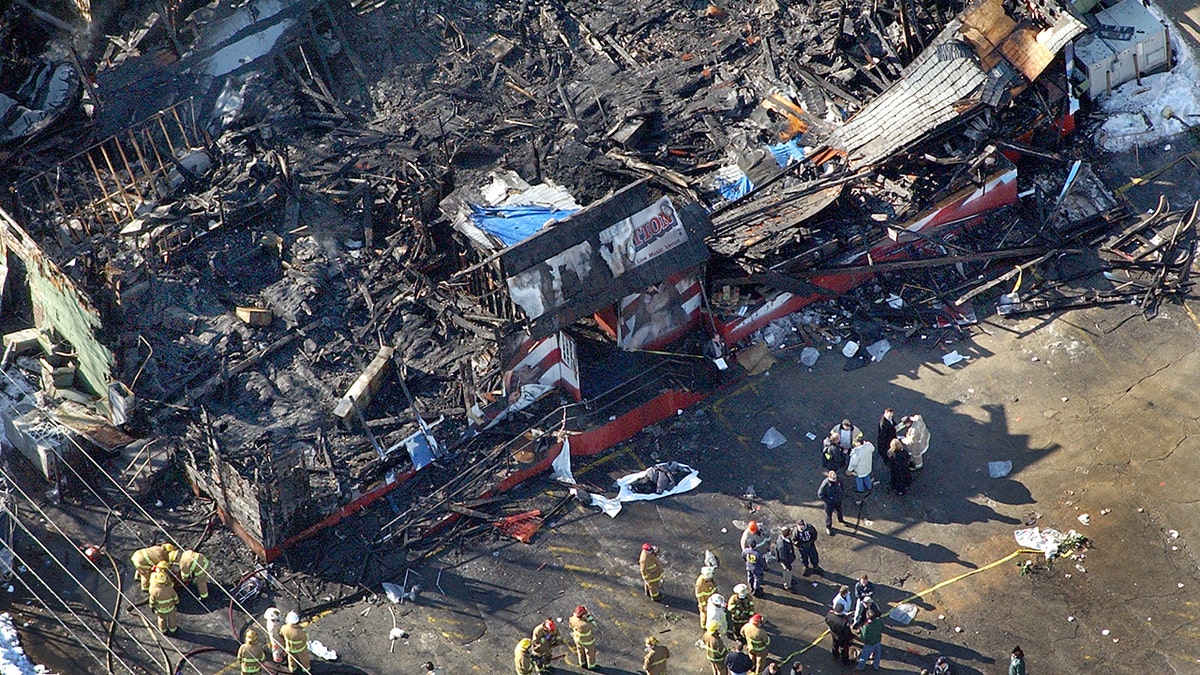
It only took ninety seconds. That’s the most haunting part of the Station nightclub fire. In less time than it takes to brew a cup of coffee, a packed room of people celebrating life was swallowed by a black, toxic curtain of smoke. Most people assume fires take time to grow, like you see in the movies where heroes run through burning hallways for ten minutes. This wasn't that. This was a flashover. It was an instant transformation from a crowded concert into a literal furnace.
February 20, 2003, started as a cold Thursday night in Rhode Island. The band Great White was playing. People were excited. You had a crowd of over 400 people packed into a building that was basically a tinderbox, though nobody knew it at the time. When the band’s tour manager, Daniel Biechele, sparked the pyrotechnics—those silver "gerbs" that shoot sparks into the air—he wasn't just starting a show. He was lighting a fuse on a building that had been accidentally engineered to kill.
Why the foam was the real killer
The music started and the sparks flew. Within seconds, the walls behind the stage were on fire. But it wasn't the wood or the structure that caught first. It was the soundproofing foam.
Honestly, the foam is the entire story here. The owners of the club, Jeffrey and Michael Derderian, had installed highly flammable polyethylene foam to keep the neighbors from complaining about the noise. If you’ve ever seen this stuff, it looks like an egg crate. It’s cheap. It’s effective for sound. But it’s also essentially solid gasoline. When the sparks from the pyro hit that foam, it didn't just burn; it off-gassed. It released hydrogen cyanide and carbon monoxide.
People in the front row actually cheered at first. They thought the fire was part of the act. That's a chilling detail that survivors often talk about—the split second where the crowd didn't realize they were looking at their own deaths. The band stopped playing. Jack Russell, the lead singer, realized something was wrong and tried to douse it with a water bottle. It was useless. By the time the fire alarm actually tripped, the ceiling was already a sheet of flame.
The bottleneck at the front door
Human nature is a strange thing under pressure. When the fire broke out, the vast majority of the 462 people in the building did exactly what we are all wired to do: they ran back out the way they came in. They headed for the front door.
There were four exits in The Station. Most people only knew about one.
As the crowd surged toward that narrow front hallway, a "crush" happened. It’s a physical phenomenon where the pressure of hundreds of bodies becomes so intense that people can't move. They tripped. They fell. Within seconds, the front doorway was jammed with a pile of people. It was a literal human logjam. Those at the bottom were pinned by those on top, and those behind were being pushed by the heat. This is why the death toll was so high. One hundred people never made it out.
Interestingly, many people think the fire killed everyone through burns. In reality, most died from smoke inhalation. The toxic gasses produced by that foam knock you out in two or three breaths. If you weren't out in the first two minutes, your chances of survival dropped to almost zero.
The failure of the "Grandfather Clause"
You’ve probably heard people talk about how the building "wasn't up to code." That’s actually a bit of a grey area that led to years of legal battles. The Station didn't have a sprinkler system. In a building that small, the law at the time didn't strictly require one because of its age—it was "grandfathered" in.
It’s a loophole that cost lives.
The fire marshal, Denis Larocque, had inspected the club multiple times. He missed the foam. Or, more accurately, he didn't realize how dangerous it was in that specific context. There’s a lot of blame to go around. The band didn't have a permit for the pyro. The owners used the wrong foam. The inspectors didn't catch the violations. It was a "Swiss Cheese" model of failure—where the holes in every layer of defense lined up perfectly to allow a disaster to happen.
Life after the tragedy
The aftermath was a mess of grief and litigation. Daniel Biechele, the tour manager, ended up being the only one who really took public responsibility. He pleaded guilty to 100 counts of involuntary manslaughter. He even sent handwritten letters to the families of the victims. Many of the families actually supported his early parole because he was the only person who seemed genuinely sorry.
The Derderian brothers also faced charges. They took plea deals—Michael went to prison, Jeffrey got community service and probation. The legal fallout lasted years, resulting in a $176 million settlement from various parties, including the foam manufacturers and the local TV station whose cameraman was inside filming when the fire started. That footage, by the way, is still used by fire departments globally to train recruits. It’s arguably the most famous and horrific record of a fire ever captured.
Today, the site in West Warwick is a memorial park. It took fourteen years to finally open. If you visit, you’ll see 100 individual monuments. It’s quiet now, which is a stark contrast to the chaos of that night.
What we learned (The hard way)
This event fundamentally changed how we handle public safety in the United States. It wasn't just a Rhode Island tragedy; it was a national wake-up call. We stopped letting "grandfather clauses" protect dangerous buildings.
If you go to a club today, you’ll notice things are different because of the Station nightclub fire.
- Sprinkler Mandates: After 2003, NFPA codes were overhauled. Now, even smaller clubs usually need sprinklers if they have a certain occupancy.
- Crowd Management: Staff are now often required to have trained crowd managers on-site who know where every exit is.
- Pyrotechnic Bans: You don't see indoor sparks much anymore. Most states have made it incredibly difficult to get permits for indoor fireworks in small venues.
- Inspections: Fire marshals are way more aggressive about checking for flammable wall coverings. "Acoustic foam" is now a dirty word in the industry unless it's specifically fire-rated.
How to stay safe in any venue
You don't need to live in fear, but you should live with awareness. Whenever you walk into a crowded bar, concert hall, or theater, do one thing: look for the "other" exit.
Don't just look at the door you walked through. Look for the side door. Look for the kitchen exit. In a crisis, everyone will run for the front door. If you know the alternative, you’re already ahead of the curve. Also, keep an eye on the ceiling. If you see foam that looks like egg crates, and someone starts lighting off fireworks, just leave. It sounds paranoid, but history shows it’s just being smart.
The legacy of the Station is one of profound loss, but also of radical change. It’s a reminder that safety isn't just about paperwork—it’s about the physics of how we move and how materials burn. We owe it to those 100 people to never forget how fast ninety seconds can go.
Actionable Safety Steps
- Identify Two Ways Out: Every time you enter a venue, mentally note the primary and secondary exits.
- Assess the Walls: If you see exposed, non-treated foam in a music venue, consider it a high-risk environment.
- Monitor Occupancy: If a room feels "too full" to move freely, it likely exceeds the legal fire capacity. Trust your gut and find a less crowded area or leave.
- Support Local Fire Codes: Be aware of local legislation regarding fire sprinklers in older buildings; advocacy saves lives.