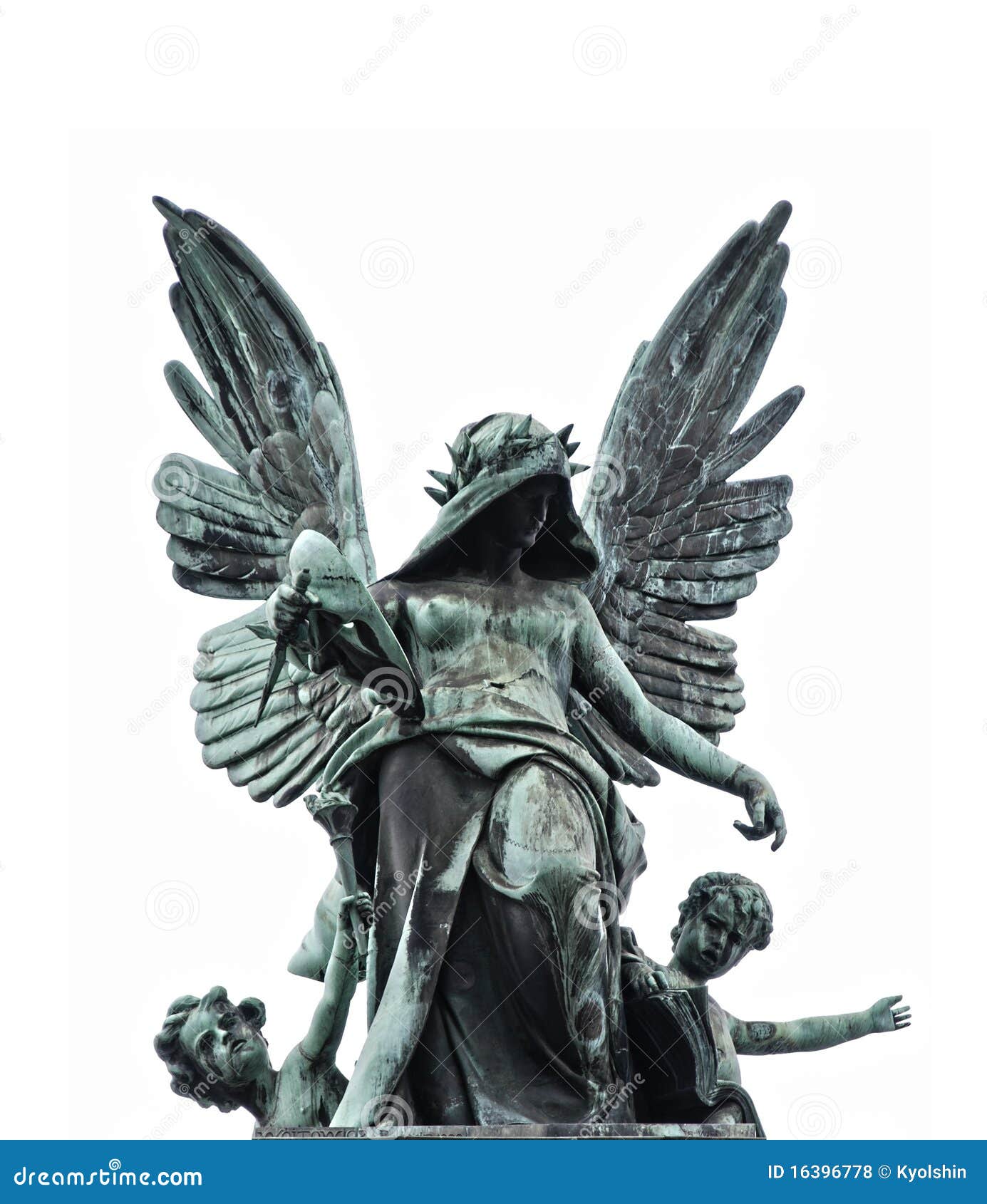
You’re walking through the Retiro Park in Madrid. It’s green, peaceful, and filled with joggers and families. Then you see it. High on a pedestal sits a man—well, almost a man—writhing in agony. It’s the Fuente del Ángel Caído, or the Fountain of the Fallen Angel. It’s literally a monument to Lucifer.
Most cities build statues of kings or poets. Madrid went another way.
Finding a statue of the fallen angel in the middle of a public park in a traditionally Catholic country feels, honestly, a bit weird. It's not tucked away in a museum basement or a private gothic estate. It’s right there, 666 meters above sea level. No, that’s not an urban legend. It was actually confirmed by topographical surveys. If you're into the occult or just like weird art, that little coincidence usually makes the hair on your neck stand up.
The Man Behind the Bronze: Ricardo Bellver
Back in 1877, a young Spanish sculptor named Ricardo Bellver was studying in Rome. He was talented but needed a "big" project to prove it. He chose a moment from John Milton’s Paradise Lost. Specifically, the moment Satan gets booted out of heaven.
It was a bold move.
Bellver didn't make a monster. He didn't give the figure horns or a pitchfork or cloven hooves. Instead, he made a beautiful, muscular youth. The "fallen angel" is screaming at the sky, a snake wrapped around his legs, and his wings are flared out in a desperate, failing attempt to catch the wind. It’s heartbreaking and terrifying all at once.
The sculpture was so good that it won a first-class medal at Spain’s National Fine Arts Exhibition. People were stunned by the technical skill. How do you capture that much kinetic energy in metal? Eventually, the Spanish state bought it, and it ended up in the Prado Museum. But the Prado is for paintings. Huge bronze statues belong outside. So, in 1885, they moved it to the Retiro.
Why the Retiro Park Location Matters
It sits at a junction where several paths meet. You can’t miss it. The pedestal itself is worth looking at because it’s covered in bronze masks of devils, lizards, and dolphins. It’s dark. It’s heavy. It feels like it belongs in a different century—which, obviously, it does.
Some people think it’s a portal. Others just think it’s a masterpiece.
Most tourists walk past it and go "Oh, look, a devil." But if you look closer, the statue of the fallen angel represents a massive shift in art history. It was one of the first times an artist treated the devil as a tragic figure rather than a cartoonish villain. Bellver was leaning into Romanticism. He wanted you to feel the weight of the fall. He wanted you to see the pride and the pain.
The "666 Meters" Mystery: Fact or Fiction?
Let’s talk about the elevation.
If you check the official maps of Madrid, the base of the statue sits almost exactly 666 meters above sea level. In a city as high as Madrid, that’s not entirely impossible, but the precision is what freaks people out. Is it a coincidence? Probably. Madrid is the highest capital in Europe (excluding tiny ones like Andorra la Vella). Much of the city fluctuates around that 600-700 meter mark.
But still.
The fact that the world's only major public monument to the devil is at the "Number of the Beast" height is too good for conspiracy theorists to ignore. Locals often joke that the park is the gateway to hell, but they usually say it while eating ice cream and sitting on a bench ten feet away from the sculpture.
Misconceptions You Should Probably Forget
A lot of people think this is the only statue of its kind. That's not true.
You can find a "Fallen Angel" in the Cathedral of St. John the Divine in New York, and there’s the Le Génie du Mal in Belgium. But those are usually inside churches or cathedrals as a warning against sin. Madrid’s version is different because it stands alone. It’s not part of a larger religious narrative. It’s just... there. Standing in the sun.
Another myth? That it was built by Satanists.
Honestly, Bellver was just a guy trying to win a prize. He was a product of his time, and the late 19th century was obsessed with the "Romantic Hero." Milton's Satan was the ultimate rebel. For artists of that era, the fallen angel wasn't about evil; he was about the tragedy of rebellion and the price of freedom.
Technical Brilliance: Why It Still Ranks as a Masterpiece
Look at the tension in the torso.
The way the muscles are pulling away from the center shows a deep understanding of human anatomy. Bellver studied the classical masters, and you can see echoes of the Laocoön in the way the snake interacts with the body. The bronze has weathered over the years, taking on a greenish patina that makes the shadows look even deeper.
The pedestal was designed by Francisco Jareño. It’s octagonal. It’s grim. The water that used to flow from the devil masks into the basin below added a layer of sound to the experience—a constant, rhythmic splashing that felt almost like a heartbeat.
Visiting the Statue Today
If you want to see the statue of the fallen angel without the crowds, go early. The Retiro opens at 6:00 AM. In the morning mist, the statue looks significantly more menacing.
- Getting there: Take the Metro to the "Retiro" or "Ibiza" stations. It's a short walk from either.
- The vibe: It’s not spooky during the day. It’s actually quite lively. You’ll see skaters, dog walkers, and people taking selfies with the devil.
- Look for: The snake. It’s biting his thigh. It’s a detail people often miss from a distance, but it’s crucial to the "punishment" theme of the piece.
Practical Insights for Art Lovers
Don't just look at the statue and leave. Compare it to the other monuments in the park. Most are dedicated to kings (like Alfonso XII) or poets. The contrast tells you everything you need to know about Madrid’s personality. The city has always had a bit of a rebellious, dark edge to its beauty.
If you’re a photographer, the best light hits the angel’s face in the late afternoon. The "Golden Hour" in Madrid makes the bronze look like it’s glowing, which adds a weirdly celestial irony to a statue of a demon.
To truly appreciate the statue of the fallen angel, you have to accept it as a piece of human psychology. It’s not about worshiping the dark; it’s about acknowledging the struggle of the spirit. It reminds us that even the brightest can fall. It’s a cold, hard, bronze reminder of the complexity of the human condition, sitting right in the middle of a park where people go to forget their problems.
Next Steps for Your Visit
- Check the elevation: If you have a GPS or a hiking app on your phone, stand at the base and see if your reading hits 666 meters.
- Visit the Prado: After seeing the statue, head to the Prado Museum nearby to see the classical works that influenced Bellver. Look for the "Black Paintings" by Goya for a similar dive into the darker side of Spanish art.
- Map the junction: The statue sits at the intersection of the Paseo de la República de Cuba and the Paseo de Uruguay. It is the literal heart of the park’s southern section.