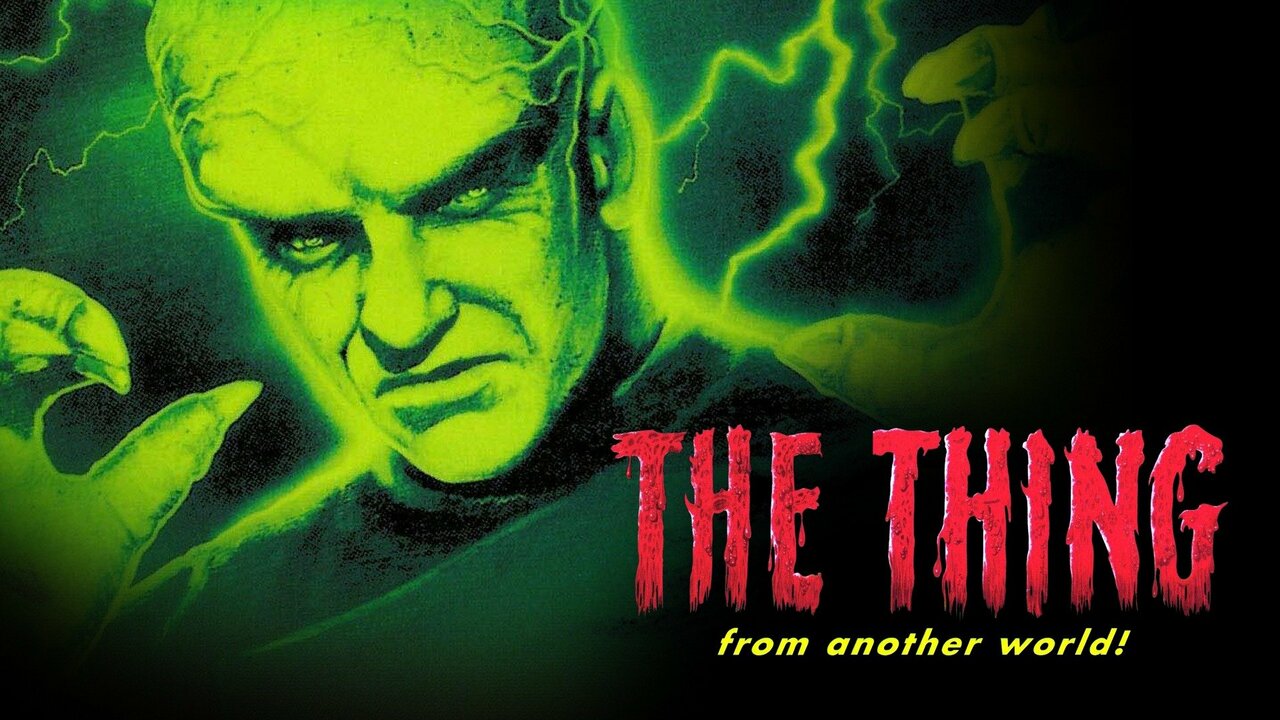
If you sit down to watch The Thing from Another World today, you might expect a campy, slow-moving relic of the fifties. You’d be wrong. Dead wrong. Most people think of John Carpenter’s 1982 masterpiece when they hear the title—and look, that movie is a practical effects miracle—but the 1951 original is a completely different beast. It’s snappy. It’s claustrophobic. It basically invented the "scientific team vs. monster" trope that every sci-fi movie has been ripping off for the last seventy years.
Christian Nyby is the credited director, but if you ask any film historian worth their salt, they’ll tell you Howard Hawks’ fingerprints are all over this thing. You can hear it in the dialogue. It’s that famous "Hawksian overlap" where characters talk over each other, bickering and joking like real people under pressure instead of reading stiff lines from a script. It makes the horror feel grounded.
The plot is deceptively simple: an Air Force crew and a group of scientists at a remote Arctic research station discover a crashed UFO. They find a pilot frozen in the ice. They bring it back. It thaws. Chaos ensues. But the "Thing" here isn't a shapeshifter like in the novella Who Goes There? by John W. Campbell Jr. Instead, it’s a giant, sentient vegetable that feeds on blood.
The Thing from Another World vs. The 1982 Remake
People love to argue about which version is better. Honestly, they aren't even trying to do the same thing. Carpenter went for body horror and paranoia—the "who can you trust?" angle. The 1951 The Thing from Another World is much more interested in the conflict between the military and the scientific community.
Dr. Arthur Carrington, played with a sort of chilling intellectual arrogance by Robert Cornthwaite, wants to communicate with the creature. He sees it as a "super-organism" that has evolved past petty human emotions like love or fear. He’s willing to sacrifice his own team to learn from it. On the other side, you have Captain Patrick Hendry (Kenneth Tobey), who just wants to keep his people alive. It’s a classic Cold War tension.
The creature itself, played by James Arness before he became a household name in Gunsmoke, is kept in the shadows for most of the film. This wasn't just a stylistic choice; it was a necessity. The makeup by Lee Greenway was effective, but the more you saw of the "Super Carrot," the less scary it became. By keeping Arness in the dark, Nyby and Hawks created a sense of impending doom that modern CGI often fails to replicate.
That Iconic Greenhouse Scene
There’s this one specific moment that still gets me. The scientists are in the lab, trying to grow "seedlings" from the creature's tissue using bags of human plasma. It’s grisly stuff for 1951. When the creature finally attacks in the greenhouse, the use of fire is incredible. Stuntman Tom Steele was actually set on fire for those takes—no digital overlays, just a guy in a suit covered in kerosene.
The pacing in these sequences is relentless.
It doesn't feel like a movie from seventy years ago. The way the characters move through the tight hallways of the polar station feels like a precursor to Aliens. You have the cynical reporter, Ned Scott, providing the "everyman" perspective, and Nikki Nicholson, who is way more than just a "damsel" archetype—she’s actually the one who suggests the best way to kill the creature.
Behind the Scenes: Who Actually Directed It?
This is the big controversy. If you watch the movie and then watch Rio Bravo or His Girl Friday, you’ll notice the similarities in the banter. Rumors have persisted for decades that Howard Hawks directed the movie but gave the credit to his editor, Christian Nyby, to help him get his director's card.
The actors have given conflicting stories over the years. Kenneth Tobey once hinted that Hawks was the one calling the shots on set, while others claimed Nyby was firmly in control with Hawks just "supervising" as a producer.
Does it matter? Maybe not to the average viewer. But for film buffs, The Thing from Another World represents the pinnacle of 1950s ensemble acting. There is no single "hero" who saves the day alone. It’s a collective effort. That’s a very Hawksian theme.
Science vs. Survival
The film leans hard into the "Red Scare" subtext of the era. The monster is an invader that doesn't feel pain, doesn't have a heart, and reproduces by the thousands. It’s easy to see it as a metaphor for communism.
But there’s also a deeper distrust of unchecked scientific curiosity. Dr. Carrington is portrayed as almost as dangerous as the monster because he refuses to acknowledge the reality of the threat. When he tells the military, "Knowledge is more important than life," he’s the ultimate villain in the eyes of a 1951 audience.
Interestingly, the movie departs significantly from the source material. Campbell’s original story was all about the shapeshifting. Why did they change it? Budget, mostly. They couldn't figure out how to do the transformations convincingly in 1951. But by making the monster a "monolithic" threat, they turned the movie into a masterclass in tension and lighting.
The "Keep Watching the Skies" Legacy
The final monologue by Ned Scott is one of the most famous endings in cinema history.
"Tell the world. Tell this to everybody, wherever they are. Watch the skies. Everywhere. Keep looking. Keep watching the skies!"
It wasn't just a warning about aliens. It was a call to vigilance during the early days of the atomic age. The film was a massive hit at the box office, outperforming almost every other sci-fi flick of its year. It set the template. Without this movie, we don't get Invasion of the Body Snatchers. We don't get the "isolated base" trope that fuels half of the horror genre today.
Technically, the film is a marvel. The sound design—the Geiger counter’s clicking getting faster and faster as the creature approaches—is a trick that Aliens would later perfect with its motion trackers.
Practical Insights for Modern Viewers
If you’re going to watch The Thing from Another World for the first time, or revisit it after years, here is how to actually appreciate it:
- Ignore the "Vegetable" Label: Don't let the "sentient plant" description ruin it for you. Think of it as a biological entity that has completely bypassed the weaknesses of mammalian evolution.
- Listen to the Background: Pay attention to the overlapping dialogue in the mess hall scenes. It’s incredibly modern and provides a lot of character depth that isn't in the actual script.
- Watch the Lighting: The film uses "low-key" lighting, a staple of Film Noir. This is what makes the creature scenes actually scary. The shadows do 90% of the work.
- Compare the Versions: Watch this and then watch Carpenter’s 1982 version back-to-back. It’s a fascinating study in how different eras interpret the same "cosmic horror" concept.
The 1951 film isn't just a "black and white version" of a better story. It’s a tight, 87-minute exercise in suspense that proves you don't need a thousand teeth or tentacles to make an audience sweat. It relies on the one thing that never goes out of style: the fear of the unknown knocking on your door while you're trapped in the dark.
Go find the high-definition restoration if you can. The crispness of the Arctic wind and the stark whites of the snow make the isolation feel much more visceral than the old grainy TV broadcasts ever did.
Keep watching the skies.
Next Steps for Enthusiasts:
To truly understand the DNA of this film, track down the original novella Who Goes There? by John W. Campbell Jr. to see what the producers chose to keep and what they threw away. Then, look for the 2011 "prequel" (also titled The Thing) to see how modern Hollywood attempted to bridge the gap between these different styles of storytelling—though, fair warning, it lacks the soul of the 1951 production.