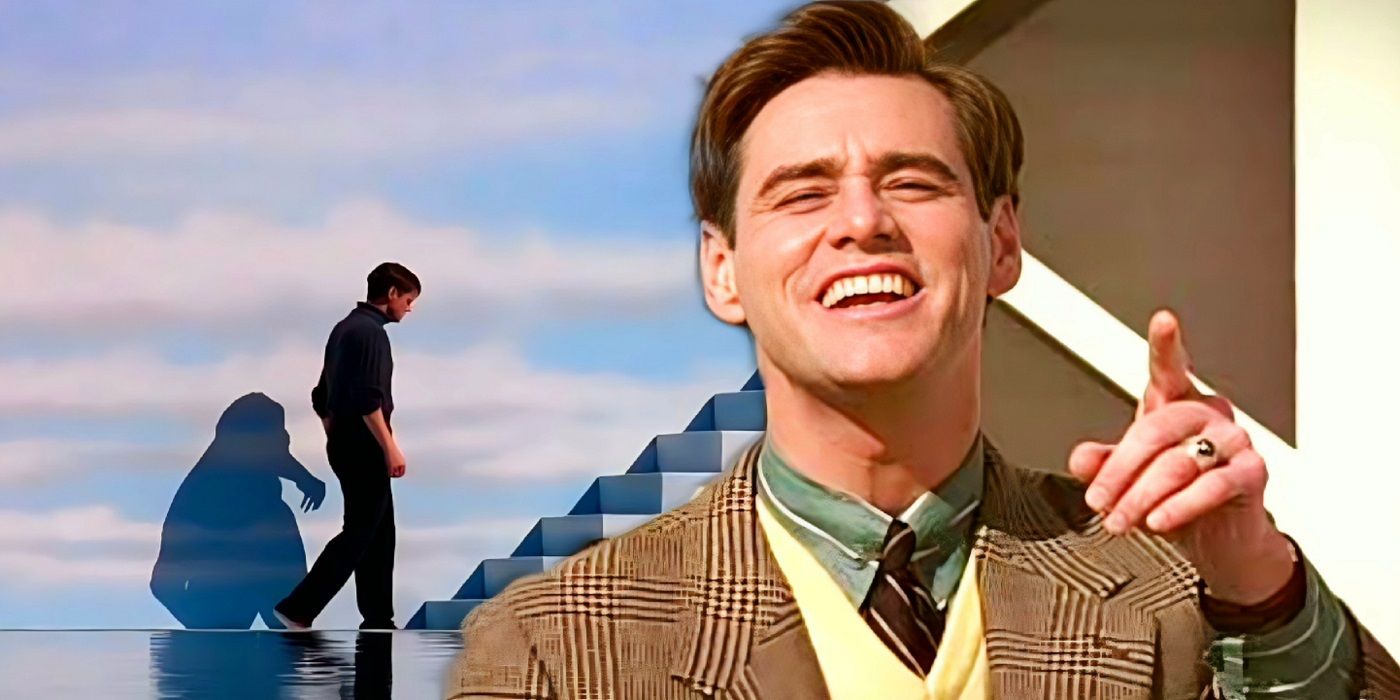
He finally hit the wall. Literally.
You remember the sound, right? That hollow, fiberglass thud when Truman Burbank’s boat, the Santa Maria, pierces the painted sky of Seahaven. It’s one of the most iconic moments in cinema history because it represents the exact second a lie becomes too small to contain a human soul. The Truman Show ending scene isn't just a movie finale; it’s a philosophical gut-punch that feels more relevant in our era of social media surveillance than it did in 1998.
Honestly, it’s terrifying.
Peter Weir, the director, didn’t just want a "happy ending." He wanted a liberation that felt like a death. When Truman steps off that boat and starts walking on water—a heavy-handed but effective messianic visual—he isn't finding a new world. He’s leaving the only one he has ever known. Think about that for a second. Everything he loved was plastic. Every person he knew was on a payroll.
The Sound of the Sky Cracking
The technical brilliance of the Truman Show ending scene starts with the silence. Up until that point, Burkhard Dallwitz’s score and Philip Glass’s haunting piano melodies have been doing a lot of the emotional heavy lifting. But when Truman reaches the edge of the world, the music settles.
He touches the wall.
It’s just paint. For thirty years, he feared the water because of a manufactured trauma involving his "father" drowning in a storm. Christof, played with a chilling, paternal arrogance by Ed Harris, used Truman’s own grief as a tether. But in this final moment, the fear is gone. Truman realizes the horizon is a physical limit, not a possibility. He finds the hidden staircase. He finds the door labeled "EXIT."
Christof’s Last Stand
The "Voice of God" moment is where the movie moves from a satire of television to a deep dive into theology and parental control. Christof speaks to Truman from the sky—the moon, actually—and tries one last time to gaslight him into staying.
He tells Truman that the "real world" is just as fake. He argues that Seahaven is better because it’s safe. It’s a compelling argument if you value comfort over truth. Christof says, "I know you better than you know yourself." Truman’s response is the ultimate act of rebellion. He doesn't argue. He doesn't scream. He just gives the audience exactly what they’ve been conditioned to expect, but on his own terms.
"In case I don't see ya... good afternoon, good evening, and good night!"
He bows. It’s a masterpiece of a performance by Jim Carrey. He’s acknowledging the cameras, acknowledging the millions of people watching him, and then he simply steps through the door into total darkness.
Why the Audience Reaction is the Darkest Part
If you watch the Truman Show ending scene closely, the cutaways to the viewers are the most cynical part of the film. We see the two security guards, the old ladies on the couch, the man in the bathtub. They are cheering. They are weeping. They are genuinely moved by Truman’s escape.
And then, the second the transmission goes to static?
"What else is on?"
"Yeah, let’s see what else is on. Where’s the TV guide?"
That’s the real horror. The world watched a man’s entire life be exploited for entertainment, and the moment he gains his freedom, he is irrelevant to them. They don't care about Truman the man; they cared about Truman the content. It’s a scathing critique of the viewer's complicity. We are the security guards. We are the reason the dome was built in the first place.
The Legacy of the Exit
There is a real psychological phenomenon called "The Truman Show Delusion." It’s a type of persecutory or grandiose delusion where patients believe their lives are staged reality shows. Psychiatrists Ian Gold and Joel Gold have documented cases where people cited this specific film as the framework for their psychosis.
That speaks to how deeply the Truman Show ending scene tapped into a fundamental human anxiety: the fear that we are being watched and that our reality is a curated performance. In the 90s, this felt like a high-concept sci-fi idea. Today, with influencers living in "content houses" and 24/7 live streams, Truman feels like a prophet.
Breaking Down the Symbolism
- The Santa Maria: Named after Columbus's ship. Truman is "discovering" a new world, but instead of finding land, he finds the limits of his cage.
- The Clouds: They are perfectly symmetrical. It’s the visual cue that Seahaven is an imitation of nature, not nature itself.
- The Door: It leads to pitch blackness. Peter Weir purposely didn't show what was on the other side. If we saw Truman reunite with Sylvia, it would undermine the sacrifice. The point is that he chose the unknown over the controlled.
Actionable Takeaways from Truman’s Final Bow
The Truman Show ending scene teaches us a lot about the cost of authenticity. If you’re looking to apply the "Truman mindset" to your own life—minus the giant dome and the paid actors—consider these shifts:
Audit your "Seahaven"
We all have comfort zones that act as cages. Sometimes it’s a job that’s "fine" but soul-crushing, or a social circle where you’re performing a version of yourself rather than being yourself. Like Truman, you have to be willing to sail into the storm to see where the wall actually is.
Recognize the "Christof" voices
There will always be people—bosses, family members, or even your own internal critic—telling you that the outside world is too dangerous. They claim to know you better than you know yourself. Learning to distinguish between protective advice and manipulative control is the first step toward the Exit door.
Value Privacy over Performance
The most rebellious thing Truman did was leave. He stopped giving the audience what they wanted. In an age where we are encouraged to broadcast every meal and every milestone, there is immense power in the things you keep for yourself. Truman’s life finally began when the cameras stopped rolling.
Accept the "Static"
When you make a major life change, people might cheer for a moment, but then they’ll look for "what else is on." Don't live for the applause of the security guards in the bathtub. Their attention is fleeting. Your freedom is permanent.
The next time you watch that final frame, don't just see a happy ending. See a man walking into the dark with no plan, no money, and no identity, simply because being real was worth more than being safe. That is the true power of the Truman Show ending scene.