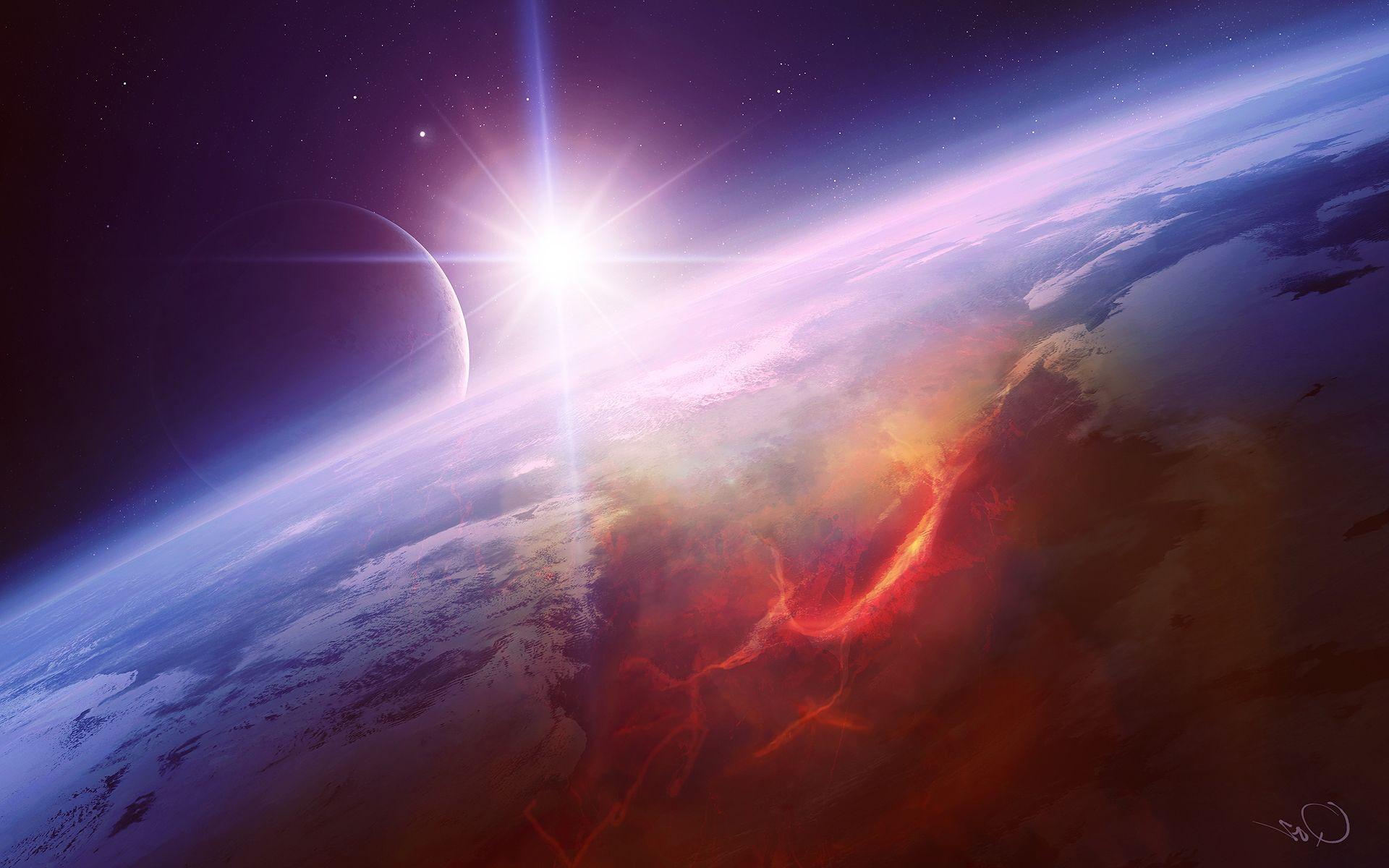
Close your eyes and picture the Sun. Most likely, you’re imagining a huge, glowing yellow ball hanging in a blue sky. Maybe it’s got that soft, orange tint from a sunset you saw last week. But here’s the kicker: that’s basically a lie told to you by the Earth’s atmosphere. If you were floating in the vacuum of space, looking out the reinforced window of the International Space Station (ISS), you wouldn't see a yellow circle. You’d see a terrifyingly bright, sterile white spotlight.
The view of Sun from space is one of those things that breaks your brain a little because it contradicts every childhood drawing you’ve ever made.
Space is weird. It’s dark, obviously. But the contrast is what gets you. Down here, the atmosphere scatters blue light—thank you, Rayleigh scattering—which gives us our sky and makes the Sun look yellowish. In the void? There is no air to scatter anything. The Sun is a ball of multi-colored fire that hits your eyes all at once, which our brains process as pure, blinding white.
Why the "Yellow Dwarf" Is Actually White
Astronomers call our Sun a "G-type main-sequence star" or a yellow dwarf. It’s a bit of a misnomer that sticks because of how we perceive it through 60 miles of gas. When you get above that gas, the reality changes. The Sun emits light across the entire visible spectrum. It’s pumping out violets, blues, greens, yellows, oranges, and reds. When those colors mix without an atmosphere to filter them, they combine into white.
If you looked at it without a filter—which, honestly, would be the last thing you ever saw—it would look like a hole punched in the universe. It’s a point of light so intense that it doesn't even look like a "surface" in the traditional sense. It’s a nuclear furnace.
Astronauts like Scott Kelly have described the experience of seeing the sun rise and set 16 times a day on the ISS. He’s noted that the light isn’t just bright; it’s sharp. On Earth, shadows have soft edges because the atmosphere bounces light around. In space, shadows are pitch black and razor-sharp. The Sun is a harsh master.
The Black Sky Paradox
You’d think that with a giant fusion reactor nearby, the sky would be bright. Nope. In space, the Sun sits in a sea of ink. Because there’s no matter to reflect the light toward your eyes, the space around the Sun stays black. This creates a visual experience that is hard to replicate on Earth. Imagine the brightest high-beam headlight you’ve ever seen, held an inch from your face in a perfectly dark room. That’s the vibe.
What Instruments See: The Invisible Sun
Human eyes are pretty limited. We only see a tiny sliver of what’s actually happening. When NASA or the ESA (European Space Agency) look at the Sun, they use things like the Solar Dynamics Observatory (SDO). These satellites don't just look at the white light. They look at X-rays, ultraviolet, and infrared.
When you see those cool NASA photos where the Sun looks neon green or deep purple, those aren't "fake," but they aren't what you’d see with your eyes either. They are false-color images. Scientists assign colors to different wavelengths to see things like:
- Coronal Loops: Huge arcs of plasma following magnetic field lines.
- Solar Flares: Sudden flashes of brightness that can knock out power grids on Earth.
- Coronal Holes: Darker, cooler areas where the solar wind escapes into space.
Basically, the Sun is a messy, chaotic ball of magnetic fields. From space, these fields aren't invisible. They manifest as massive plumes of fire—prominences—that can be dozens of times larger than Earth itself.
The Corona: The Sun’s Ghostly Halo
One of the most striking parts of the view of Sun from space is the corona. This is the Sun’s outer atmosphere. On Earth, you can only see it during a total solar eclipse when the moon perfectly blocks the main disk. In space, you can use a coronagraph—a little metal disk inside a telescope—to create a permanent eclipse.
The corona is strange. It’s actually hotter than the surface of the Sun. While the surface (the photosphere) is about 10,000 degrees Fahrenheit, the corona reaches millions of degrees. Why? We’re still not 100% sure. It’s one of the biggest mysteries in heliophysics. Seeing that wispy, ghostly white fringe stretching out into the blackness is a reminder that the Sun’s influence doesn't stop at its "edge." We are essentially living inside the extended atmosphere of a star.
Real Dangers of Taking a Peek
You can't just stare at the Sun from the ISS. The windows on the station have heavy-duty shutters and specialized coatings. When astronauts go on a spacewalk (EVA), their gold-plated visors act as extreme sunglasses. This isn't just for style. That gold layer reflects the intense solar radiation and heat. Without it, the infrared light would cook their eyes, and the ultraviolet light would cause instant, severe sunburn or blindness.
It’s a bit ironic. We spend our whole lives dependent on this thing, but the moment we get close to it without protection, it tries to delete us.
The Color Shift Myth
You might have heard people say the Sun is actually green because its peak wavelength is in the green-blue part of the spectrum. Technically, if you measure the photons, the Sun "peaks" there. But don't go around telling people the Sun is green. It’s not. Because it’s also emitting so much of everything else, our eyes just see white. It’s like saying a white cake is "flour-colored" because flour is the main ingredient. It’s a mix.
Watching a Solar Transit
From space, you get to see things Earth-dwellers rarely witness. Occasionally, a planet like Venus or Mercury will pass directly between the Sun and the observer. It’s called a transit. From a spacecraft’s perspective, the planet looks like a tiny, perfect black dot crawling across a vast white desert. It puts the scale of the solar system into perspective. You realize that Earth is just a speck of dust in the path of a giant.
Then there’s the Parker Solar Probe. This thing is the bravest piece of hardware humans have ever built. It’s currently "touching" the Sun, flying through the corona. It’s moving so fast that it could fly from Philadelphia to Washington D.C. in about a second. The views it captures are grainy and filled with "snow" (which is actually high-energy particles hitting the camera), but they show the solar wind in its rawest form.
Practical Takeaways for Space Enthusiasts
If you're interested in tracking the Sun's current state from a "space perspective," you don't need a rocket.
- Check SDO Real-Time Images: NASA’s Solar Dynamics Observatory website lets you see the Sun in about 10 different wavelengths right now. You can see active sunspots before they rotate toward Earth.
- Monitor Solar Weather: Websites like SpaceWeather.com track the solar wind. This tells you when a "view of the sun" is about to turn into an Aurora Borealis display on Earth.
- Use Proper Filters: If you’re a backyard astronomer, never—literally never—look at the Sun through a telescope without a certified solar filter. You want a "White Light" filter or an "H-Alpha" filter if you want to see the red flares and surface texture.
- Understand the Cycle: The Sun goes through an 11-year cycle. We are currently near "Solar Maximum," meaning the Sun looks much more "busy" from space right now than it did five years ago. More spots, more flares, more drama.
The Sun isn't a static yellow ball. It’s a dynamic, white-hot, magnetic beast. Looking at it from space strips away the comforting blue veil of our atmosphere and reveals a cosmic engine that is both beautiful and terrifyingly powerful.
To stay updated on the Sun's activity, follow the official feeds from the National Oceanic and Atmospheric Administration (NOAA) Space Weather Prediction Center. They provide the most accurate data on solar cycles and flares that could affect our technology here on the ground. For those wanting a deeper dive into the physics, the NASA Heliophysics division publishes monthly digests on the Parker Solar Probe’s latest findings.