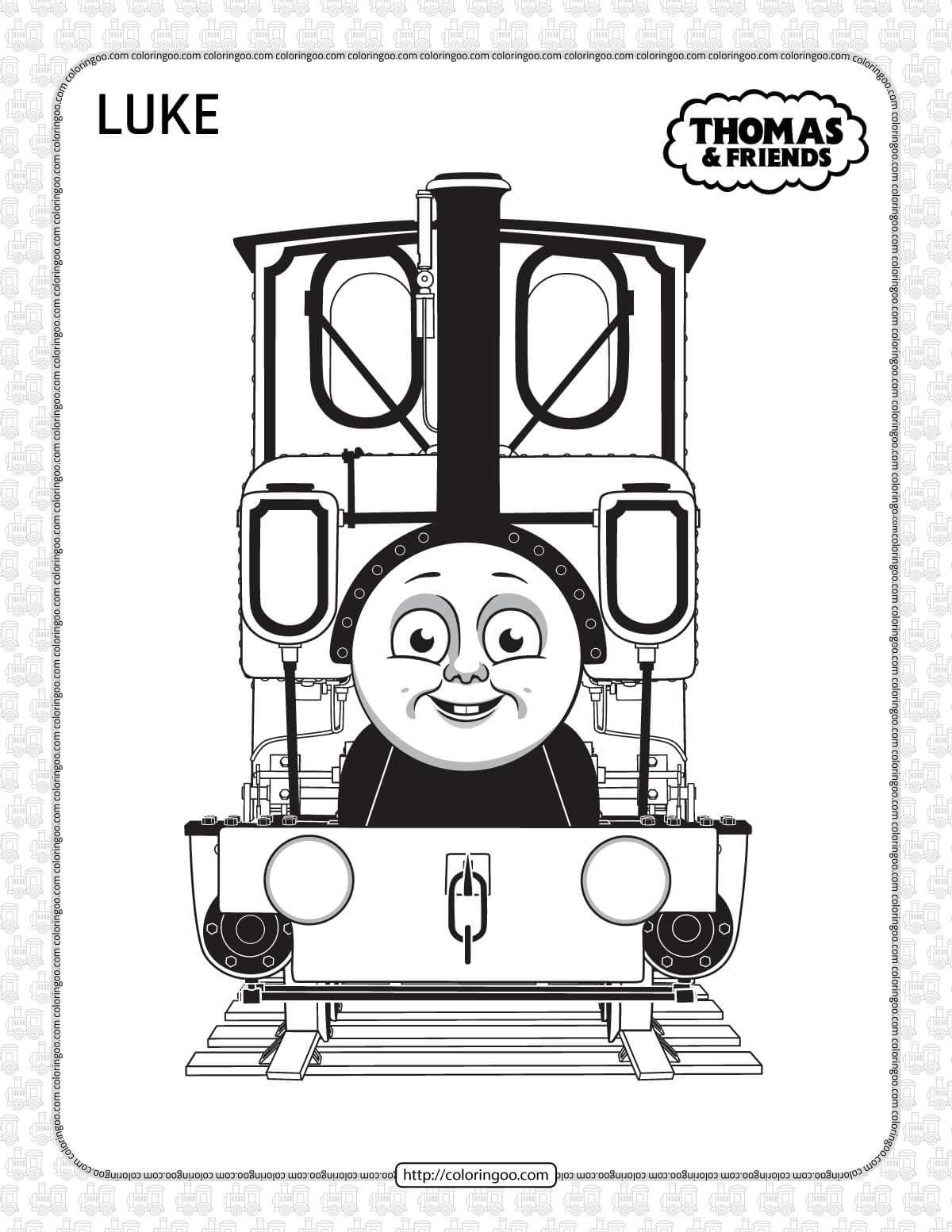
Kids see a tiny green engine and think "cute." Fans of the Skarloey Railway see something else entirely. They see a character whose introduction basically redefined how the show handled "darker" themes without losing that Sodor charm. Luke isn't just another engine added to sell toys; he’s the engine who spent years living in the literal shadows because of a mistake he thought was a tragedy.
Honestly, the story of Luke is one of the most heavy-hitting narratives in the CGI era. If you’ve ever felt like you didn't belong or carried a secret that felt too big to share, you've got more in common with this little 0-4-0ST than you might think.
Who is Luke, Really?
Luke is a narrow gauge engine who works at the Blue Mountain Quarry. He’s recognizable by his vibrant "pea green" paint, white lining, and the number 22. But his most defining trait? He’s small. Even for a narrow gauge engine, Luke is diminutive.
He made his big debut in the 2012 film Blue Mountain Mystery. For a long time, viewers didn't even know he existed. Why? Because he was hiding. He spent years darting into tunnels and behind rock faces whenever a "standard gauge" engine like Thomas or James came near. He was convinced he’d done something unforgivable.
The Secret of the Yellow Engine
The crux of Luke's character is guilt. When he first arrived on Sodor from Ireland, he was on a ship with another engine—a yellow one who didn't speak English. Luke was so eager to get off the boat and start his new life that he begged the workmen to unload him first.
During the process, he accidentally bumped into the yellow engine. The yellow engine fell into the sea.
Luke was young, scared, and impatient. He watched that engine sink and spent the next several years believing he had sent a fellow locomotive to the "Smelters Yard" (essentially engine heaven/hell). It’s a pretty heavy backstory for a show about talking trains.
The Real Life History of Luke
Most engines on Sodor have a "basis"—a real-world locomotive they were modeled after. Luke is no exception. He is based on a Kerr Stuart 0-4-0ST Wren Class locomotive.
- The Basis: Specifically, the engine "Peter Pan" (No. 4256).
- The Connection: Peter Pan was built in 1922, which is exactly why Luke wears the number 22 on his sides.
- The Build: These engines were "contractor's locomotives." They were built for tough, temporary work like building reservoirs or working in quarries. This makes his home at the Blue Mountain Quarry historically accurate.
If you want to see a real-life Luke, you can actually visit the Leighton Buzzard Narrow Gauge Railway in England, where Peter Pan is preserved. Seeing the scale of the real engine helps you realize just how small Luke actually is compared to the "standard" engines like Gordon.
What Most People Get Wrong About Luke’s "Friends"
There is a bit of a debate in the fandom about the other narrow gauge engines—Skarloey, Rheneas, Sir Handel, and Peter Sam. They knew Luke was hiding. They helped him stay hidden.
Some fans argue they were "fake friends" because they let Luke live in fear for years instead of helping him find out what happened to the yellow engine. But if you look at it from their perspective, they were trying to protect him. They believed if the "Thin Controller" found out, Luke would be sent away.
It took Thomas—a newcomer to the quarry—to actually do the legwork. Thomas eventually realized that the "yellow engine" Luke accidentally knocked into the water wasn't scrapped. It was Victor.
Victor had been repainted red and learned English since the accident, which is why Luke never realized his old friend was working right there at the Sodor Steamworks. The moment they reunited is arguably one of the most emotional scenes in the entire franchise.
Why Luke Matters to the Series
Luke represents a shift in the Thomas & Friends storytelling style. He wasn't just a "gimmick" engine with a weird crane or a different fuel type. His personality is:
- Sensitive: He’s easily rattled and feels things deeply.
- Enthusiastic: Once he’s out of hiding, he’s one of the hardest workers.
- Brave: He’s been known to risk his own safety to save others, like when he saved Thomas from falling off a cliff at the quarry.
He brought a sense of mystery back to the Island of Sodor. In the earlier seasons, Sodor felt huge and full of secrets. Luke brought that feeling back for a new generation of fans.
Quick Facts for Collectors and Fans
- Voice Actor: He was voiced by Michael Legge in the UK and US versions until Legge retired from acting.
- Irish Heritage: He is the only engine in the franchise to explicitly originate from Ireland.
- Whistle: His whistle is actually a modified version of Rheneas’ whistle, just pitched three steps lower.
How to Explore More of Luke’s Story
If you're looking to dive deeper into Luke's world, don't just stop at the movie. His character development continues in later episodes where he has to deal with his own fears.
Watch "Luke’s New Friend"
In this episode, Luke befriends a young deer at the quarry. It shows his gentle side and how he’s willing to change the entire workflow of the quarry just to keep a small animal from being scared. It's a great look at his growth from a scared engine in hiding to a leader who cares about the environment around him.
Visit the Real Basis
Check out the Leighton Buzzard Narrow Gauge Railway if you're ever in the UK. Seeing the Kerr Stuart "Wren" class in person puts Luke’s size and power into perspective. It’s a tiny engine that was built to do some of the heaviest lifting in the industrial world.
Re-watch Blue Mountain Mystery
Pay attention to the lighting and the "atmosphere" in the tunnels where Luke hides. The animators at Nitrogen Studios used a lot of "chiaroscuro" (high contrast between light and dark) to emphasize Luke’s isolation. It’s a masterclass in visual storytelling for a children's show.
The story of Luke reminds us that we are often our own harshest judges. Most of the "monsters" we hide from are just misunderstandings waiting for a bit of light—or a friend like Thomas—to clear them up.
To get the most out of Luke's history, look into the production notes of the "Brenner Era" of Thomas & Friends. This was the period when the show moved toward more character-driven stories and historical accuracy. You'll find that Luke was the catalyst for many of the more "grounded" stories that followed in the later seasons.
If you’re a modeler, the Bachmann Narrow Gauge line often features Luke, and comparing his size to the standard Skarloey or Rheneas models is a great way to see the engineering "Wren" design in 3D. Luke might be small, but his impact on Sodor’s lore is massive.