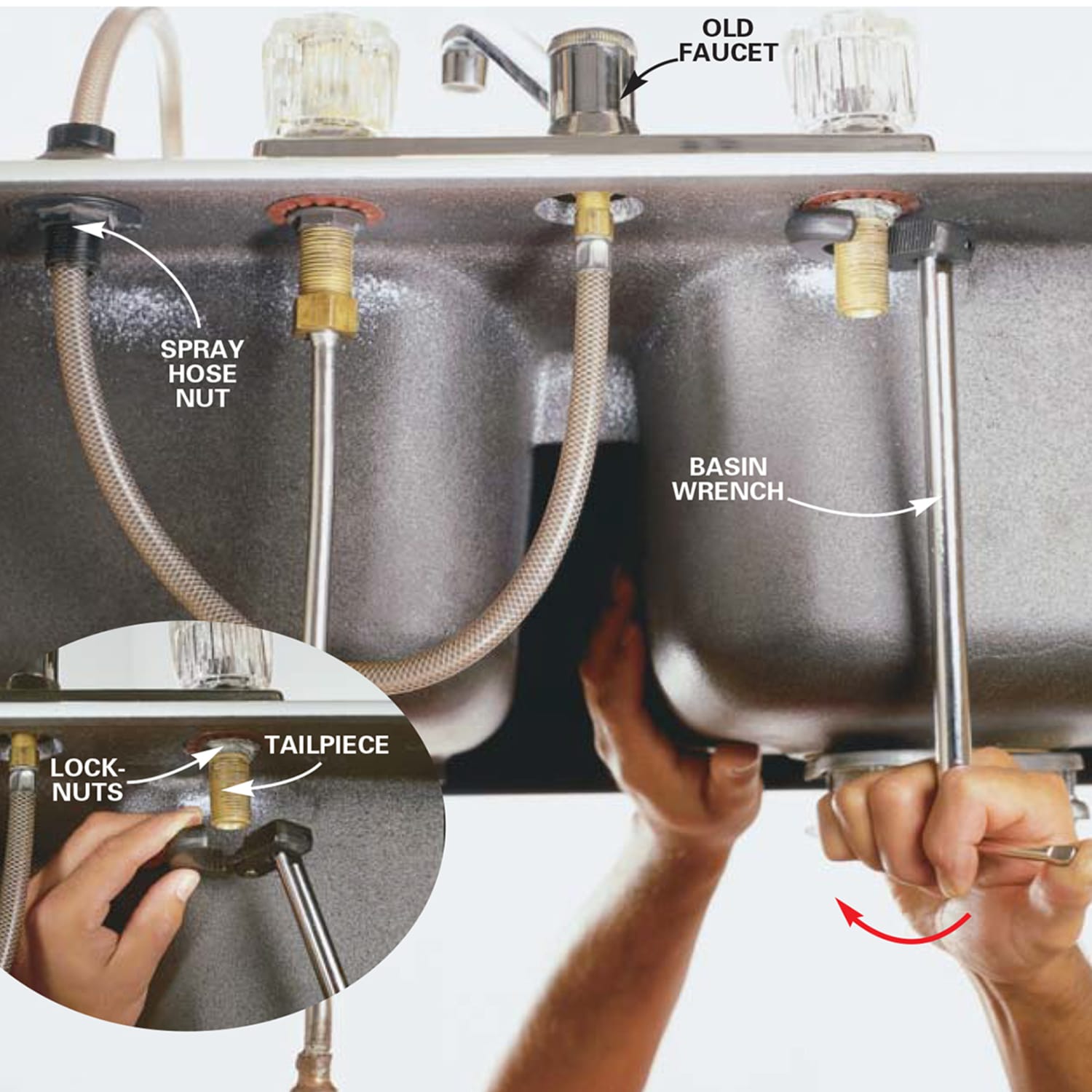
You're standing under the sink. It's dark. Your back hurts already.
Most DIY plumbing "guides" make it sound like you'll just breeze through a faucet swap in twenty minutes with a single wrench. That’s a lie. Honestly, the hardest part of this job isn’t the new faucet—it's the old, rusted-out hunk of metal you're trying to rip out. If you don't have the right tools needed to install a kitchen faucet before you start crawling into that cramped cabinet, you're going to end up taking three separate trips to the hardware store while your kitchen remains a disaster zone.
Plumbing is less about "fixing" things and more about having the right leverage. You're fighting years of mineral buildup, corrosion, and awkward angles.
The Tool Everyone Forgets: The Basin Wrench
Let's talk about the basin wrench. It looks like something from a medieval torture chamber. It has a long handle and a pivoting, spring-loaded jaw. You need this. Why? Because you cannot fit a standard crescent wrench behind a deep-basin sink. There is maybe two inches of clearance between the back of the sink and the wall.
Your hand won't fit. A socket wrench won't reach.
The basin wrench is specifically designed to reach up into that narrow "basin" area to grip the mounting nuts. If you try to skip this and use pliers, you will strip the nut. Once that nut is stripped, you are effectively doomed to a weekend of misery. Pros like the ones at Roto-Rooter or independent master plumbers usually carry a high-quality telescopic version. If you’re buying one, get the telescopic kind. It extends so you aren't jamming your shoulder against the cabinet floor.
Wrenches, Pliers, and the Reality of Rust
You’ll need two adjustable wrenches. Not one. Two.
When you're disconnecting the supply lines from the shut-off valves, you need one wrench to hold the valve steady and another to turn the nut. If you only use one wrench, you risk twisting the entire copper pipe coming out of your wall. If that pipe snaps? You aren't just replacing a faucet anymore; you're calling an emergency plumber to open up your drywall.
Channel-lock pliers (tongue-and-groove pliers) are also non-negotiable. They are the "muscle" of the operation. Get the 10-inch or 12-inch size. Brands like Channellock or Knipex are the gold standard here because their teeth actually bite into the metal instead of sliding off.
Dealing with the "Gross" Stuff
Underneath your sink is probably a graveyard of old sponges and leaky soap bottles. But beyond the mess, there's the thread sealant.
Basically, you have two choices: Teflon tape (PTFE tape) or pipe dope. Most modern faucets come with rubber gaskets that don't technically require tape, but experienced plumbers often use a little bit of pipe joint compound on the threads anyway. It acts as a lubricant and a secondary seal.
Don't overdo it.
Too much tape can actually cause a leak by preventing the threads from seating properly. Wrap the tape clockwise. If you wrap it counter-clockwise, the tape will just unspool and bunch up when you screw the nut on. It’s a tiny detail that determines if you’ll be waking up to a puddle at 3:00 AM.
Safety and Clean-up Gear
You're going to get wet. Even if you turn the water off, there is always residual water in the lines.
- A shallow bucket: Not a 5-gallon pail. It won't fit under the P-trap. Use an old Tupperware container or a dedicated small utility bucket.
- Microfiber towels: You’ll need at least three. One to lay down on the cabinet floor, one to wipe the grime off the sink surface, and one to dry your hands so you don't slip while using the tools.
- Safety glasses: This sounds overkill until a piece of rusted metal or a drop of stagnant water falls directly into your eye while you're looking upward.
The "Specialty" List for Specific Faucets
Not all faucets are created equal. If you bought a high-end Kohler or Delta model, they might include a plastic "installation tool" in the box. It looks like a hollow tube. Do not throw this away. It’s often designed to fit the specific, weirdly-shaped mounting nut that comes with that specific model.
If your new faucet has a pull-down sprayer, you might need a screwdriver (usually Phillips head) to tighten the weight onto the hose. This weight is what makes the sprayer retract. If you put it in the wrong spot, the hose will snag on your shut-off valves every time you use it.
Why the "Hole" Situation Matters
Before you even gather your tools, look at your sink. How many holes are there?
If you have a four-hole sink and you bought a single-handle faucet, you'll need a "deck plate" (also called an escutcheon). If the faucet didn't come with one, you’ll need to buy it separately. Otherwise, you’ll have random holes in your sink that just let water leak into the cabinet. Conversely, if you have a one-hole sink and a faucet with a wide base, you might be in trouble.
A Quick Word on Shut-off Valves
Sometimes the "tools" you need aren't tools at all—they're replacement parts.
Test your shut-off valves before you take the old faucet apart. Turn them clockwise. Do they turn? Do they actually stop the water? If those valves are ten years old, there’s a 50% chance they’ll leak the moment you touch them. If they look crusty or green (corroded), go ahead and buy two new compression-fit shut-off valves while you're at the store.
It is better to have them and not need them than to have a fountain in your kitchen because a valve stem snapped.
Essential Tool Checklist
- Basin Wrench: Essential for the mounting nut.
- Two Adjustable Wrenches: To prevent pipe torque.
- Channel-lock Pliers: For heavy gripping.
- Phillips and Flathead Screwdrivers: For set screws and weights.
- Flashlight or Headlamp: You cannot work if you can't see. A headlamp is better because it keeps your hands free.
- Thread Sealant: Tape or dope.
- Small Bucket and Rags: For the inevitable spill.
- Allen Wrench Set: Some handles require a tiny hex key to remove.
- Penetrating Oil: Like WD-40 Specialist or PB Blaster. If the nuts are rusted, spray them and wait 15 minutes.
Putting it All Together
Installing a faucet is 90% preparation and 10% actual assembly. You’ll spend most of your time clearing out the cabinet, shimmying into a position that doesn't hurt your neck, and trying to get the old hardware off.
Once the old faucet is out, take a moment to clean the sink surface. Use a plastic putty knife to scrape off old plumber's putty or mineral deposits. You want a perfectly smooth surface for the new gasket to sit on. If the surface is uneven, the new faucet will wobble, and water will seep under the base.
When you finally hook up the supply lines, hand-tighten them first. Then give them a quarter-turn with the wrench. Do not "white-knuckle" it. Over-tightening ruins the rubber seals.
Turn the water back on slowly. Take the aerator (the little screen at the tip of the faucet) off before you turn the water on for the first time. This lets any trapped air or debris flush out of the lines without clogging the new faucet. Run the water for a minute, check for leaks, and then screw the aerator back on.
Practical Next Steps
Check under your sink right now. Look at the nuts holding your current faucet in place. If they look like they’ve been underwater since the 1990s, go buy a can of penetrating oil and spray them today, even if you aren't installing the new faucet until tomorrow. This gives the oil time to work into the threads.
Next, measure your supply lines. New faucets often come with lines attached, but they might be too short to reach your valves. If they are, you'll need to buy 12-inch or 16-inch braided stainless steel extensions.
Finally, ensure your flashlight has fresh batteries. There is nothing more frustrating than having your only light source die while you're wedged under a sink with a wrench in your hand. Clear out the entire cabinet space so you have room to move; trying to work around bottles of Windex and old rags will only make the job twice as long.