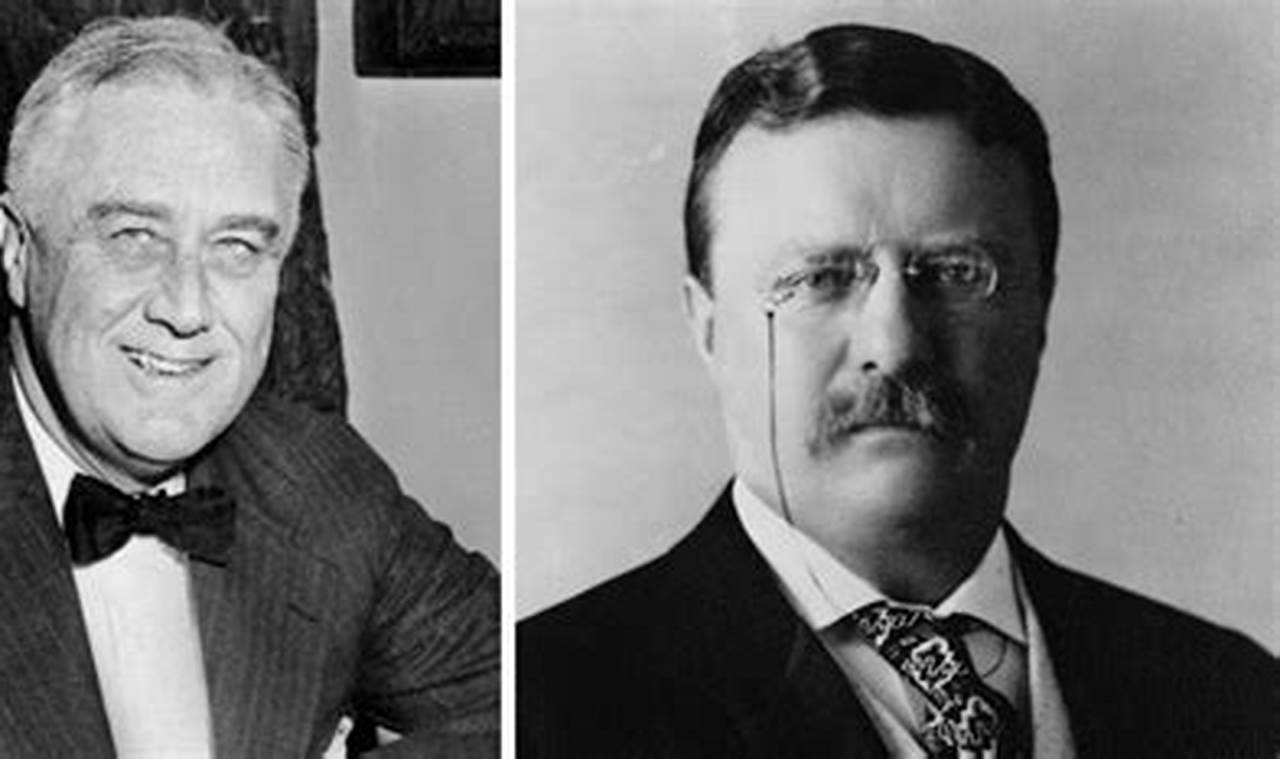
You’ve probably seen the grainy photos. There’s Theodore "Teddy" Roosevelt, the rough-riding, big-stick-wielding 26th President, with his spectacles and iconic mustache. Then there’s Franklin Delano Roosevelt, the man who led America through the Great Depression and World War II. They share the name. They share the charisma. They even shared a penchant for expansionist government policy. But was FDR related to Teddy Roosevelt in a way that actually mattered, or was it just a coincidence of history?
The short answer is yes. They were cousins.
Specifically, they were fifth cousins. If you’re scratching your head trying to figure out how much DNA that actually involves, don’t worry—most people can’t track their family tree past their great-grandparents. In the world of the New York "Knickerbocker" elite, however, these connections were everything. It wasn't just about blood; it was about the brand.
The Shared Roots of the Oyster Bay and Hyde Park Roosevelts
To understand how these two titans were connected, you have to go back to the 1600s. Claes Maartenszen van Rosenvelt arrived in New Amsterdam (now New York City) from Holland. He’s the "Adam" of the Roosevelt clan. Everything stems from him.
Eventually, the family split into two distinct branches.
Teddy belonged to the Oyster Bay Roosevelts. They were Republicans. They lived on Long Island. They were generally considered the more "athletic" and outdoorsy side of the family. Franklin belonged to the Hyde Park Roosevelts. They were Democrats (eventually), lived in the Hudson Valley, and were often viewed by the Oyster Bay side as the "socialite" cousins.
Honestly, the relationship was a bit awkward at times. While they were fifth cousins, the bond was tightened significantly by a marriage that sounds like something out of a period drama.
The Eleanor Factor: When the Tree Becomes a Web
Here is the kicker: Franklin didn't just share a last name with Teddy; he married Teddy's favorite niece.
Eleanor Roosevelt was the daughter of Elliott Roosevelt, Teddy’s younger brother. This makes Franklin and Eleanor fifth cousins, once removed. When Franklin and Eleanor married in 1905, Teddy Roosevelt actually gave the bride away. At the time, Teddy was the sitting President of the United States.
Can you imagine that wedding?
The press was obsessed. Teddy, being the ultimate attention-hog (his own daughter Alice once said he wanted to be the corpse at every funeral and the bride at every wedding), completely overshadowed the couple. But for Franklin, the connection was pure gold. He was a young, ambitious law student, and suddenly he was the "nephew-in-law" of the most powerful man in the world.
Political Rivalry or Family Mentorship?
It’s easy to assume they were best friends. They weren’t.
Teddy was a staunch Republican. Franklin started his career as a Democrat. In the early 20th century, that was a massive divide. When Franklin first ran for the New York State Senate in 1910, some of the Oyster Bay Roosevelts were genuinely annoyed. They felt he was "using" the family name to help the "wrong" party.
Alice Roosevelt Longworth, Teddy’s sharp-tongued daughter, famously mocked Franklin for years. She called him a "maverick" in a derogatory way and spent much of her life trying to undermine his political rise. She once remarked that Franklin was "one-third mush and two-thirds Roosevelt."
Ouch.
But Franklin didn't care. He idolized Teddy. He imitated Teddy’s mannerisms, his energetic speaking style, and even his career path. Look at the parallels:
- Teddy: New York State Assembly -> Assistant Secretary of the Navy -> Governor of New York -> President.
- Franklin: New York State Senate -> Assistant Secretary of the Navy -> Governor of New York -> President.
It wasn't a coincidence. It was a roadmap. Franklin knew exactly what he was doing. He saw the "Roosevelt" name as a bipartisan symbol of leadership. He took the "Progressive" energy Teddy had brought to the Republican party and translated it into the "New Deal" for the Democrats.
A Tale of Two Secretaries
The "Assistant Secretary of the Navy" bit is particularly interesting. When Franklin took the job in 1913 under Woodrow Wilson, he was only 31. He used the exact same desk Teddy had used years prior. He even tried to walk like Teddy.
There’s a great story from historian Doris Kearns Goodwin about this era. Franklin was so eager to be seen as a "Roosevelt" leader that he often overstepped his bounds, much like Teddy had done. He wanted the navy to be ready for World War I, and he didn't mind breaking a few bureaucratic eggs to make it happen.
Did the Relationship Change History?
If Franklin hadn't been related to Teddy, he probably wouldn't have become President. That sounds like a bold claim, but think about the branding.
In 1932, during the height of the Depression, voters were desperate. They remembered the "Square Deal" of Teddy Roosevelt. They remembered the feeling of strength the Roosevelt name provided. Franklin leaned into this. He didn't run away from his Republican cousin; he embraced the legacy of the name.
He was essentially the "reboot" of a popular franchise.
The Genetic Legacy: Polio and Perseverance
There is also a deeper, more personal connection. Both men faced immense physical trials. Teddy was a sickly, asthmatic child who "made" his body through grueling exercise. Franklin was a vibrant, athletic man who was paralyzed by polio at age 39.
The Roosevelt family ethos was "strength through struggle."
When Franklin was recovering at Warm Springs, he often thought about Teddy’s "Strenuous Life" philosophy. It gave him a framework for his suffering. It allowed him to project an image of vigor even when he couldn't walk. The family connection provided a psychological blueprint for how a leader should behave in the face of adversity.
What Most People Get Wrong
The biggest misconception is that they were "enemies" because of their parties.
In reality, they were more like distant competitors. Teddy actually liked Franklin personally, at least early on. He saw Franklin as a "good Roosevelt." It was the later generation—Teddy’s children—who grew to resent Franklin’s success. They felt he had "stolen" the family’s political destiny and moved it to the Democratic side of the aisle.
Also, people often think Eleanor and Franklin’s marriage was purely political. While the Roosevelt name certainly helped both of them, they were genuinely in love in their youth. The fact that they were cousins was almost secondary to the fact that they moved in the same tiny social circles of New York high society.
Final Verdict on the Roosevelt Connection
So, was FDR related to Teddy Roosevelt? Yes, through a common ancestor in the 1600s and a high-profile marriage in 1905.
They represented two sides of the same coin. Teddy was the explosive, impulsive catalyst of the early 1900s. Franklin was the calculating, visionary builder of the mid-20th century. Together, they defined the "American Century."
If you want to dive deeper into this family saga, there are a few things you should do next to really grasp the nuance of their relationship:
- Read "The Roosevelts: An Intimate History" by Geoffrey C. Ward. It accompanies the Ken Burns documentary and is basically the gold standard for understanding the Hyde Park vs. Oyster Bay rivalry.
- Visit Sagamore Hill and Springwood. If you're ever in New York, visit Teddy’s home (Sagamore Hill) and FDR’s home (Springwood). The difference in the houses—one a rugged, trophy-filled mansion and the other a refined, European-style estate—tells you everything you need to know about their personalities.
- Look up the 1912 Election. Check out how Teddy’s "Bull Moose" party split the Republicans, which indirectly helped create the political vacuum that Franklin would eventually fill decades later.
Understanding the Roosevelts isn't just a history lesson; it's a study in how family legacy, branding, and a little bit of shared DNA can change the course of a superpower.