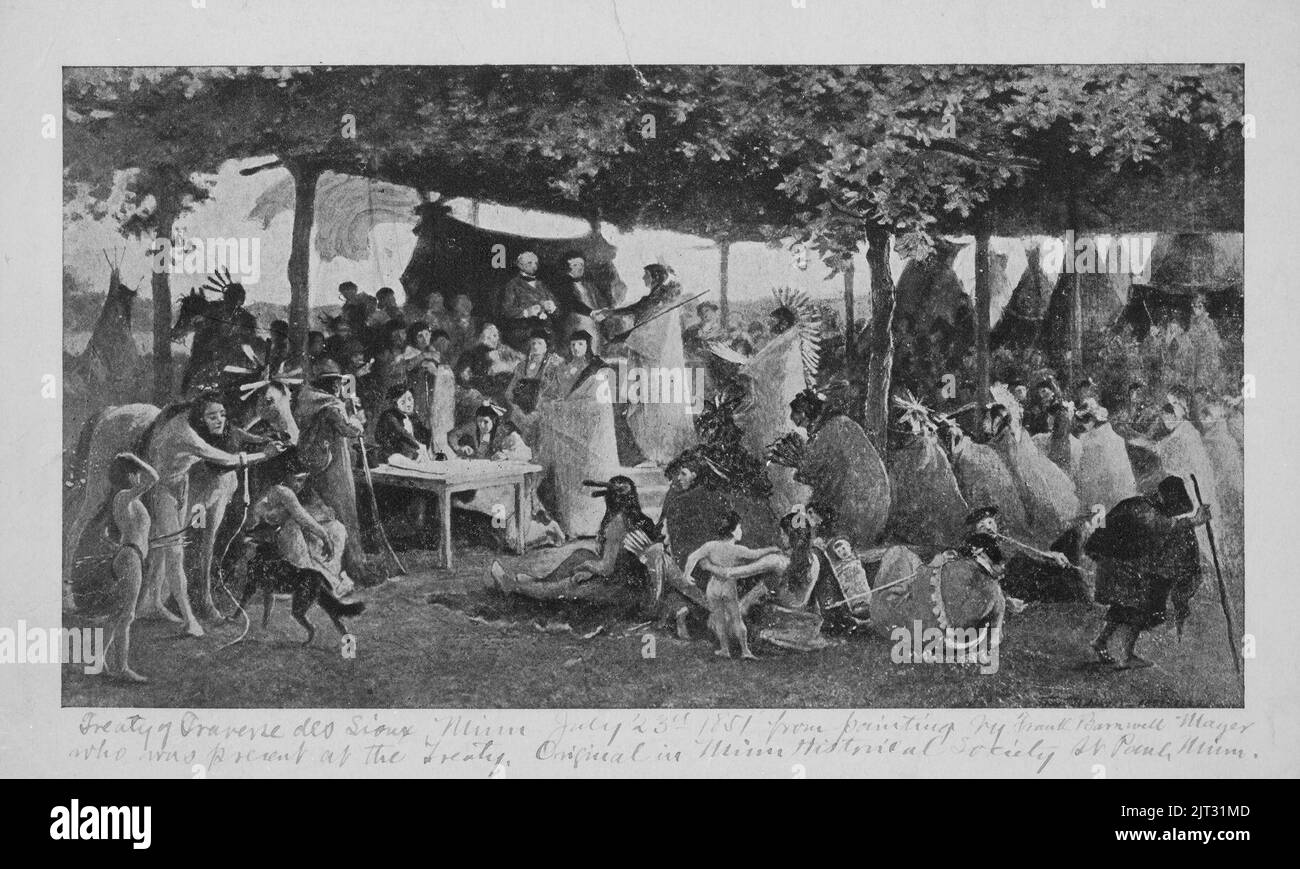
History is messy. It isn't just dates on a page or some dusty ink on parchment; it's about people getting backed into corners. In 1851, the Treaty of Traverse des Sioux wasn't just a real estate deal. It was a massive, seismic shift that fundamentally altered the map of the American Midwest and basically ended a way of life for the Sisseton and Wahpeton bands of the Dakota people.
You've probably seen the paintings. There's a famous one by Francis Millet that shows a grand, sunny gathering on the banks of the Minnesota River. It looks orderly. It looks like a polite negotiation. But if you dig into the journals of the people who were actually there—men like James Madison Goodhue or the missionary Stephen Riggs—the reality was a lot more frantic and, honestly, pretty shady.
The United States government wanted land. Specifically, they wanted about 24 million acres of what is now southern and western Minnesota, plus bits of Iowa and South Dakota. Why? Because the tide of white settlement was pushing west, and the "Suland" was some of the most fertile territory on the planet. For the Dakota, the situation was desperate. Furs were getting scarce, debts to traders were mounting, and the buffalo were disappearing. They were essentially being forced to trade their ancestral homeland for the promise of enough money to survive the next winter.
The Setup at the "Crossing of the Sioux"
Traverse des Sioux was a natural spot for this kind of thing. It was a shallow place where people crossed the Minnesota River, long used as a meeting ground. In June 1851, the U.S. commissioners, Alexander Ramsey (Minnesota’s first territorial governor) and Luke Lea, arrived with high hopes and a lot of cattle to feed the crowd.
Rain ruined everything at first. It poured. For weeks, everyone sat in the mud, waiting for the bands to arrive and for the clouds to break. This delay was more than just an inconvenience; it put the Dakota in a position where they were eating through the supplies the government provided, making them even more dependent on the commissioners before the talking even started.
When the sun finally came out, the negotiations were intense. The Dakota weren't some monolith. Some leaders, like Sleepy Eye and Red Iron, were deeply skeptical. They knew how these things worked. They’d seen treaties before where the money never actually reached the people. But the pressure was immense. Imagine standing there with your family’s future on the line, knowing that if you don't sign, the settlers might just take the land anyway.
The Traders' Table: The Ultimate Bait and Switch
Here is where the Treaty of Traverse des Sioux gets really dark. After the main document was signed on July 23, 1851, the Dakota chiefs were ushered to another table. They thought they were signing a third copy of the treaty.
They weren't.
It was something later called the "traders' paper." This document stated that a huge chunk of the cash payment—roughly $210,000, which was an astronomical sum in 1851—would go directly to white fur traders to pay off "debts" allegedly owed by the Dakota. The chiefs felt they had been tricked. Honestly, they were tricked. Many of these debts were inflated or completely made up, but because the traders held so much political sway, the government baked the theft right into the process.
This moment poisoned the well. It created a deep, festering resentment that didn't just go away. It stayed in the hearts of the Dakota for a decade. If you want to understand why the US-Dakota War of 1862 broke out, you have to look at that second table at Traverse des Sioux. You can't separate the two.
The 24-Million-Acre Math
What did the U.S. actually get? A lot. Basically, the treaty, along with the subsequent Treaty of Mendota, opened up the entire "Big Woods" and the prairie lands to the west.
- The price worked out to about 12.5 cents an acre.
- A permanent reservation was established—a 20-mile-wide strip along the Minnesota River.
- Education and agriculture funds were set up (though much of this was used to force "assimilation").
The government promised $1,665,000 in total. Most of that wasn't paid in cash up front. It was held in a trust, with the interest supposed to be paid out annually. But between the traders taking their cut and the bureaucracy of the Indian Office, the Dakota saw only a fraction of what they were promised. It was a bureaucratic nightmare designed to benefit everyone except the people who actually owned the land.
Why We Still Talk About It
You can't drive through southern Minnesota today without seeing the legacy of this event. Every farm, every town like St. Peter or Mankato, exists because of what happened at that river crossing.
But it’s also a case study in legal ethics—or the lack thereof. Many historians, like Gary Clayton Anderson, have pointed out that the treaty-making process was fundamentally coercive. It wasn't a meeting of equals. It was a powerful empire dictating terms to a people who were starving.
The Treaty of Traverse des Sioux also represents a massive cultural collision. The Dakota viewed land as something they belonged to; the U.S. viewed it as a commodity to be gridded, sold, and plowed. When those two worldviews met in the mud of 1851, the result was a tragedy that is still being litigated in tribal courts and historical societies today.
The Practical Legacy: What to Do With This History
If you're visiting Minnesota or studying U.S. expansion, don't just look at the statues. The actual site of the treaty is now a state wayside park near St. Peter. It’s quiet there now. You can walk down to the river and try to imagine the thousands of people camped out, the smell of woodsmoke, and the mounting tension.
To truly understand this event, you need to look at the primary sources.
- Read the "Dakota War of 1862" archives at the Minnesota Historical Society.
- Look at the specific language of the Treaty of 1851. Pay attention to what isn't said.
- Visit the Hoċokata Ti cultural center to get the Dakota perspective on what it means to lose a homeland.
Understanding the Treaty of Traverse des Sioux isn't just about being a history buff. It’s about acknowledging the shaky foundation that much of the American West was built upon. It reminds us that "legal" doesn't always mean "just." The next time you see a vast field of corn in the Midwest, remember the 12 cents an acre and the second table that changed everything.
Actionable Next Steps:
To see the direct impact of this treaty today, research the current legal status of the Minnesota River Valley reservations. Many of the land rights issues being discussed in state legislatures stem directly from the ambiguous language used in the 1851 negotiations. If you are a student or researcher, utilize the National Archives' "Treaties Explorer" tool to compare the original handwritten Traverse des Sioux documents with the final ratified versions to see exactly how the U.S. Senate altered the terms after the Dakota had already signed.